
Coffee Table Decor Ideas: 7 Designer Layouts for Real Living Rooms
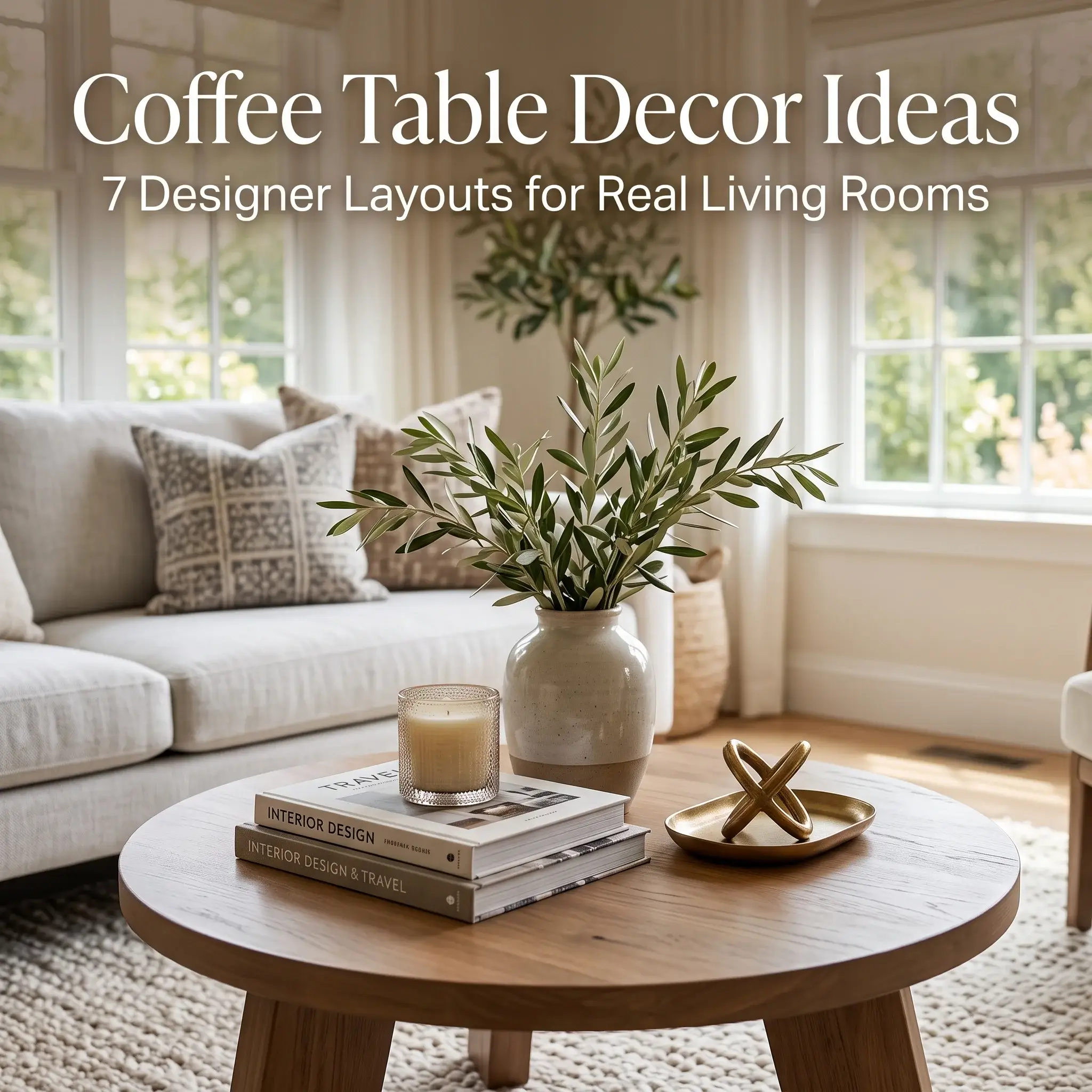
A coffee table holds your living room together. It serves as the visual anchor of the seating area and supports everyday life, from morning coffee mugs to evening remotes.
Styling this surface does not require filling every square inch with fragile ornaments. Good curation balances architectural height, rich textures, and open breathing room.
The seven practical concepts below show you how to style your table using proven design formulas and durable, accessible accents.
7 Practical Coffee Table Styling Ideas
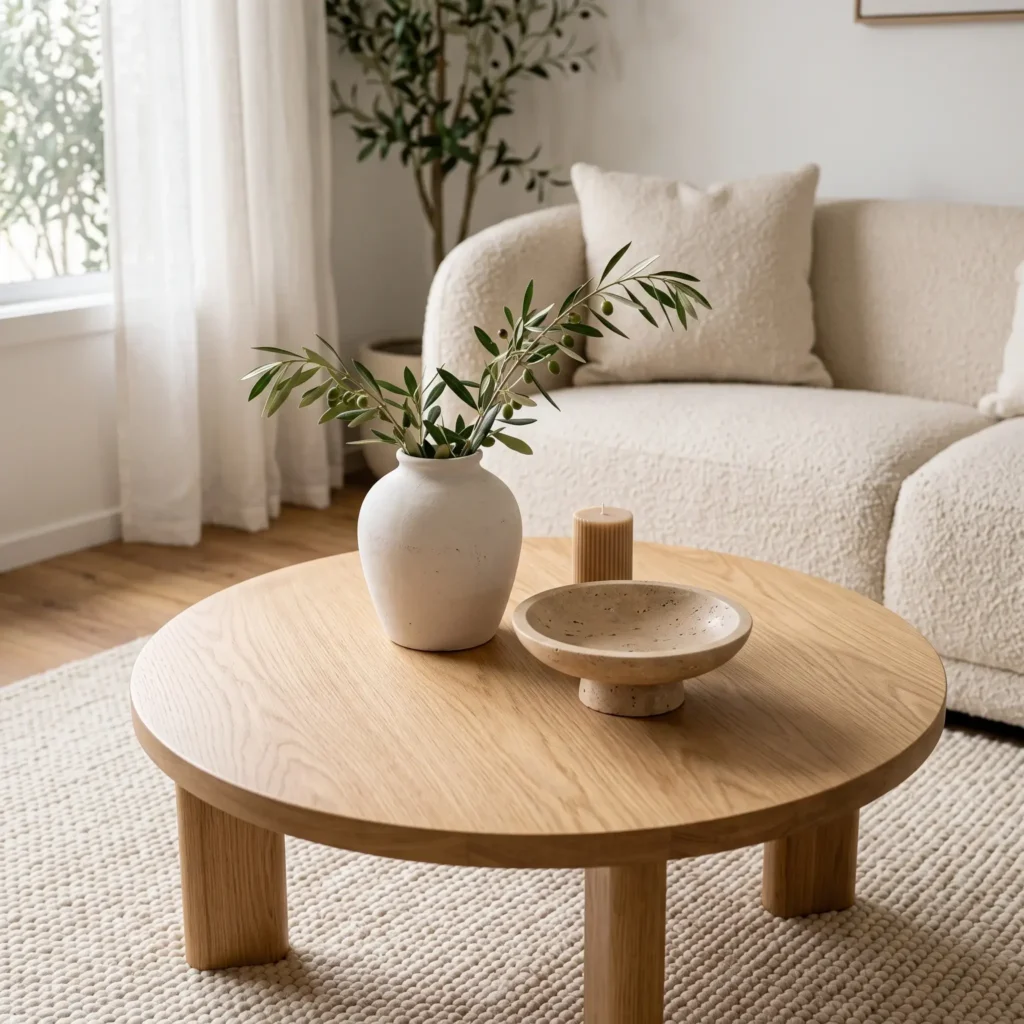
1. The Organic Modern Trio
This arrangement uses three core items of varying heights clustered in the center of a circular surface. It softens hard room angles and keeps walkways clear.
How to Style: Place a tall, matte earthenware vase with two olive branches slightly off-center. Next to it, add a medium-sized ribbed soy candle. Ground the grouping with a low, footed travertine bowl holding smooth river stones.
- Curated Products:
- 10-inch unglazed ceramic jug in chalk white
- Honed beige travertine pedestal dish (8-inch diameter)
- Ribbed unscented pillar candle in sand ceramic vessel
- Fresh or preserved olive branch stems
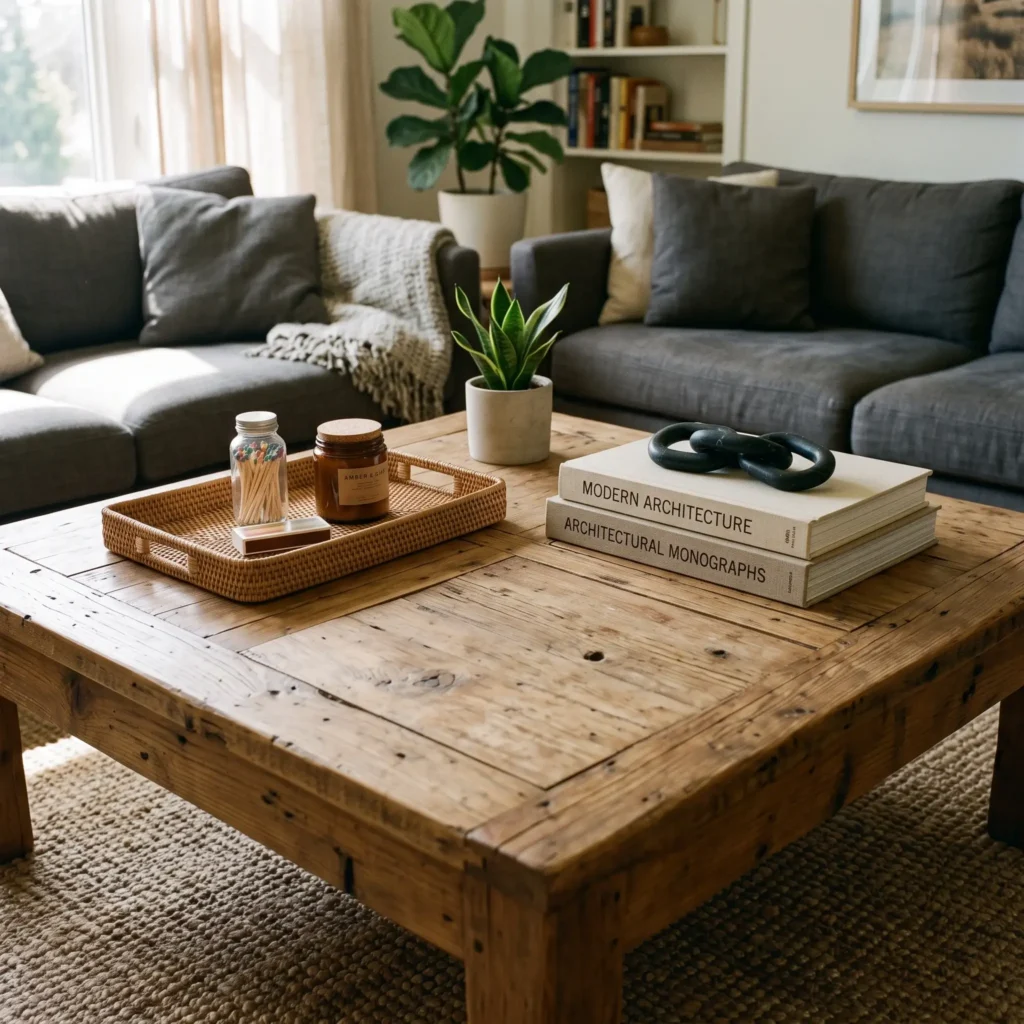
2. The Four-Quadrant Grid
Square coffee tables often look awkward because people place one small item in the exact center. Dividing the surface into four balanced zones creates structure and controls clutter.
How to Style: Treat the tabletop like a four-box grid. Fill the back-left box with a large woven tray. Fill the back-right box with two oversized art books stacked flat. Fill the front-right box with a sculptural black marble chain. Leave the entire front-left box empty for drinks and daily use.
- Curated Products:
- Square handwoven rattan tray with low handles (14×14 inches)
- Hardcover architecture monograph with neutral linen spine
- 3-link black Marquina marble knot sculpture
- Set of four cork-backed slate coasters
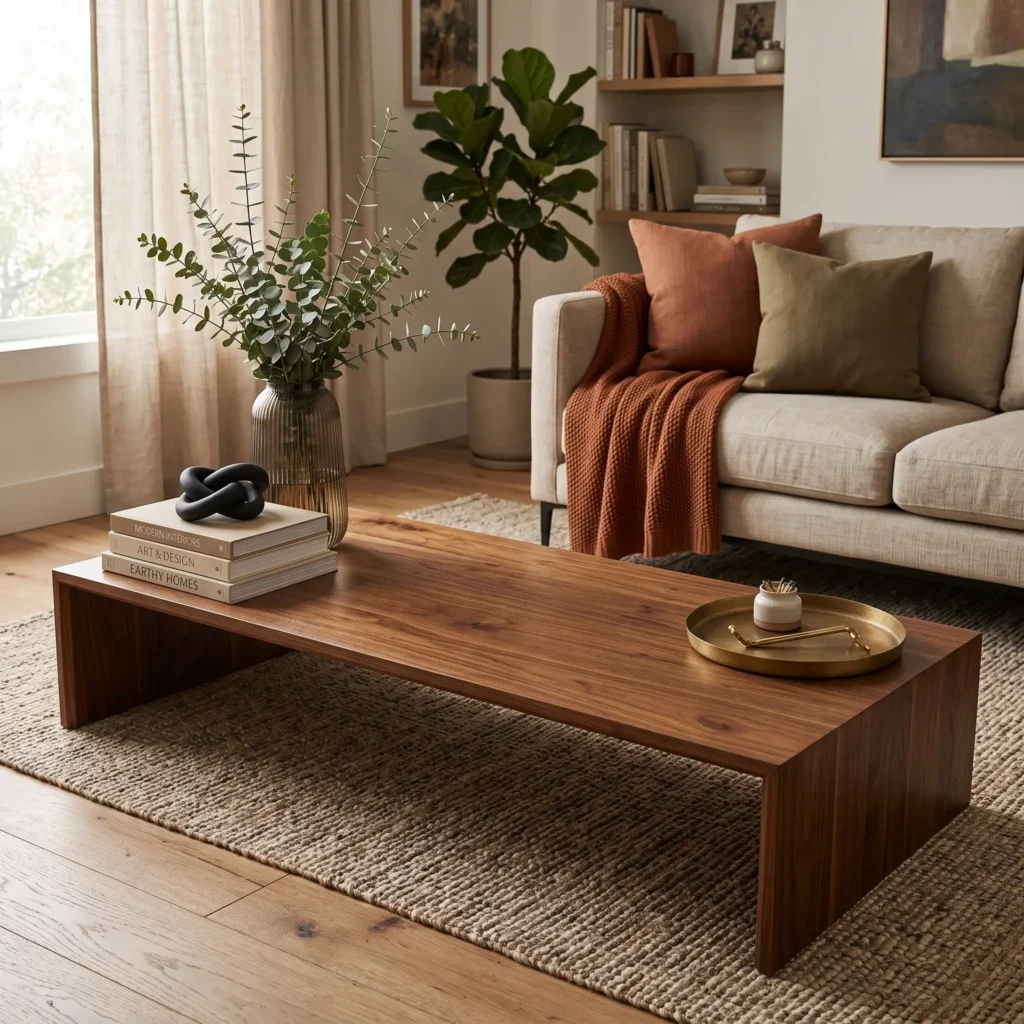
3. Asymmetrical Linear Balance
Rectangular tables run the risk of looking like a cafeteria line if you spread decor evenly across the length. Setting up two distinct focal points of contrasting heights creates visual movement.
How to Style: Anchor the left third of the table with an 11-inch fluted smoked glass vase containing wild dogwood cuttings. Anchor the right third with a low stack of three design books topped with a brushed brass dish. Leave the center third open to preserve sightlines toward the television.
- Curated Products:
- Fluted charcoal-tinted glass cylinder vase
- Trio of hardcover photography books in monochrome tones
- Heavy solid brass catchall dish
- Natural beeswax taper candle in a low stoneware holder
4. The Upholstered Ottoman Catchall
Ottomans provide extra seating and comfortable footrests, but their soft, tufted tops cannot support drinks without a sturdy base. A rigid tray creates a stable, functional zone.
How to Style: Center an oversized, dark-stained timber tray over the middle of the ottoman. Keep items inside the tray so the surrounding fabric remains usable as a footrest. Place a scented candle, a low brass box for remotes, and a small bud vase inside the tray.
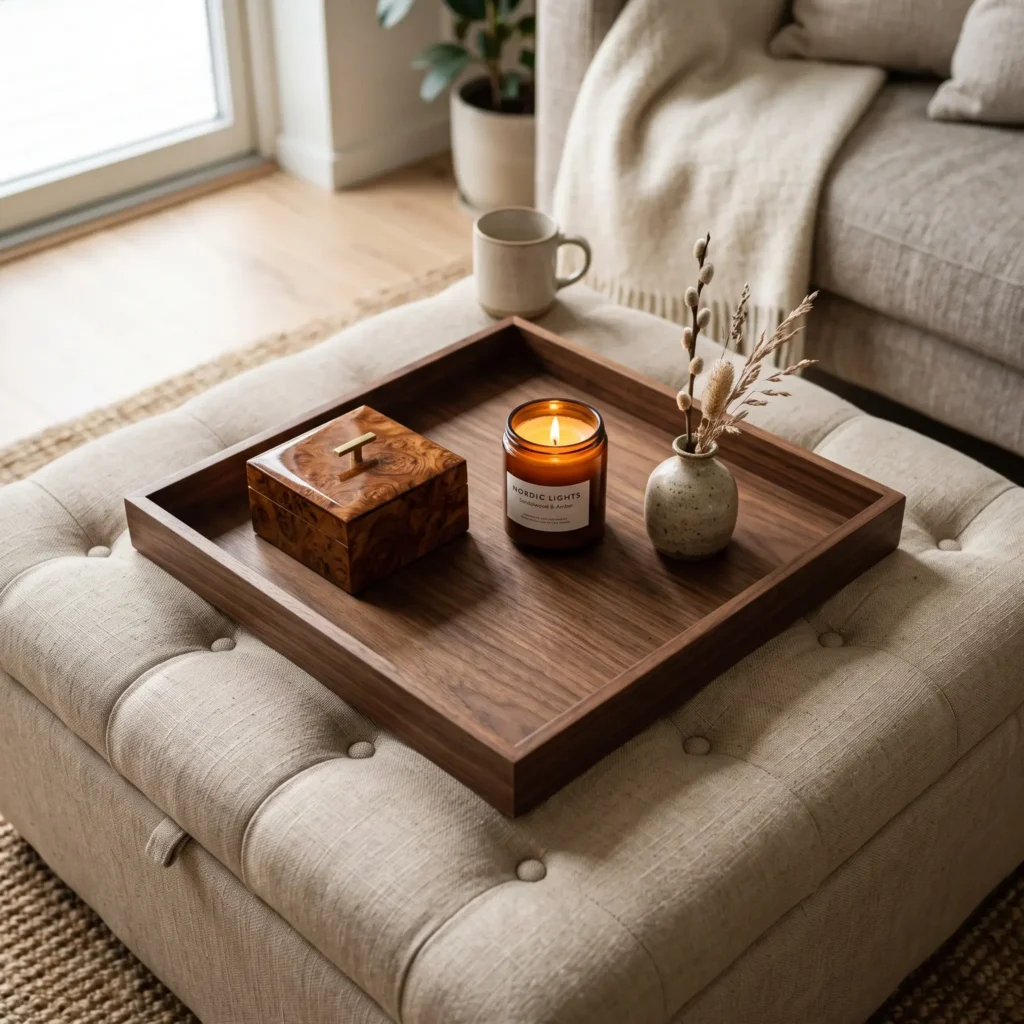
- Curated Products:
- Solid dark ash serving tray with cutout side handles (18×18 inches)
- Burl wood lidded storage box for electronics and remotes
- Hand-poured amber glass candle with notes of cedar and smoke
- Petite fluted ceramic bud vase with two dried bunny tail stems
5. The Restrained Wabi-Sabi Display
Rooted in Japanese and Nordic design principles, this layout embraces natural imperfection, raw organic finishes, and breathing room. It works best on low-profile timber tables.
How to Style: Skip trays entirely. Place a single hand-thrown ceramic vessel with a natural matte glaze directly on the table. Add one bare, sculptural branch with visible knots. Place one small, linen-bound book alongside an unpolished black soapstone disc.
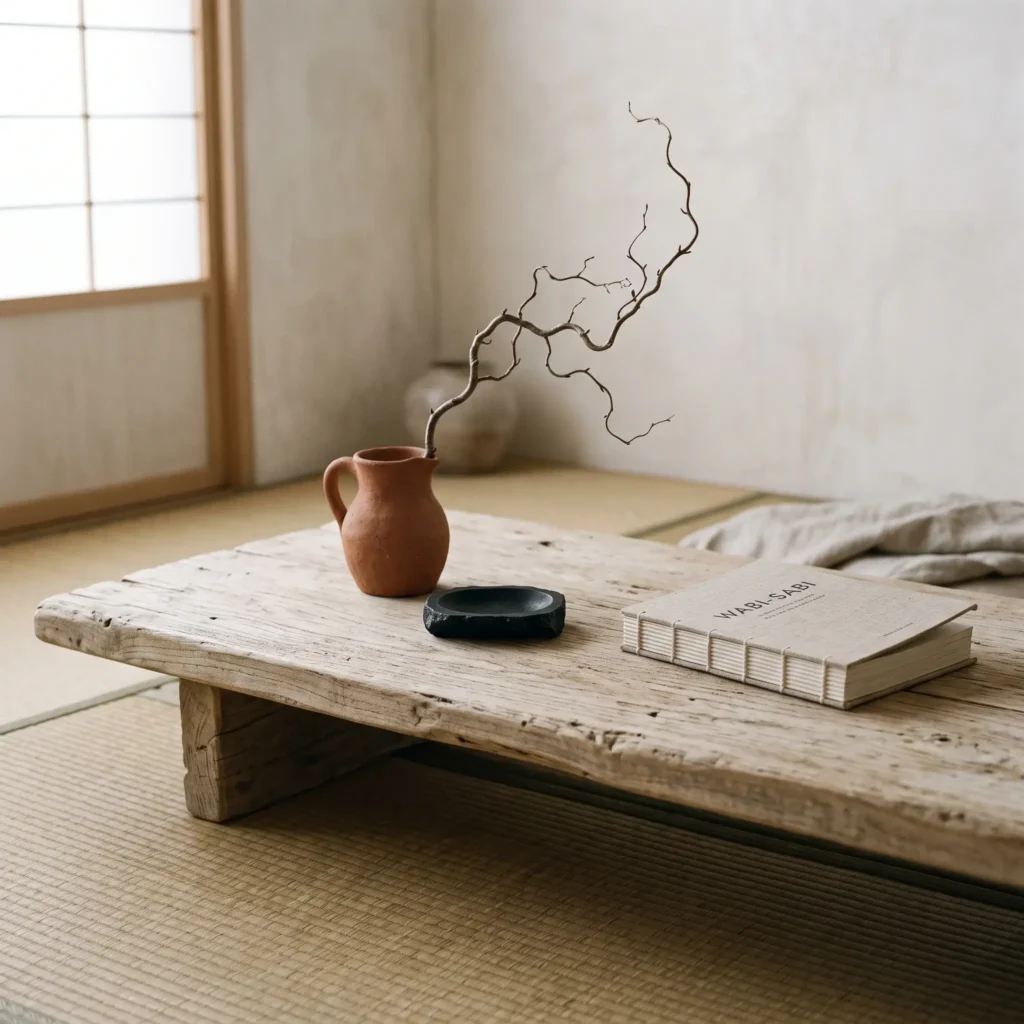
- Curated Products:
- Asymmetrical hand-thrown stoneware vessel with exposed clay base
- Single sculptural dried magnolia branch
- Raw black soapstone coaster dish
- Japanese architecture monograph bound in raw oatmeal linen
6. The Two-Tier Smart Storage Solution
Two-tier tables double your surface space, but the bottom shelf quickly turns into a dusty dumping ground. Giving each level a specific task keeps the setup clean.
How to Style: Keep the top glass or wood surface minimal with a single footed bowl and a candle. Use the bottom shelf for heavy visual items. Stack large museum folios side-by-side on the lower tier, paired with a low woven basket to conceal loose living room items.
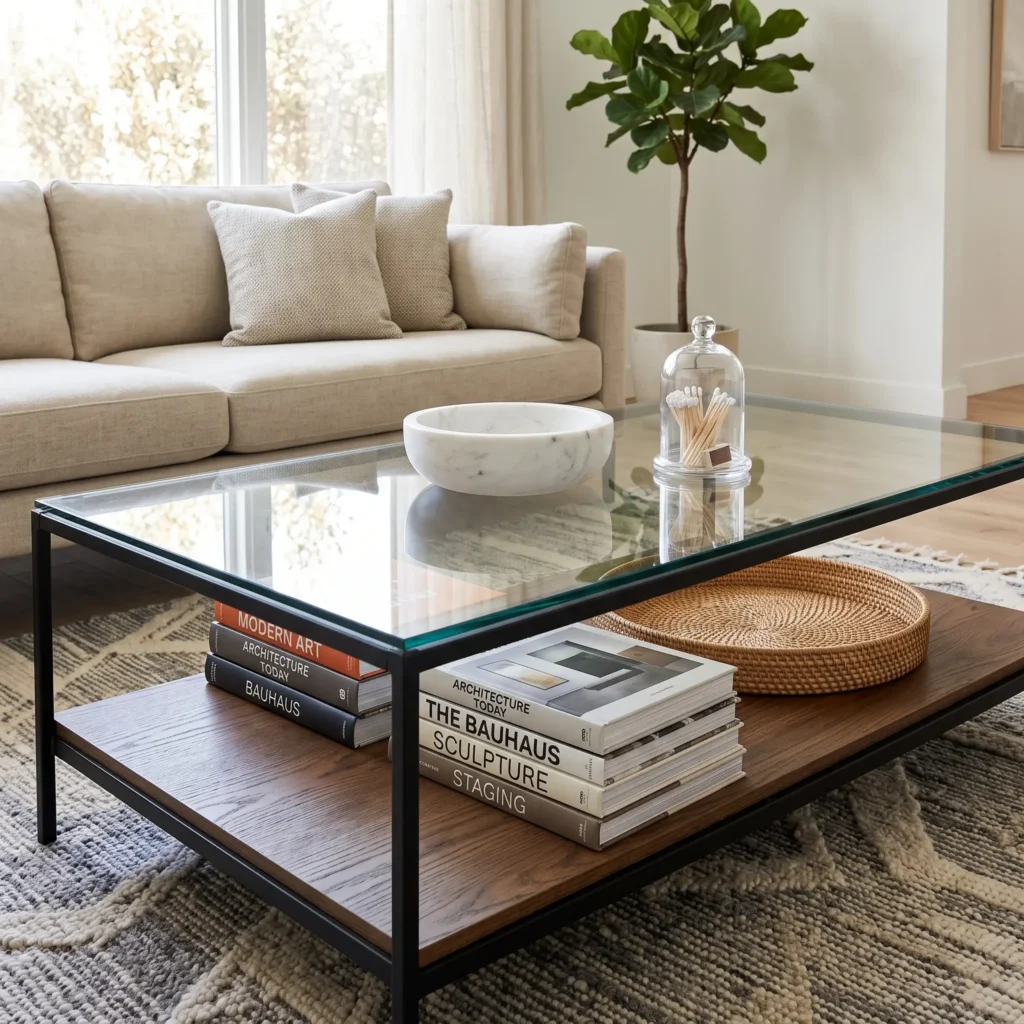
- Curated Products:
- Shallow woven water hyacinth storage basket with lid
- Oversized hardcover fine art folios (12×15 inches)
- Fluted white marble decorative bowl
- Heavy glass cloche with wooden matchsticks
7. The Moody Luxe Contrast
This approach uses high-contrast finishes like brushed metals, dark timber, and polished horn to add depth to light or neutral living rooms.
How to Style: Anchor a pale marble or travertine tabletop with a deep espresso walnut tray. Inside the tray, pair polished brass taper holders with a black earthenware bowl. Add a stack of fashion folios with dark spines to ground the composition.
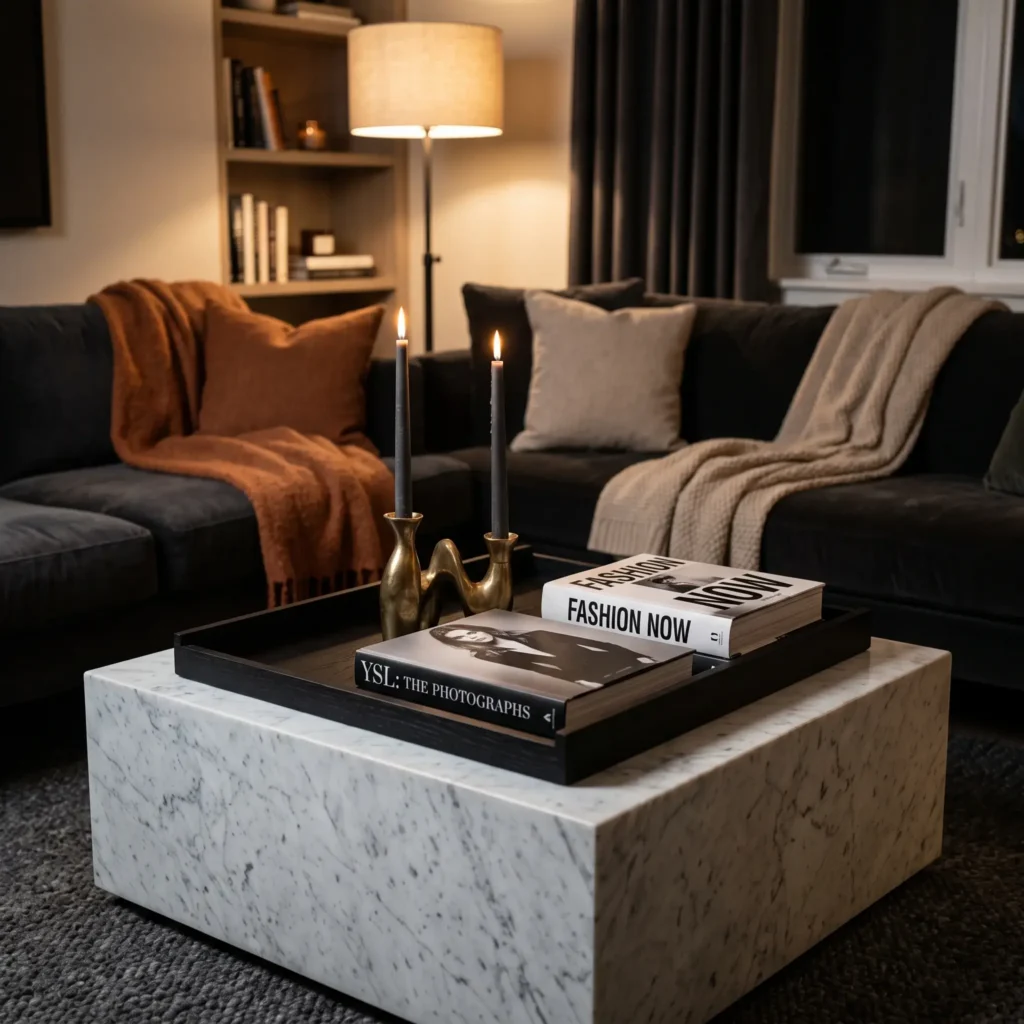
- Curated Products:
- Solid brass asymmetrical taper candle holders
- Matte black flared earthenware dish
- High-gloss dark lacquer or stained ash tray
- Charcoal beeswax taper candles
Ergonomic Guidelines and Spatial Proportions
Styling succeeds only when the table functions well within the room layout. Before placing accessories, verify that your table matches the dimensions of your seating.
| Measurement Dimension | Recommended Specification | Practical Rationale |
| Table-to-Sofa Length | 50% to 66% (Half to two-thirds of sofa length) | Prevents the table from looking tiny or overwhelming the room. |
| Table-to-Cushion Height | Level with cushion or up to 2 inches lower | Keeps sightlines open and items within easy reach. |
| Perimeter Seating Gap | 16 to 18 inches (40 to 45 cm) | Provides adequate legroom while allowing you to set down drinks comfortably. |
| Primary Walkway Gap | 24 to 30 inches (60 to 75 cm) | Keeps main traffic paths open toward entryways and media consoles. |
| Maximum Decor Height | 12 to 14 inches (30 to 35 cm) | Prevents vases and botanicals from blocking views of the television or guests. |
| Surface Balance | 60% styled, 40% open space | Leaves practical room for daily living activities. |
When styling sectionals with an extended chaise, calculate your 50% to 66% length ratio against the horizontal seating span only. Do not measure across the full width including the chaise, or the table will crowd the corner.
3 Proven Designer Styling Frameworks
Professional stylists use repeatable frameworks to arrange decor naturally without creating visual clutter.
| Designer System | Core Philosophy | Step-by-Step Execution |
|---|---|---|
|
Nate Berkus The 3-Item Triad | Organic modern balance emphasizing natural texture and personal connection. |
1. Something Flat: Horizontal book stack to establish height. 2. Something Tactile: Stone or carved marble knot for sculpture. 3. Something Natural: Artisanal clay vessel with leafy cuttings. |
|
Studio McGee Thematic Modules | Structured lifestyle clusters tailored to spacious or square surfaces. |
1. The Mini-Library: Parallel book stacks sorted by spine tone. 2. Curiosity Cabinet: Glass cloches with brass accents. 3. The Game Room: Sculptural timber or marble game boards. |
|
Martyn Lawrence Bullard 5-Step Maximalism | Curatorial abundance blending lighting, books, and vintage collectibles. |
1. Base: Oversized travel monographs. 2. Artifacts: Meaningful personal travel dishes. 3. Light: Multi-wick candles or candelabras. 4. Utility: Lidded bone-inlay box for loose tech. 5. Crown: Symmetrical floral arrangement in an urn. |
The Nate Berkus Three-Piece Triad
Designer Nate Berkus relies on a simple, foolproof formula that works on tables of any size:
- Something Flat: A horizontal stack of two hardcover books that reflect personal interests.
- Something Tactile: A solid object placed on top of the books, such as a carved marble knot, a horn bowl, or an iron ring.
- Something Natural: A hand-thrown ceramic vessel holding fresh branches or a small potted plant to add life.
The Studio McGee Thematic Modules
Studio McGee approaches large tables by styling them around specific lifestyle themes:
- The Library Module: Two parallel book stacks positioned side-by-side, arranged by spine tone, topped with brass reading glasses or a small magnifying glass.
- The Curiosity Module: A fluted glass cloche placed over an interesting collected item, paired with a small stoneware candle.
- The Game Module: A vintage wooden tic-tac-toe or marble checkerboard that serves as an interactive centerpiece.
The Martyn Lawrence Bullard Five-Step Method
For layered, collected interiors, designer Martyn Lawrence Bullard builds surfaces in five clear steps:
- Lay down oversized art and travel folios to anchor the space.
- Place authentic artifacts or travel dishes directly on the book stacks.
- Add tall candelabras or heavy multi-wick candles for ambient evening lighting.
- Position a lidded bone-inlay or leather box to keep daily clutter out of sight.
- Finish with a dramatic, single-species floral bouquet placed in an urn.
How to Style by Coffee Table Shape
Styling Geometry Matrix
Round Table
Layout: Centered Triangle
Cluster three elements in the middle: Tall Vase + Medium Candle + Low Books.
Rectangular Table
Layout: Asymmetric Split
Tall Vessel on left third, Low Book Stack on right third, Open Space in center.
Square Table
Layout: 4-Quadrant Grid
Corner 1: Woven Tray | Corner 2: Book Stack
Corner 3: Open Zone | Corner 4: Sculptural Accent
Oval Table
Layout: Linear Triad
One primary tall floral moment in center, flanked symmetrically by two low flat objects.
Round Coffee Tables
Round tables naturally promote circular movement. Keep styling centered so you do not disrupt room flow:
- Use a triangular composition with three items of different heights.
- Pair a tall vessel with a medium candle and a low book stack.
- Always match tray shapes to the table. Use round trays on round tables. Square trays create awkward corners that fight the table edges.
Rectangular Coffee Tables
Long rectangular surfaces look cluttered when items are spread out evenly:
- Break the table into three distinct sections.
- Place your tallest anchor piece off-center on either the left or right third.
- Balance the opposite side with a low, wide grouping like books or a tray.
- Keep the middle third completely empty to preserve visual breathing room.
Square Coffee Tables
Square tables offer wide surfaces that feel disconnected without clear boundaries:
- Divide the surface into four quadrants.
- Place a large square or rectangular tray in one corner to group smaller items.
- Place a stack of oversized books in the opposite diagonal corner.
- Add one standalone sculptural element, and leave the final quadrant clear.
Oval Coffee Tables
Oval shapes offer long surfaces without sharp corners:
- Follow the rule of three along the center spine.
- Place a tall centerpiece in the middle, flanked by two lower, matching book stacks on either side.
- Keep accents tucked toward the middle to leave the curved edges clear for resting cups.
Substrate Care: Glass, Marble, and Wood
The material of your tabletop dictates which decor items are safe to use.
Glass Surfaces
Glass shows every smudge, dust particle, and water ring. It also lets the rug below show through clearly:
- Group items inside a structured wood or leather tray to keep decor from looking like it is floating.
- Attach adhesive felt pads to the base of every heavy object to prevent scratches.
- Avoid heavy, unglazed pottery that can scratch glass when moved.
Honed and Polished Marble
Natural marble is soft, porous, and susceptible to acid etching and oil staining:
- Never place unlined candles directly on raw marble; hot wax can seep into the pores.
- Use sealed stone, wood, or brass trays beneath beverage zones and botanicals.
- Avoid citrus-scented diffusers or cleaning sprays containing vinegar or lemon juice near marble.
Solid and Reclaimed Timber
Solid wood expands with humidity changes and absorbs liquids easily:
- Use heavy coasters backed with cork or felt for all cold and hot beverages.
- Avoid placing wet terracotta pots directly on raw wood finishes.
- Wipe down natural timber using a dry microfiber cloth, avoiding silicone polishing sprays.
Practical Concealment and Family-Friendly Safety
A well-styled living room must handle real-life family habits, curious pets, and loose electronics without looking messy.
Practical Concealment System
Hidden Inside: Keeps daily technology clutter out of view
Outside Profile: Doubles as an architectural plinth for small accents
Concealing Daily Clutter
Plastic remote controls, gaming devices, and loose chargers quickly disrupt a styled table. Hide these essentials using functional decor:
- Use lidded boxes crafted from burl wood, bone inlay, woven cane, or saddle leather to store remotes within reach.
- Place a heavy brass or stone match strike on top of a book stack instead of leaving plastic lighters visible.
- Keep coasters grouped inside a low, matching rimmed dish rather than leaving them scattered loose.
Child and Pet Precautions
Homes with toddlers or energetic pets require sensible styling choices:
- Select coffee tables with rounded edges, such as round, oval, or waterfall silhouettes, to eliminate sharp corners.
- Trade out delicate blown glass and thin ceramics for durable accents like turned wood bowls, cast brass knots, and paper-mache vessels.
- Anchor tall vases and valuable pottery to the tabletop using clear, removable museum putty.
- Avoid plants toxic to cats and dogs. Skip eucalyptus, lilies, and ivy. Choose pet-safe options like preserved olive stems, spider plants, or prayer plants instead.
Seasonal Rotation Framework
You do not need to replace your core decor pieces when the seasons change. Keep your foundational trays, large bowls, and book stacks in place, swapping only foliage, accent colors, and scents.
| Season | Botanical Accent | Color and Material Palette | Scent Profile |
| Spring | Fresh tulips, blooming quince branches, sweet peas | Chalk white, pale celadon, clear recycled glass | Bergamot, cut grass, neroli |
| Summer | Broad monstera fronds, dried palm spears, olive stems | Washed linen, bleached oak, woven seagrass | Sea salt, ripe fig leaf, driftwood |
| Autumn | Rust-toned cotinus, preserved oak leaves, seed pods | Unglazed terracotta, hammered bronze, amber glass | Spiced clove, warm bourbon, cedarwood |
| Winter | Fresh cedar boughs, bare dogwood stems, magnolia leaves | Polished brass, dark walnut, deep forest tones | Pine resin, frankincense, rich amber |
Frequently Asked Questions
What is the 60/40 rule for styling a coffee table?
The 60/40 rule is a spatial guideline where you style 60% of your tabletop surface with decorative accents, leaving 40% open as negative space. This preserves functional room for coffee cups, laptops, and remotes, keeping the table practical for daily living.
How high should items on a coffee table be?
Keep centerpieces and decorative items under 14 inches (35 centimeters) tall. This height allows seated guests to converse easily and preserves a clear line of sight to the television or fireplace.
What should you place on a round coffee table?
Style a round coffee table using a centered triangular grouping of three items at different heights. Combine a tall vase with greenery, a medium-height scented candle, and a low stack of two hardcover books. If you use a tray, choose a circular one to match the table edges.
How can you make a coffee table look nice on a budget?
Start by shopping your own home. Stack existing hardcover art, travel, or photography books flat on the table to create height. Clip fresh greenery or wild branches from your garden and place them in a glass jar or ceramic pitcher. Add a simple unscented pillar candle and a small thrifted bowl to complete the grouping without spending money.
How do you hide remote controls on a coffee table?
Store remote controls inside a decorative lidded box made of burl wood, woven cane, or bone inlay. The box conceals black plastic remotes and cables while acting as an attractive accent on the table or on top of a book stack.
Intentional coffee table styling comes down to scale, geometry, and restraint. When you anchor your layout with balanced heights, protect 40% of the surface for daily use, and conceal household clutter in lidded vessels, your coffee table becomes both a functional piece of furniture and a comfortable focal point for the entire home.
