Moody Bedrooms That Do Not Feel Like a Cave: 7 Ideas and Rules

Painting a bedroom in a dark, rich color feels like a major risk. Most people worry they will turn their space into a cramped box or a gloomy basement.
That closed-in feeling does not come from dark paint. It happens when a room lacks light reflection, texture contrast, and warm illumination. If you paint walls dark but leave a stark white ceiling, use cool light bulbs, or stick to flat drywall, the space will look dull and flat.
A well-designed moody bedroom feels like a quiet, restorative retreat. The walls recede into soft shadow, the lighting glows warmly, and the bed acts as a bright, welcoming centerpiece.
Here are seven practical moody bedroom ideas that keep your room open, warm, and comfortable.
7 Practical Moody Bedroom Ideas That Stay Bright and Open
1. The Deep Olive and Crisp Linen Retreat
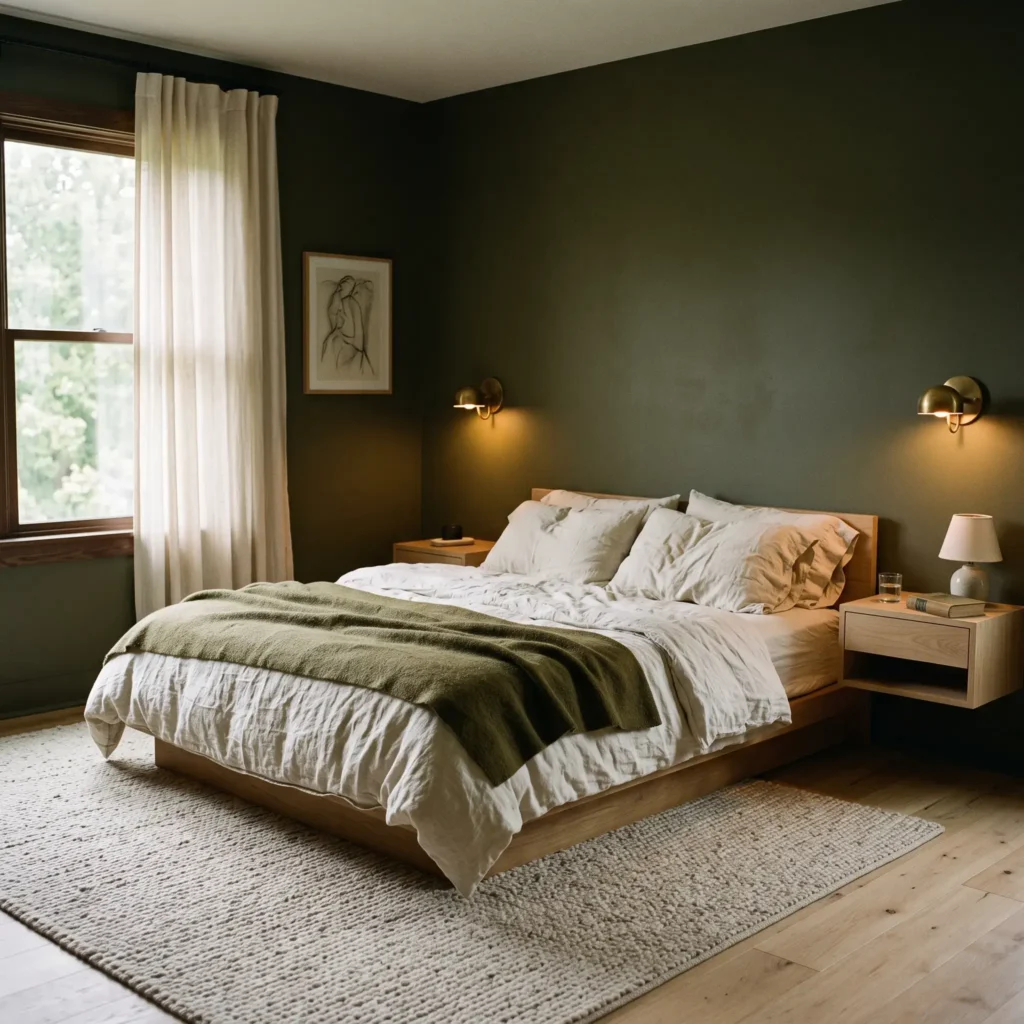
This design uses a rich, yellow-based forest green across all four walls. Instead of feeling heavy, the space feels grounded and connected to nature. Warm unlacquered brass sconces flank the headboard, casting warm light downward. Ivory linen bedding reflects ambient daylight into the center of the room. Natural white oak nightstands break up the dark perimeter, adding light wood grain that keeps the lower half of the space visually open.
- Featured Products:
- Wall Paint: Sherwin-Williams Night Watch (SW 9125) in Matte Finish
- Lighting: Aged Brass Articulating Wall Sconces with Pleated Linen Shades (2700K Warm White LED)
- Bedding: European Washed Flax Linen Duvet Set in Ivory and Natural Oatmeal
- Furniture: Solid White Oak Floating Nightstands with Soft-Close Drawers
- Hardware: Unlacquered Brass Switch Plates and Cabinet Pulls
2. The Midnight Navy and Oiled Walnut Haven
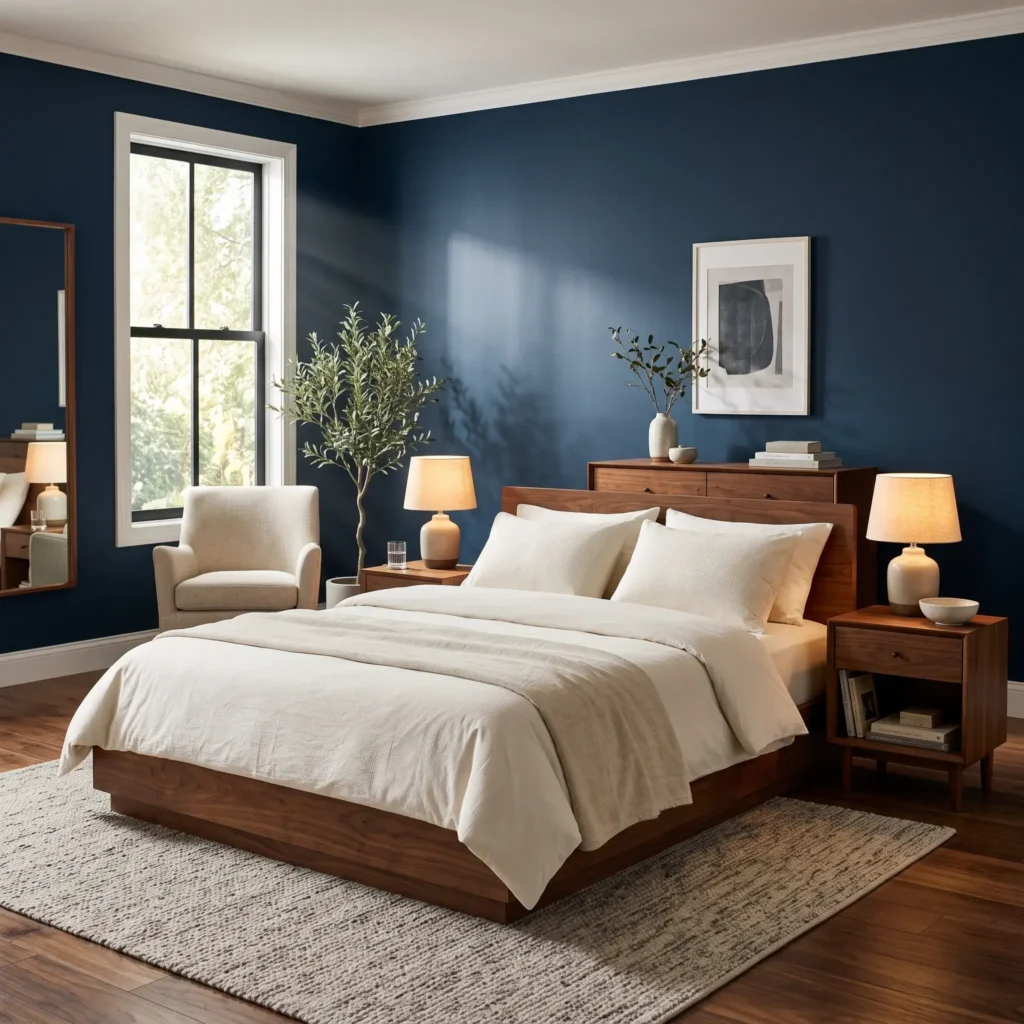
Dark blue can look chilly under cool daylight. This setup balances midnight navy walls with warm, oiled American walnut furniture. The red-brown tones in the wood cancel out the cool tones of the blue paint. Crisp cotton sheets in warm cream provide a clean focal point against a dark upholstered headboard. Two table lamps with translucent parchment shades cast wide pools of amber light across the wall planes.
- Featured Products:
- Wall Paint: Benjamin Moore Hale Navy (HC-154) in Eggshell Finish
- Bed Frame: Mid-Century Solid American Walnut Platform Bed with Upholstered Headboard
- Bedding: 400-Thread-Count Crisp Cotton Percale Sheets in Warm Cream
- Lighting: Turned Walnut Table Lamps with Amber Parchment Drum Shades
- Accents: Burnished Bronze Decorative Bowls and Framed Art with Wide White Mats
Check out more Styling Ideas
3. The Charcoal Limewash Japandi Sanctuary
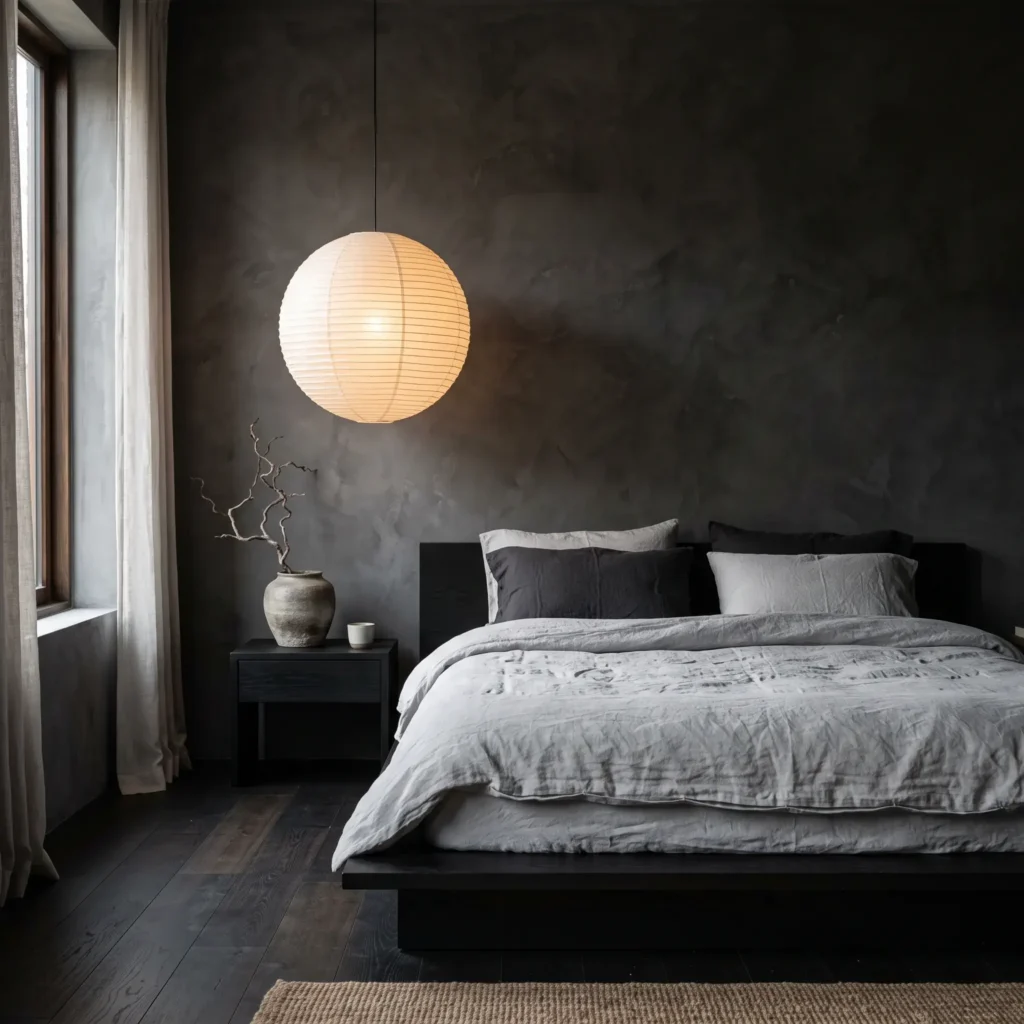
Flat black paint absorbs light completely, making drywall look cheap. This concept avoids that trap by using charcoal limewash plaster. The mineral crystals in the plaster create soft texture and natural movement, so the walls never look flat. A large, ribbed washi paper lantern hangs from the ceiling, casting a diffused glow. Low-profile furniture keeps sightlines open, which makes the bedroom feel larger than it is.
- Featured Products:
- Wall Finish: Portola Paints Roman Clay in Chimney Sweep
- Lighting: Oversized Ribbed Washi Paper Globe Pendant (30-inch diameter)
- Bed: Low-Profile Wire-Brushed Ebonized Oak Bed Frame
- Bedding: Crinkled Washed Cotton Coverlet in Pale Stone Gray with Jute Accent Cushions
- Decor: Hand-Thrown Stoneware Ceramic Vases with Dried Botanical Branches
4. The Plum and Aubergine Color-Drenched Suite
This concept uses full color drenching. The rich plum shade covers the baseboards, walls, doors, and ceiling. By wrapping the entire space in one tone, the corners disappear, preventing the room from feeling small. Heavy velvet drapery pools on the floor, framing the window while dampening echo. A high-gloss clear coat on the ceiling reflects lamp light like a still pond, visually lifting the height of the room.
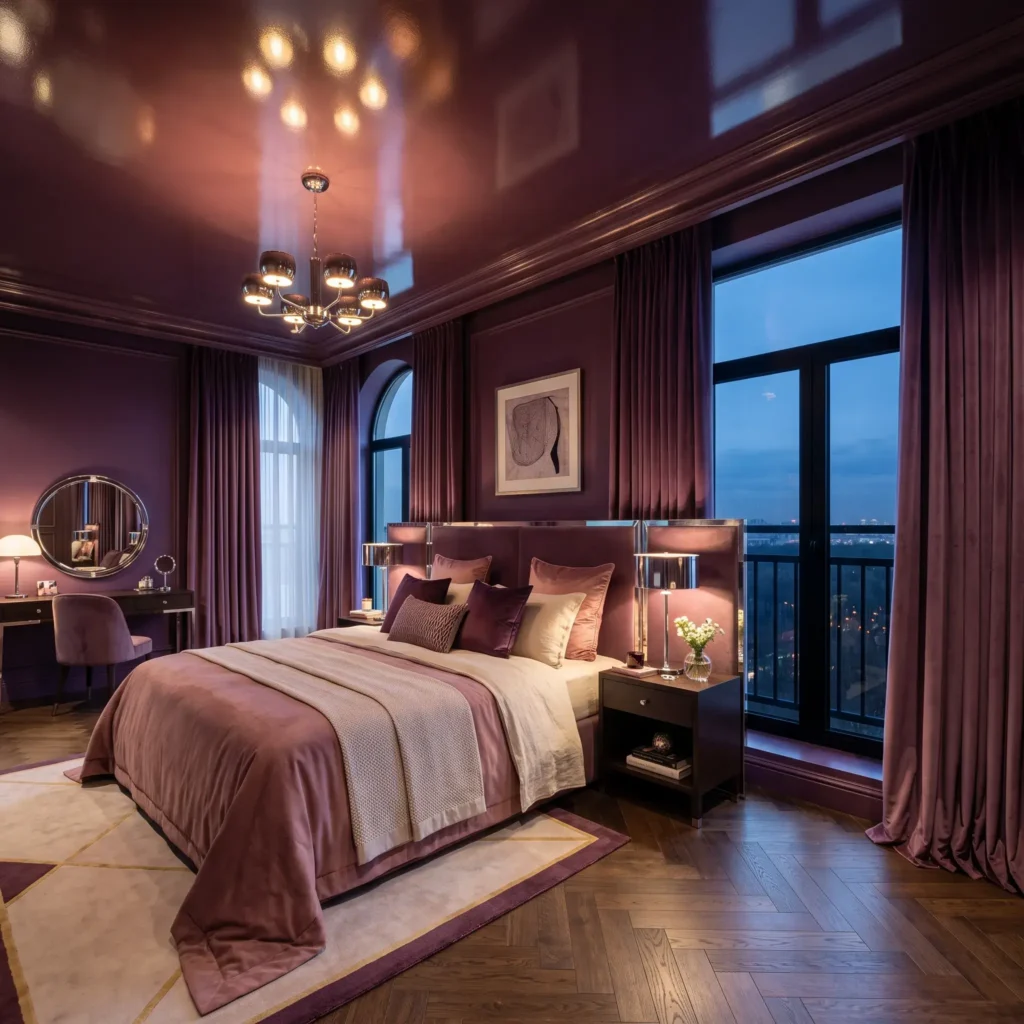
- Featured Products:
- Wall and Trim Paint: Farrow & Ball Brinjal (No. 222) in Estate Emulsion on Walls and Full Gloss on Ceiling
- Window Treatments: Floor-to-Ceiling Cotton Velvet Curtains in Deep Maroon
- Bedding: Dusty Rose and Terracotta Washed Sateen Sheets with a Quilted Coverlet
- Lighting: Polished Chrome Bedside Sconces with Adjustable Swing Arms
- Floor: Antique Persian Heriz Wool Rug with Rust, Plum, and Ivory Tones
5. The Warm Umber and Cognac Leather Bedroom
Chocolate brown creates immediate warmth. Unlike cold gray, an earthy umber base makes a room feel secure and grounded. This bedroom pairs matte brown walls with a caramel cognac leather headboard and brass art lights. The leather catches light along its stitched seams, while framed prints with wide white mats break up large wall spaces into bright focal points.
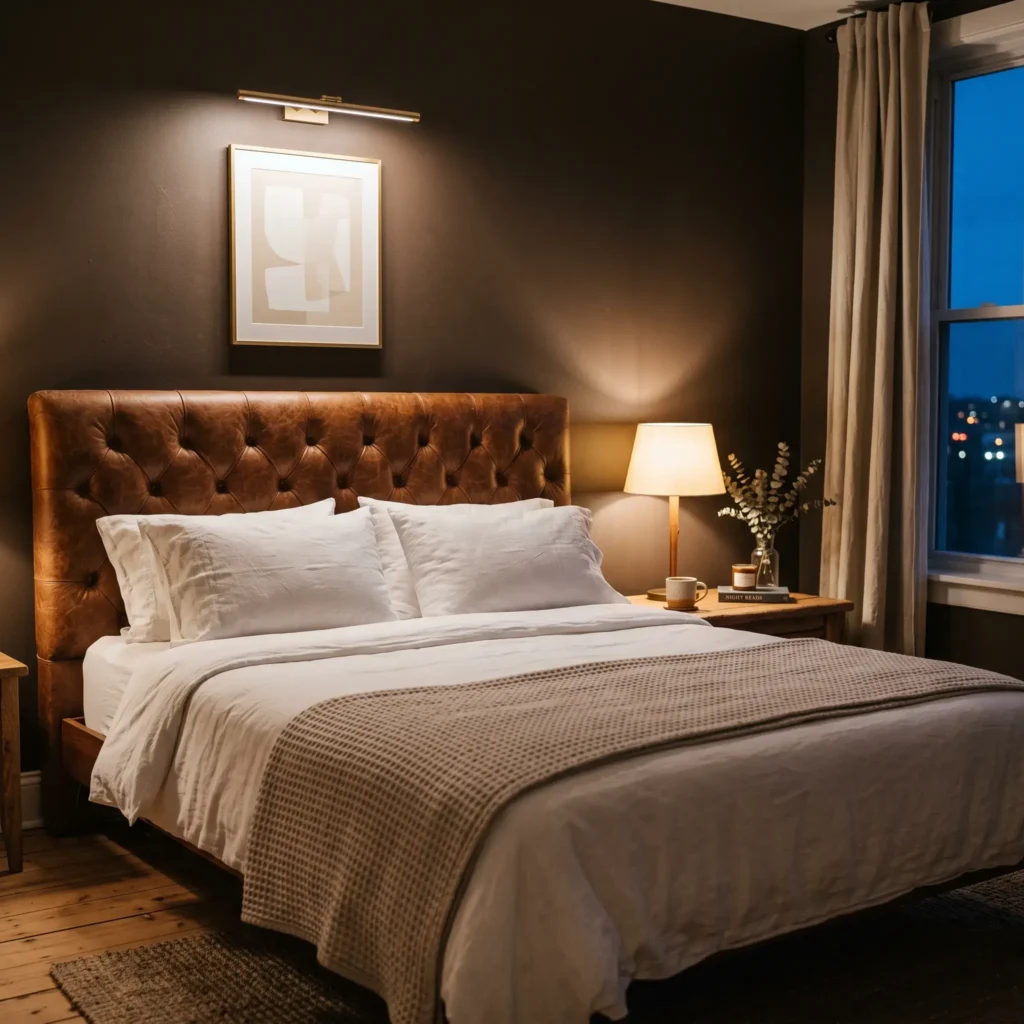
- Featured Products:
- Wall Paint: Farrow & Ball Broccoli Brown (No. W108) in Dead Flat
- Headboard: Channel-Tufted Top-Grain Cognac Leather Headboard
- Lighting: Hardwired Brass Picture Lights with 2400K LED Bulbs
- Bedding: Waffle-Weave Cotton Blanket in Biscuit Brown with Crisp White Pillowcases
- Art: Framed Botanical Prints with 4-inch Off-White Acid-Free Mats
6. The Forest Green Nook with Antiqued Mirrors
Small bedrooms often feel boxy when painted dark. This design fixes that issue by placing an oversized antiqued floor mirror directly across from the window. The dark pine walls frame the mirror, which bounces daylight back into the corners without creating blinding glare. Broad-leaf indoor plants introduce fresh greenery that stands out against the dark paint.
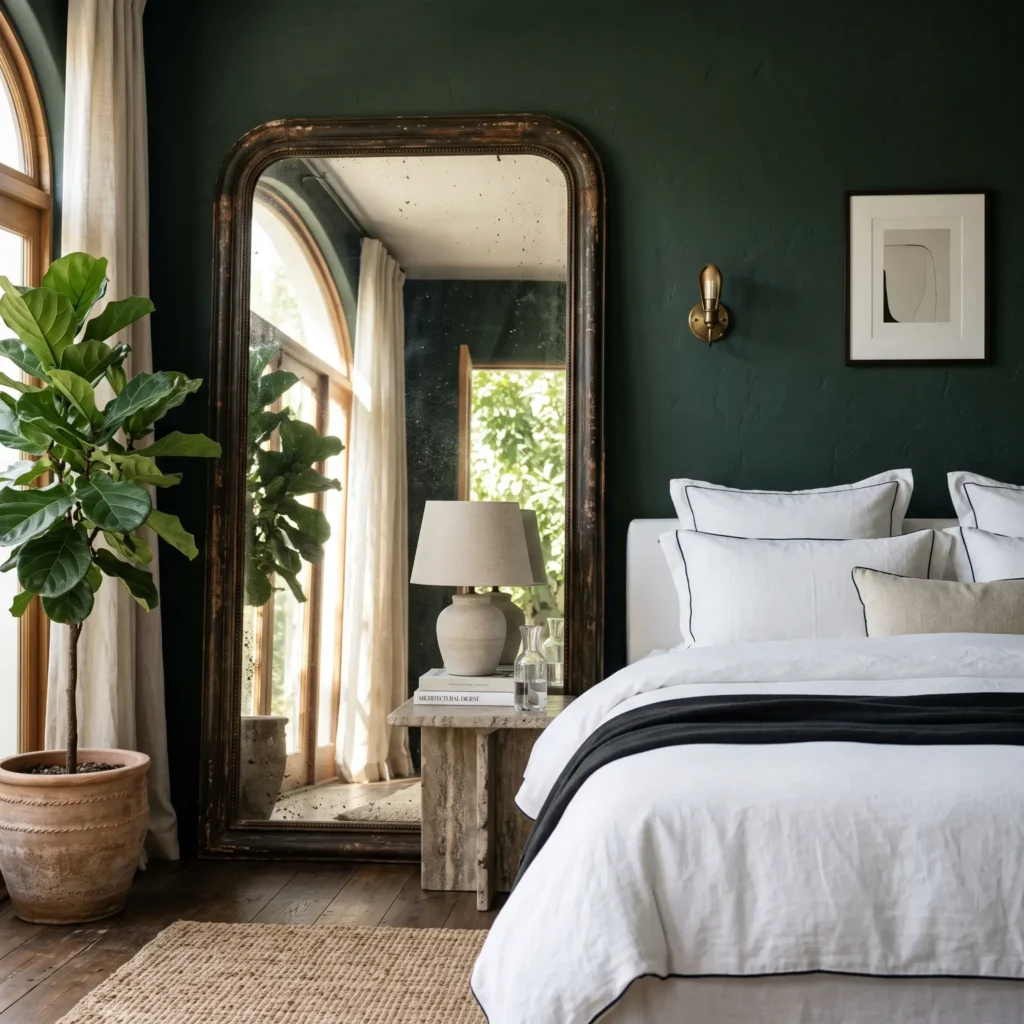
- Featured Products:
- Wall Paint: Benjamin Moore Salamander (2050-10) in Matte Finish
- Mirror: 72-Inch Arched Antiqued Glass Floor Mirror with Thin Gilt Frame
- Plants: Fiddle Leaf Fig in a Handcrafted Glazed Terracotta Pot
- Bedding: Pure White Linen Duvet with Forest Green Piping
- Accent Furniture: Fluted Travertine Bedside Table
7. The Inky Charcoal Bedroom with Wall-Grazing Light
This modern design uses architectural lighting to keep dark walls expansive. An LED light channel tucked along the ceiling drop sends a soft, indirect wash down the matte charcoal wall. Because the light grazes the wall vertically, it highlights the wall finish and removes dark shadows from the corners. Low-profile reading lights provide direct task light without cluttering the nightstand.
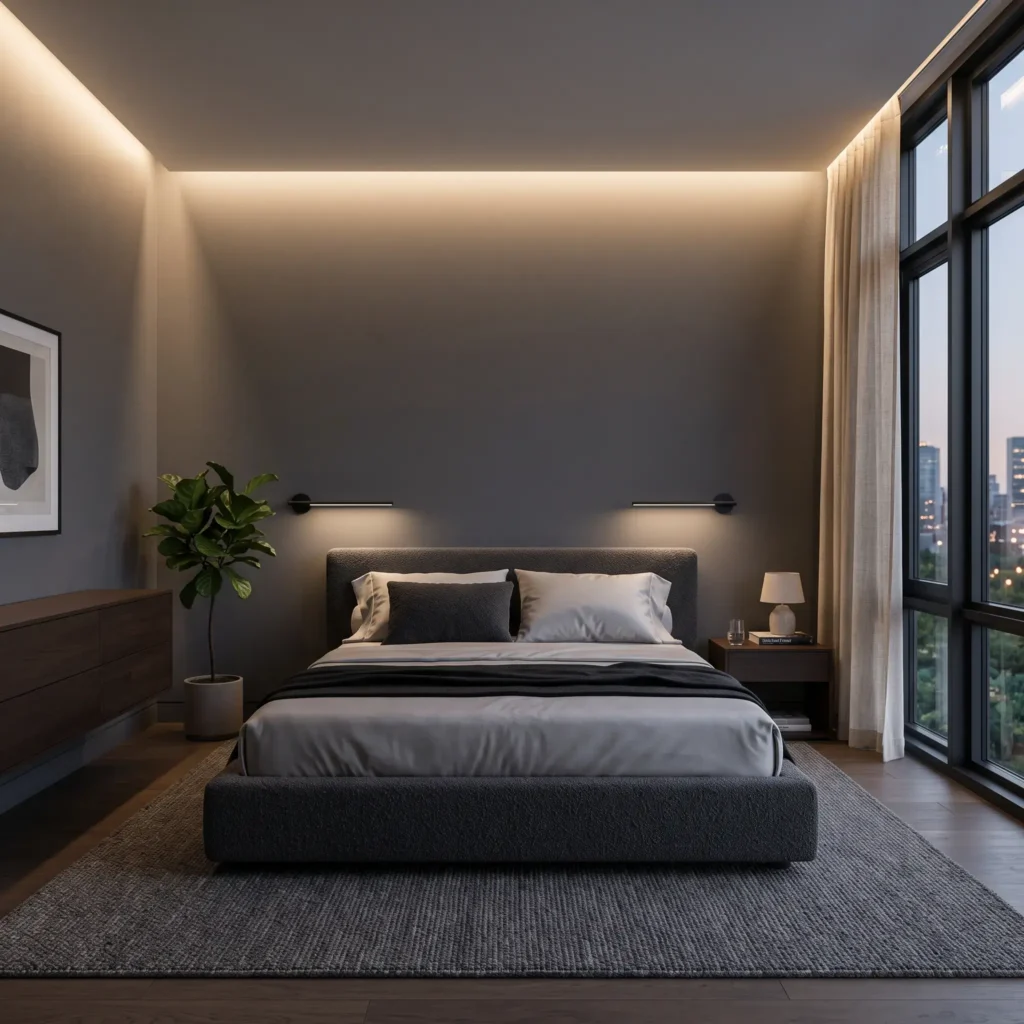
- Featured Products:
- Wall Paint: Sherwin-Williams Iron Ore (SW 7069) in Flat Finish
- Architectural Lighting: Concealed 2700K High-CRI LED Tape Light with Aluminum Channel Diffuser
- Bed: Fully Upholstered Low Platform Bed in Charcoal Boucle
- Bedding: Smooth Tencel Sheet Set in Soft Cloud Gray with a Charcoal Throw
- Hardware: Matte Black Recessed Reading Sconces with Directional Beam Focus
Why Dark Bedrooms Fail: The Science of the Cave Effect
Dark rooms fail when people ignore light physics. Many homeowners select a color from a small swatch under bright store lighting, take it home, and paint a room with small windows. The result is often dull, flat, and claustrophobic.
The Muddy Middle Trap and Light Reflectance Value
Light Reflectance Value, or LRV, measures the percentage of visible light a paint color reflects. The scale runs from zero (pure black) to one hundred (pure white).
- The Problem Zone (LRV 20 to 50): Paint colors in this middle range often fail in low-light rooms. These mid-tone grays, slates, and beiges need strong natural light to look good. Without direct sunlight, they cannot bounce light, yet they lack the pigment depth needed to feel intentional. They end up looking dirty, flat, and dreary.
- The Moody Sweet Spot (LRV 15 and Below): True atmospheric rooms work best with an LRV of 15 or lower. Highly saturated, deep pigments soften the hard boundaries of the room. The eye cannot easily tell where the walls end, which creates a sense of depth that expands the space.
Cardinal Light Rules: Matching Deep Paint to Window Direction
Natural daylight changes color depending on which direction your windows face. Choosing the wrong undertone for your window exposure will turn a rich paint into an uninviting room.
| Window Direction | Natural Light Quality | Impact on Dark Paint | Best Color Palette | Colors to Avoid |
| North-Facing | Cool, indirect light with a light blue cast all day | Makes cool grays and blues look icy and institutional | Warm aubergine, deep olive, chocolate umber, warm plum | Cold charcoal, slate gray, pure black, navy blue |
| South-Facing | Warm, bright, yellow-gold sunlight for hours | Warms up cool tones without washing them out | Midnight navy, deep teal, inky charcoal, forest green | Overly warm browns that can look red or muddy |
| East-Facing | Bright, warm mornings followed by cool shade | Morning light brings out warmth, but afternoons cool down | Muted forest greens, neutral slate blues, warm charcoal | Stark cool grays that lose life by early afternoon |
| West-Facing | Dull morning light with hot amber light at dusk | Sunset light intensifies warm red and orange tones | Deep plum, espresso, rich mahogany, earthy charcoal | High-chroma blues that fight orange sunset rays |
Always test paint swatches on large poster boards. Move them to different walls and inspect them at 8:00 AM, 1:00 PM, and 8:00 PM under your lamps.
The 4-Tier Lighting Blueprint for Low-Light Rooms
You cannot light a dark room the same way you light a white room. White walls bounce light across the entire floor plan. Dark walls absorb up to 90 percent of that light.
Relying on a single overhead fixture casts a harsh circle of light on the floor while leaving the walls in shadow. That extreme contrast creates the cave feeling. Instead, spread your illumination across four distinct layers:
- Ambient Ceiling Fill: Use indirect cove lighting, milk-glass globes, or fabric drum pendants to create a gentle base level of light without casting hard shadows.
- Eye-Level Warmth: Install sconces and table lamps between 36 and 60 inches from the floor. Use parchment, linen, or frosted glass shades to soften the light.
- Vertical Wall Grazing: Place adjustable recessed spotlights 6 to 10 inches away from walls to graze textured plaster, wallpaper, or drapes. This adds visible depth to dark surfaces.
- Focused Task Lighting: Add directional reading lights at the bedside so you can read comfortably without flooding the entire bedroom with bright light.
Color Temperature: Keep It Between 2400K and 2700K
Never use 4000K or 5000K daylight bulbs in a moody room. Cool white light clashes with deep wall colors, making them feel like a sterile commercial office. Stick strictly to warm white bulbs between 2400K and 2700K. This warm light brings out rich pigments and helps your brain produce melatonin for restful sleep.
Spectral Fidelity: Check the CRI and R9 Rating
Budget LED bulbs make dark walls and wood furniture look dull. Check the lighting package for two specifications:
- CRI ($R_a$): The Color Rendering Index measures how accurately a bulb reveals colors compared to natural light. Choose bulbs with a CRI of 90 or higher.
- $R_9$ Value: Standard CRI tests ignore deep red wavelengths. The $R_9$ metric measures red light output. You need an $R_9$ of 50 or higher to reveal the rich undertones in walnut furniture, leather, linen, and warm paint.
Defeating the Lid Effect: Ceilings and Trim
A frequent mistake in dark bedrooms is painting four walls in navy or charcoal while leaving the ceiling and baseboards bright white.
Homeowners do this hoping to preserve vertical height. Instead, it creates a stark line where the dark wall meets the white drywall. This line draws the eye straight to the perimeter, creating a visual lid that pulls the ceiling down.
Option A: Complete Color Drenching
Paint the baseboards, window trim, doors, walls, and ceiling in the same low-LRV color. You can vary the sheen to make the room durable and interesting:
- Walls: Flat, matte, or Roman clay to absorb light and hide drywall imperfections.
- Trim and Doors: Satin or semi-gloss to handle touch and bounce soft highlights.
- Ceiling: Flat emulsion in the same color, or mixed at 75 percent strength to keep it soft.
Option B: The Lacquered Ceiling Mirror
If you want an open, dramatic look, apply a high-gloss lacquer finish to the ceiling in the same dark hue as the walls. While matte paint absorbs light, high gloss acts like a dark reflecting pool. It mirrors your bedside lamps and window light, visually doubling your vertical ceiling height.
The Chiaroscuro 60/30/10 Rule for Texture and Contrast
In fine art, chiaroscuro describes the balance between deep shadows and bright pools of light. A moody bedroom should never be a flat sea of dark paint. It needs bright points of contact to reflect light back to your eyes.
Use this simple proportion to balance your room:
- 60 Percent Dark Base: Your saturated wall color, trim, and large window drapes form the main envelope.
- 30 Percent Mid-Tone Textures: Natural wood bed frames, wool rugs, textured velvet pillows, and matte pottery provide warmth.
- 10 Percent Luminous Anchors: Crisp ivory sheets, wide white picture mats, glowing parchment lamp shades, and polished brass or chrome hardware catch the eye.
The bed must act as a light-reflecting island. Using crisp white or light oatmeal linen gives ambient light something bright to bounce off, keeping the whole bedroom balanced and welcoming.
Frequently Asked Questions
Can I paint a small bedroom dark without making it feel tiny?
Yes. Deep paint colors with an LRV under 15 blur the sharp corners of the room. When the eye cannot find the physical boundaries, the walls appear to recede outward. Keep the furniture low to the floor, hang your drapery from the ceiling to the floor, and use color drenching across the baseboards and ceiling to remove visual breaks.
What is the best paint finish for dark bedroom walls?
Matte or flat finishes work best on dark drywall. Shiny paints highlight every bump, tape joint, and flaw in the wall surface, creating harsh glare under artificial light. If you want subtle movement, use Roman clay or limewash, which offers a soft mineral finish without artificial shine.
Will a moody bedroom make it harder to wake up in the morning?
Not if you plan your window treatments properly. Avoid heavy blackout shades that permanently seal the window. Layer sheer linen curtains under lined drapery panels. During the day, draw the heavy curtains open to let natural light fill the room through the sheers. You can also install smart light switches that slowly bring your 2700K lamps up to full brightness thirty minutes before your alarm sounds.
What light bulb wattage should I use in a dark bedroom?
Wattage measures energy use, not light output. Look for lumens and Kelvin instead. Choose bulbs that produce between 450 and 800 lumens with a warm color temperature of 2700K. Instead of using one high-lumen bulb in the center of the room, install three to five lower-lumen light sources around the perimeter to create an even, comfortable glow.
Planning Your Next Steps
- Check Your Windows: Identify whether your room faces north, south, east, or west before you buy paint.
- Order Large Swatches: Never paint directly from a two-inch paper chip. Look at large peel-and-stick samples against your trim in morning light and under evening lamps.
- Swap Your Light Bulbs First: Replace every cool bulb with 2700K bulbs featuring a CRI of 90 or higher before picking your final shade.
- Plan Your Bedding Contrast: Choose your ivory, flax, or pale linen bedding before you open a single paint can. That high-contrast island will keep your dark walls feeling grounded, warm, and expansive.