10 Modern Wood Kitchen Cabinet Ideas: Design Blueprints, Wood Species, and Finish Engineering
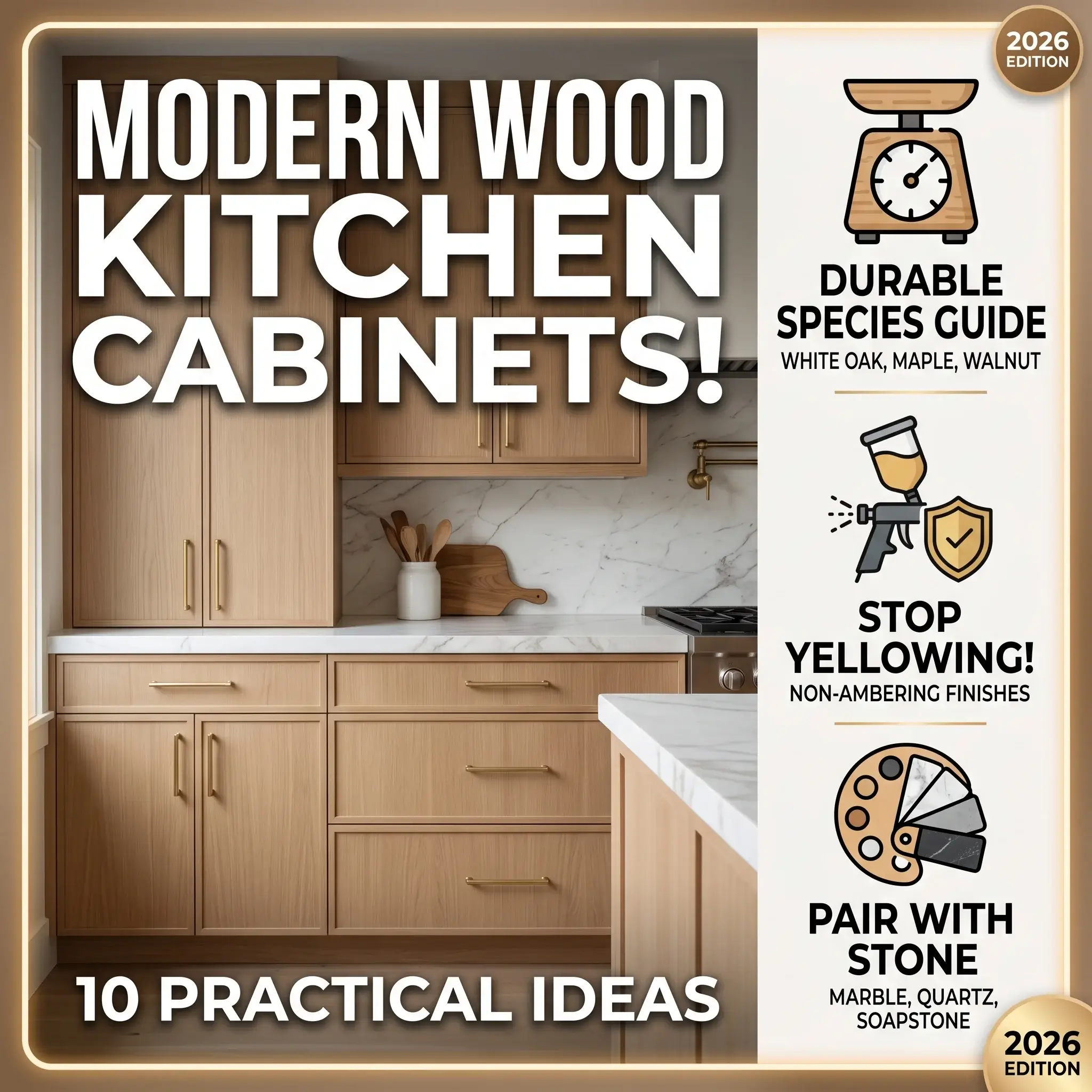
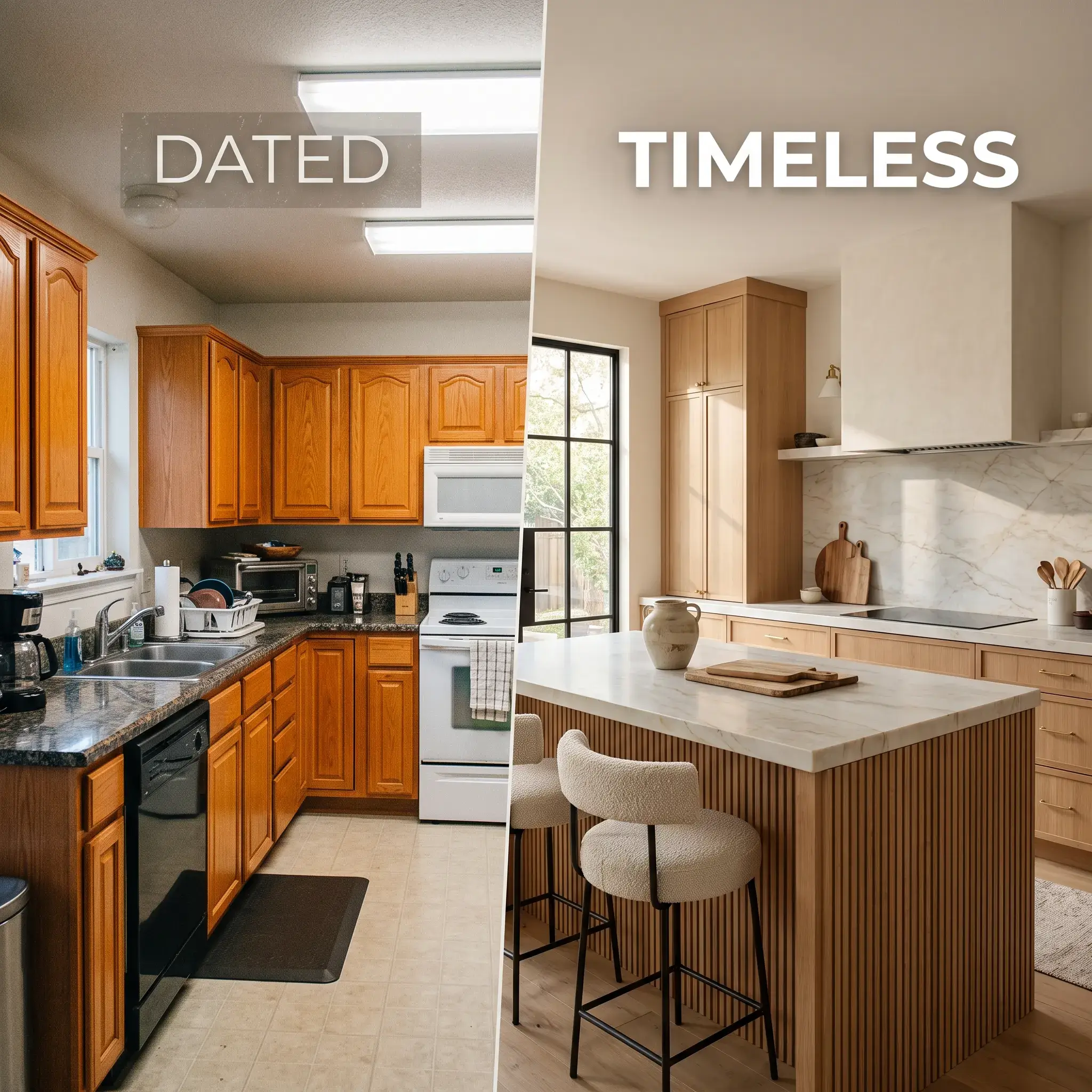
Natural wood kitchen cabinets have replaced painted white cabinetry in modern residential architecture. Homeowners want organic warmth and tactile texture. However, nobody wants a kitchen that looks like an orange, glossy relic from the 1990s.
Today’s wood cabinetry relies on low-sheen matte finishes, precise door reveals, and balanced architectural stone. Success comes down to understanding wood species, finish chemistry, and structural core engineering.
Below are 10 practical design ideas you can replicate. Following the ideas, you will find our technical guide to wood hardness, warp prevention, and non-yellowing protective coats.
10 Modern Wood Kitchen Cabinet Ideas
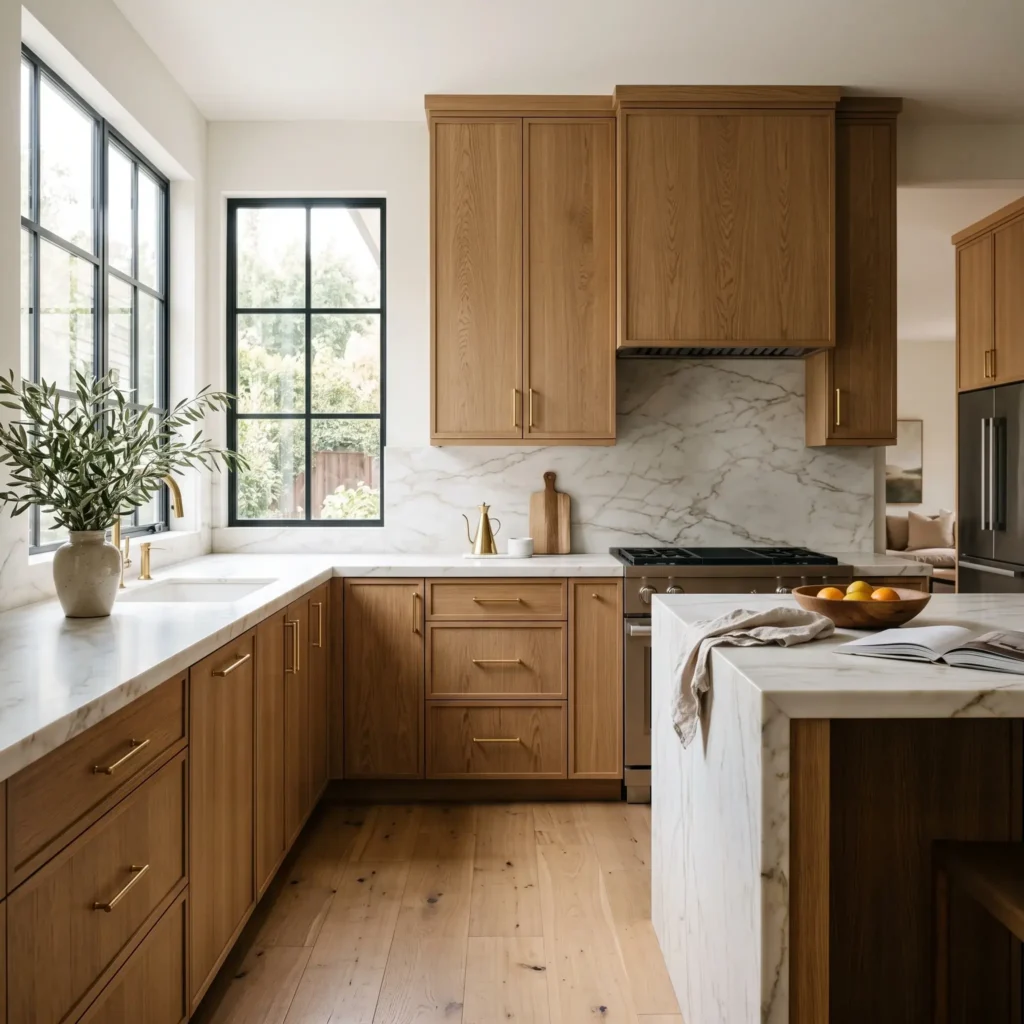
1. Rift-Sawn White Oak Slim Shaker with Calacatta Marble
This design pairs pale white oak with slender frame profiles. Traditional shaker doors feature wide two-and-a-half-inch frames. This modern variation uses a slim half-inch frame, creating clean shadow lines without visual bulk. Honed Calacatta marble provides bold gray and taupe veining that matches the cool tan tones of raw oak.
- Products and Materials Used:
- Cabinetry: Rift-sawn white oak with half-inch micro-shaker profiles
- Finish: Ultra-matte non-yellowing 2K conversion varnish (5% sheen)
- Countertops and Backsplash: Honed Calacatta Gold marble slab
- Hardware: Brushed unlacquered brass linear pulls
- Flooring: Wide-plank white oak finished one shade darker than cabinets
- Lighting: Recessed warm ceiling spotlights (2700K) and under-cabinet LED strips
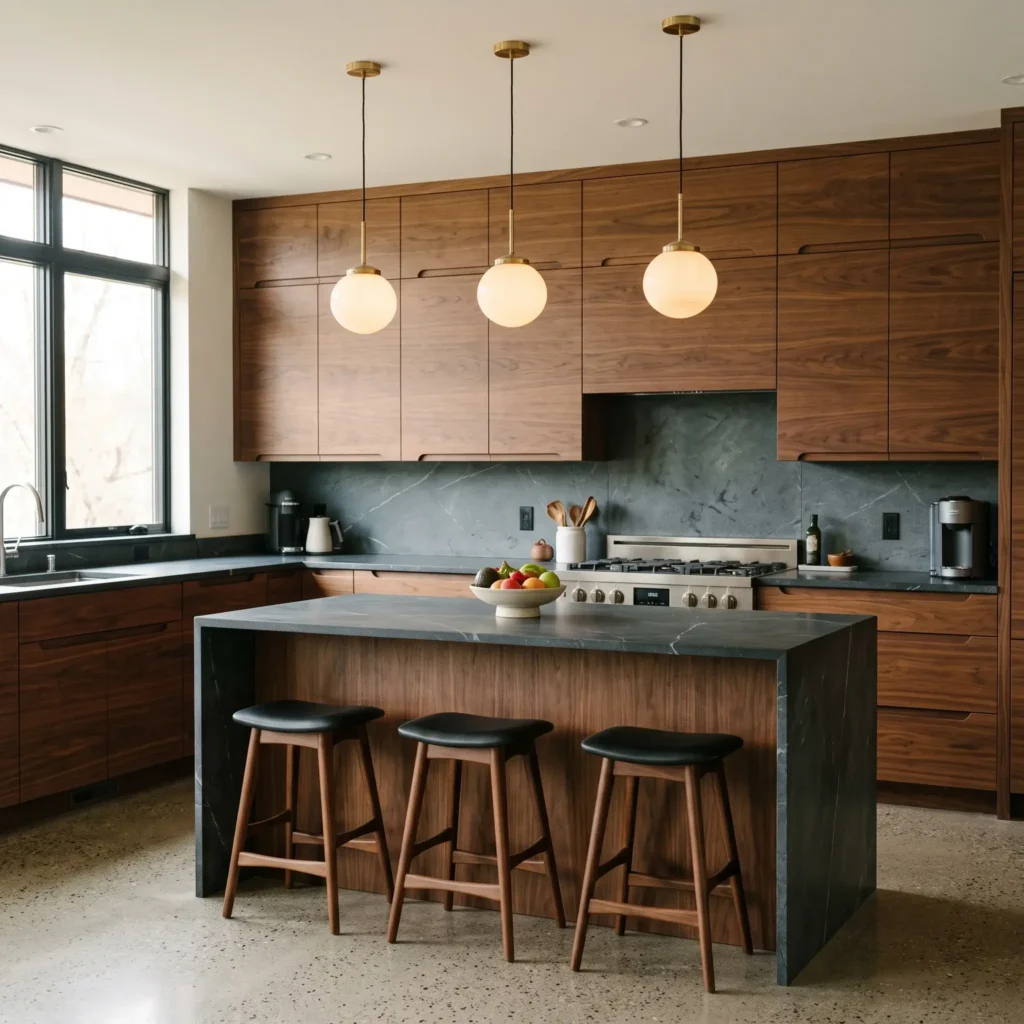
2. Mid-Century Walnut Slab with Continuous Horizontal Grain
This layout focuses on natural grain flow across flat cabinet faces. Woodworkers sequence consecutive walnut veneer sheets horizontally across door and drawer runs. The rich cocoa and charcoal heartwood tones establish a clean, architectural focal point that anchors large, open kitchens.
- Products and Materials Used:
- Cabinetry: American black walnut flat slab doors with sequenced book-matched grain
- Core Substrate: Balanced MDF core with matching walnut edge banding
- Finish: Clear matte penetrating hardwax oil
- Countertops: Honed absolute black granite or dark soapstone
- Hardware: Integrated routed finger grooves (no surface metal pulls)
- Accents: Fluted glass upper cabinet doors with dark bronze frames
Check out more Modern Kitchen Ideas
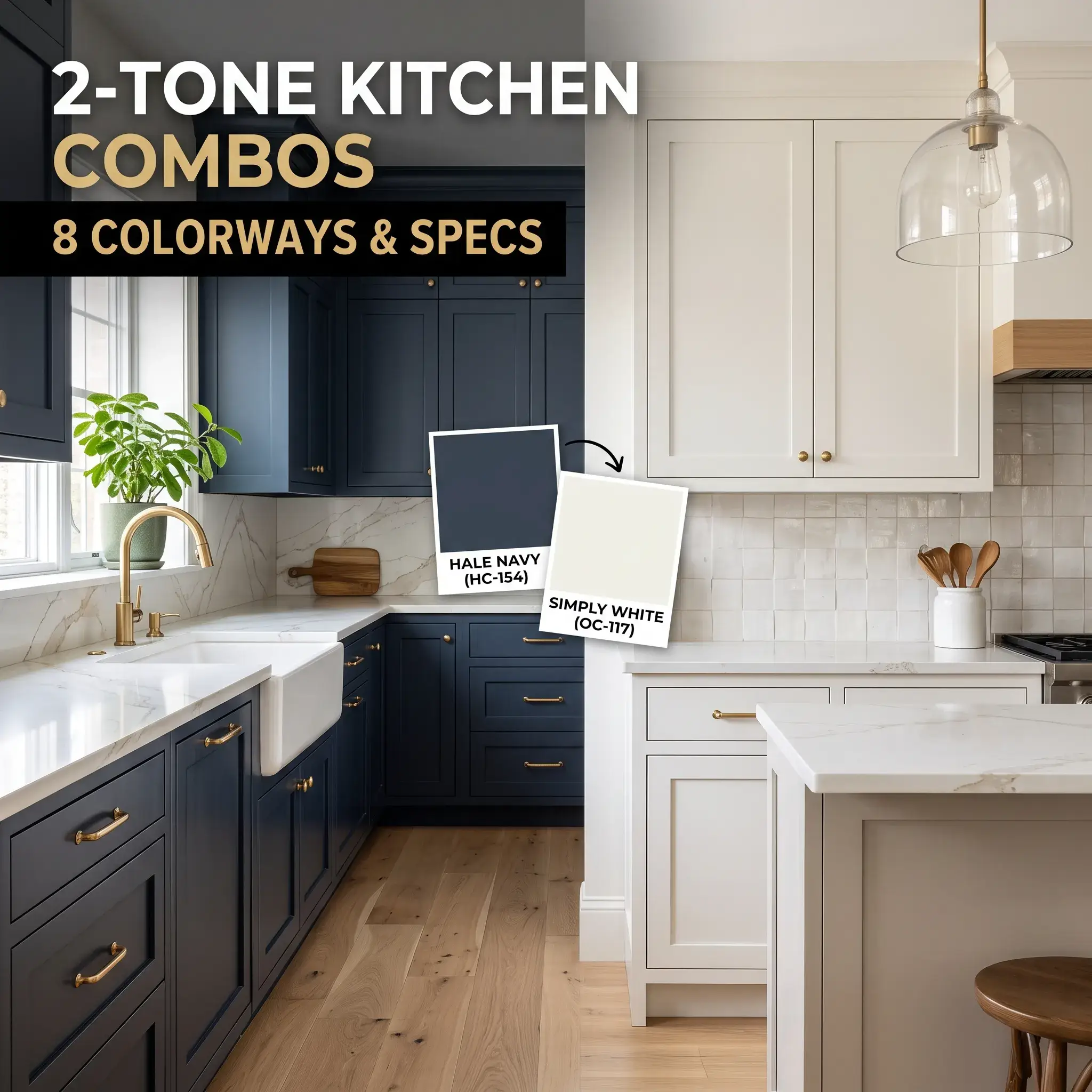
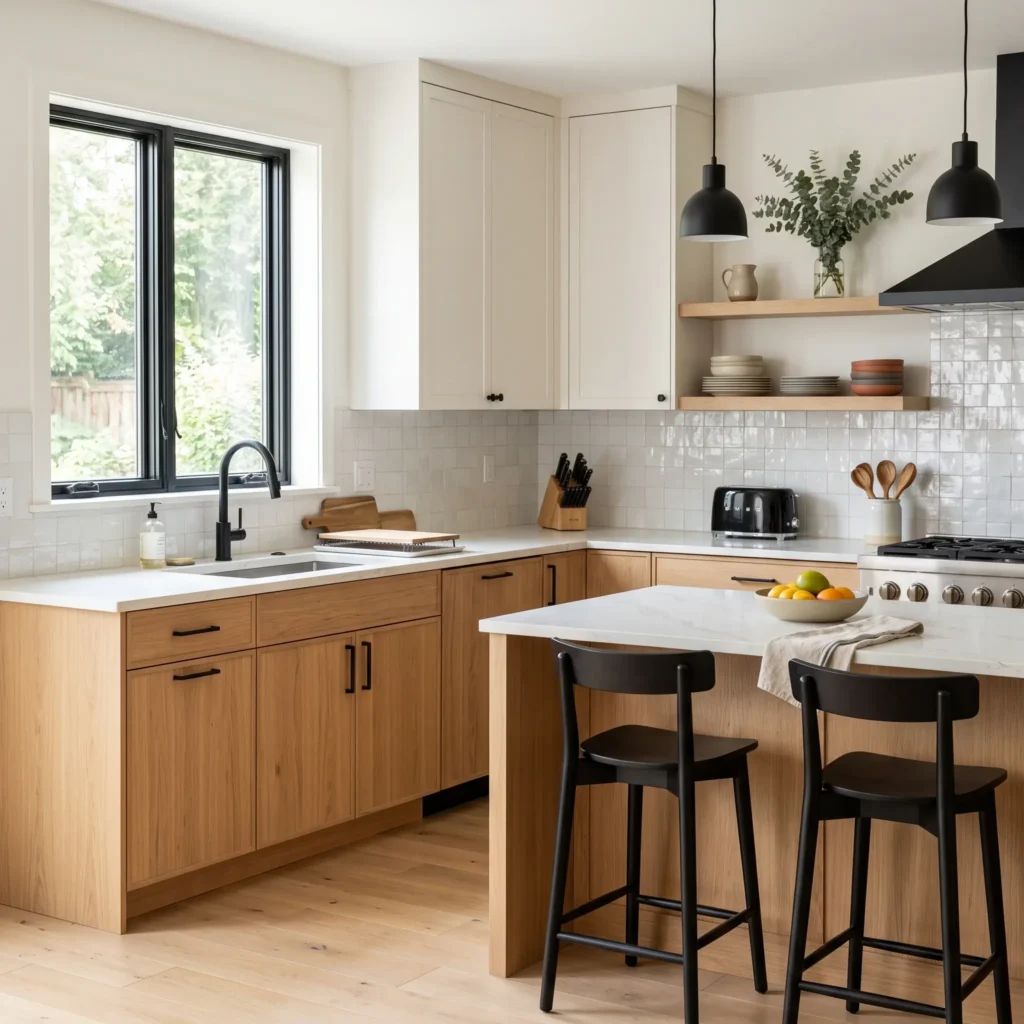
3. Two-Tone White Oak Lowers with Warm Alabaster Uppers
Two-tone kitchens provide visual balance. Placing wood on base cabinets grounds the room and conceals everyday foot-level scuffs. Painting upper cabinets in warm off-white reflects daylight and makes eight-foot ceilings feel significantly taller.
- Products and Materials Used:
- Base Cabinets: Natural white oak flat panels
- Upper Cabinets: Paint-grade maple finished in Sherwin-Williams Alabaster (matte)
- Countertops: Warm white engineered quartz with subtle gold veining
- Backsplash: Cream handmade zellige ceramic wall tiles
- Hardware: Matte black slim iron bar pulls
- Faucet: Matte black gooseneck pull-down kitchen faucet
4. Fluted White Oak Island with Honed Soapstone Counters
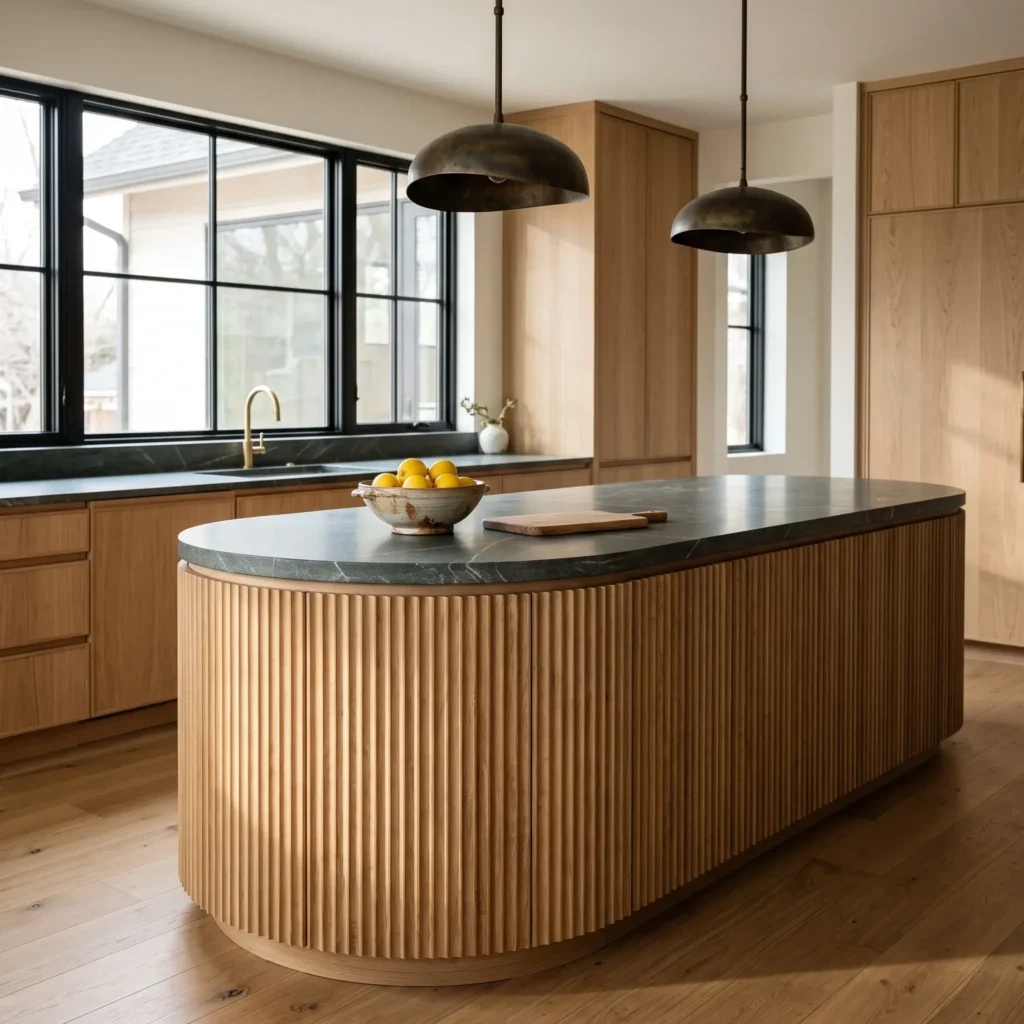
Textured wood surfaces break up flat drywall and smooth stone surfaces. This concept features a curved kitchen island clad in vertical fluted white oak slats. The perimeter cabinets stay simple to let the three-dimensional island woodwork act as the primary design feature.
- Products and Materials Used:
- Island Base: Solid white oak fluted tambour cladding
- Perimeter Cabinets: Plain-sliced white oak flat-panel slab
- Countertops: Honed charcoal soapstone with active white quartz veins
- Backsplash: Matte lime-wash plaster wall finish
- Hardware: Minimalist dark bronze tab pulls
- Stools: Oak counter stools with curved boucle upholstered seats
5. Bleached Ash Slab with Integrated Finger Pulls (Japandi Style)
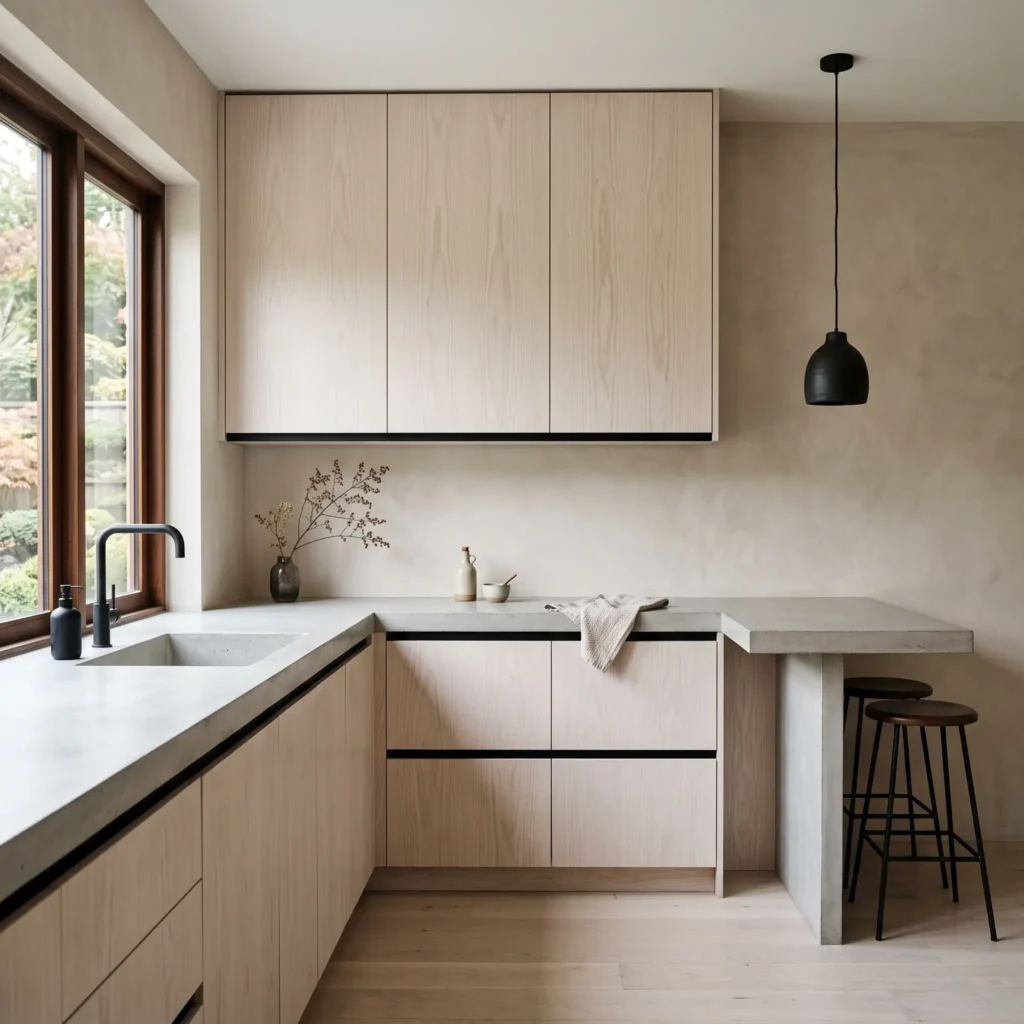
Japandi design merges Scandinavian functional minimalism with Japanese organic balance. Bleaching removes yellow casts from white ash, creating a serene, desaturated biscuit tone. Recessed aluminum Gola channels eliminate handles, leaving pure wood planes.
- Products and Materials Used:
- Cabinetry: Bleached white ash veneer on high-density core
- Door Style: Full-overlay flat slab with concealed European hinges
- Hardware System: Anodized black aluminum Gola channel system
- Countertops: Pale gray poured concrete with sealed satin finish
- Backsplash: Full-height waterproof microcement in neutral greige
- Accent: Recessed niche with matte black tea set
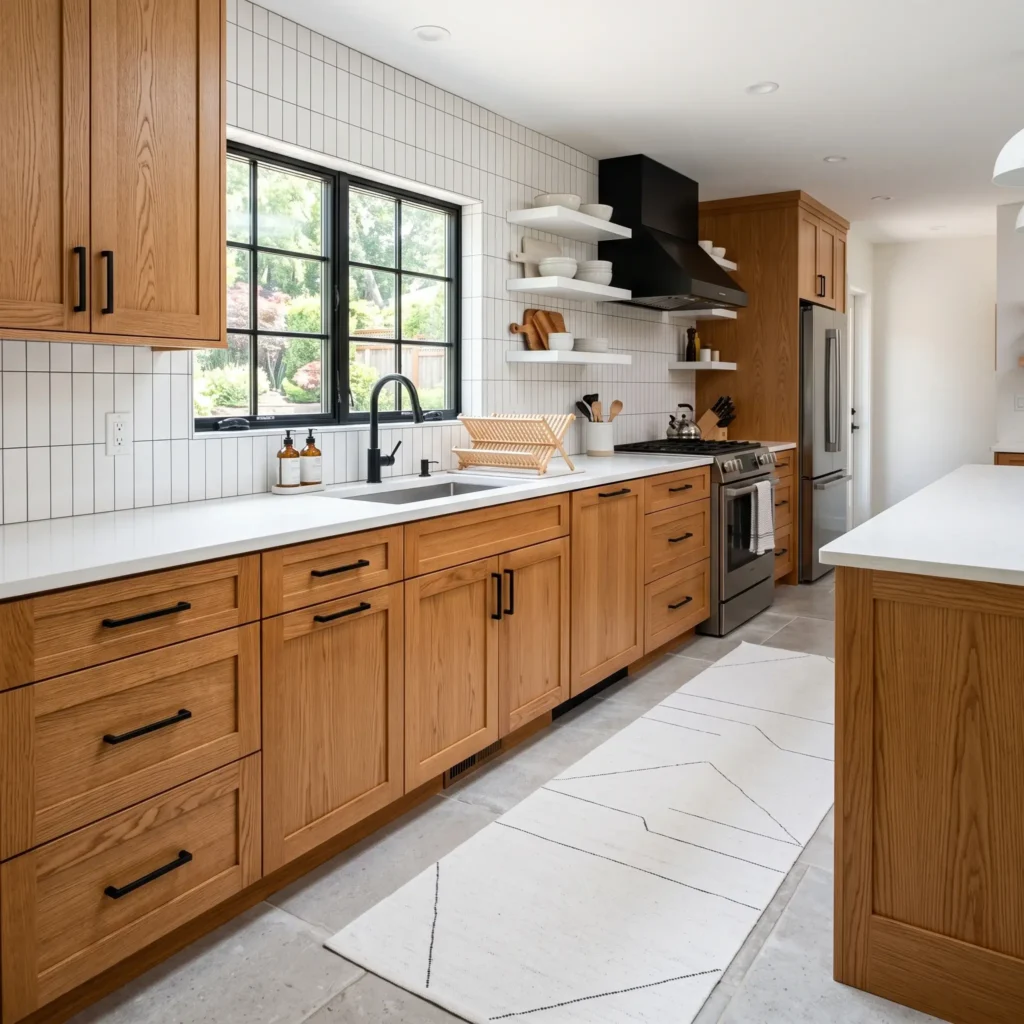
6. Modernized Honey Oak with Matte Black Framing and White Quartz
Honey oak does not need to feel outdated. This design modernizes warm golden tones by pairing flat-grain oak with crisp white quartz and black accents. The matte black hardware and dark window frames neutralize yellow tones and add architectural contrast.
- Products and Materials Used:
- Cabinetry: Clear-coated golden red oak with square shaker profiles
- Countertops: Pure white quartz with subtle cool gray flecks
- Backsplash: White vertical stacked ceramic tiles with matching white grout
- Hardware: Matte black square metal knobs and pulls
- Sink: Undermount composite black granite sink
- Lighting: Flush-mount black metal directional spotlights
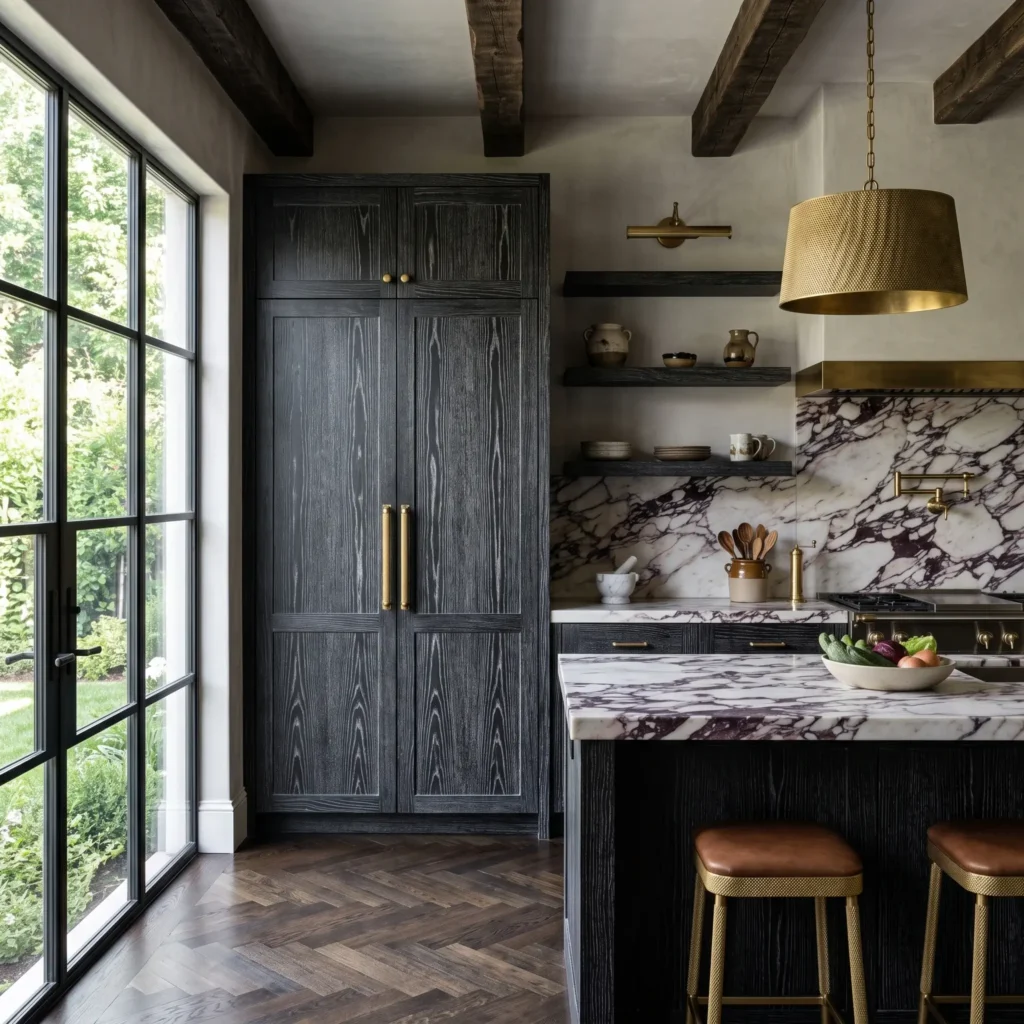
7. Cerused Black Oak with Brushed Brass Accents
Cerused wood uses contrasting pigment to highlight natural grain lines. Wire-brushing clears out soft grain channels before a light or dark wash is applied. Here, charcoal-stained oak features white-limed grain pores, providing rich visual depth under bright lighting.
- Products and Materials Used:
- Cabinetry: Rift-cut white oak wire-brushed with black stain and white liming wax
- Door Style: European frameless full-overlay slab
- Countertops: Calacatta Viola marble with dark burgundy veining
- Hardware: Heavy knurled solid brass bar handles
- Appliances: Built-in panel-ready refrigerator with matching cerused fronts
- Flooring: Light chevron-patterned French oak flooring
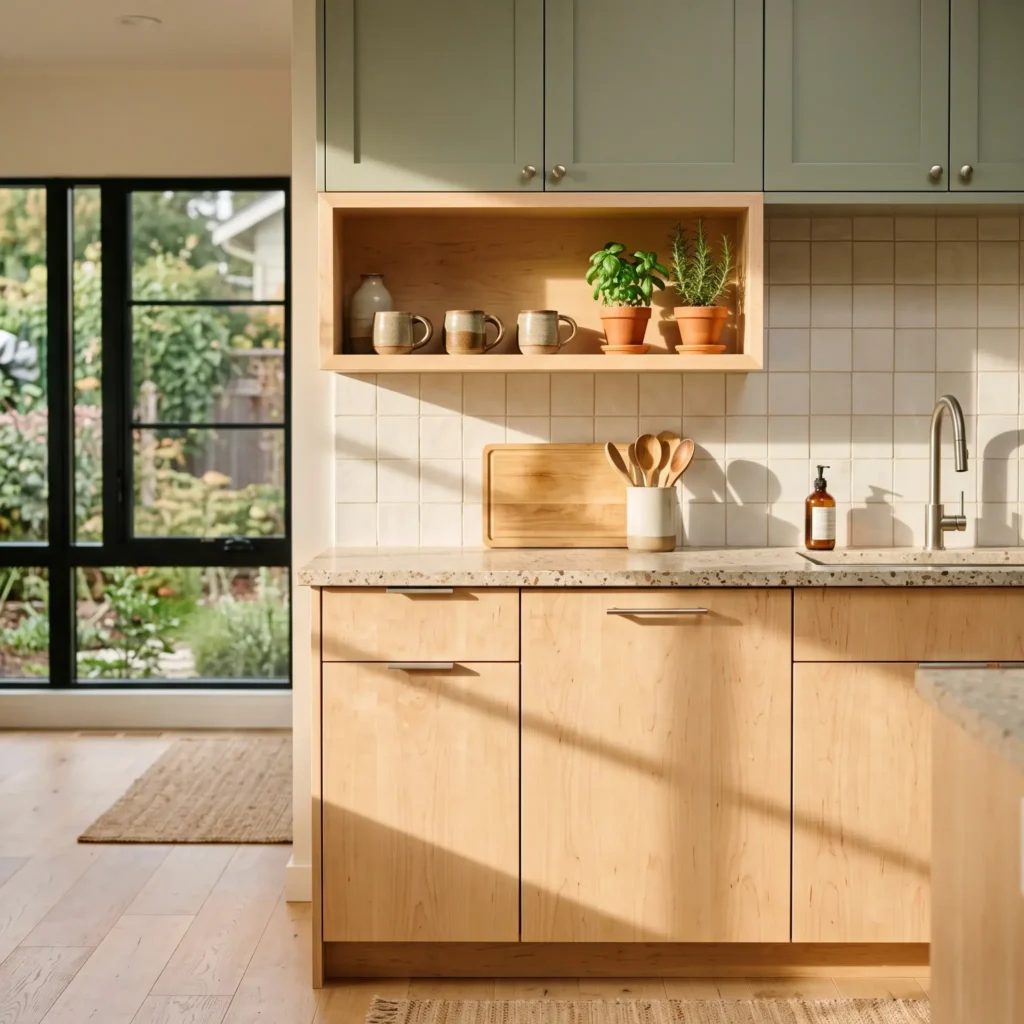
8. Natural Hard Maple Slab with Muted Sage Green Accents
Hard maple offers an ultra-fine, uniform pore structure with minimal grain variation. Its blonde, clean appearance pairs naturally with muted earthy colors. This layout uses maple for main work zones and soft sage green for the pantry wall.
- Products and Materials Used:
- Perimeter Cabinets: Natural clear-coated hard maple flat slab
- Accent Wall Cabinets: Paint-grade maple in Benjamin Moore October Mist
- Countertops: Honed terrazzo with green, white, and quartz flecks
- Backsplash: 4×4 inch square glazed green ceramic tiles
- Hardware: Satin brushed nickel cup pulls and matching latch hardware
- Shelving: Floating solid maple open shelves with concealed brackets
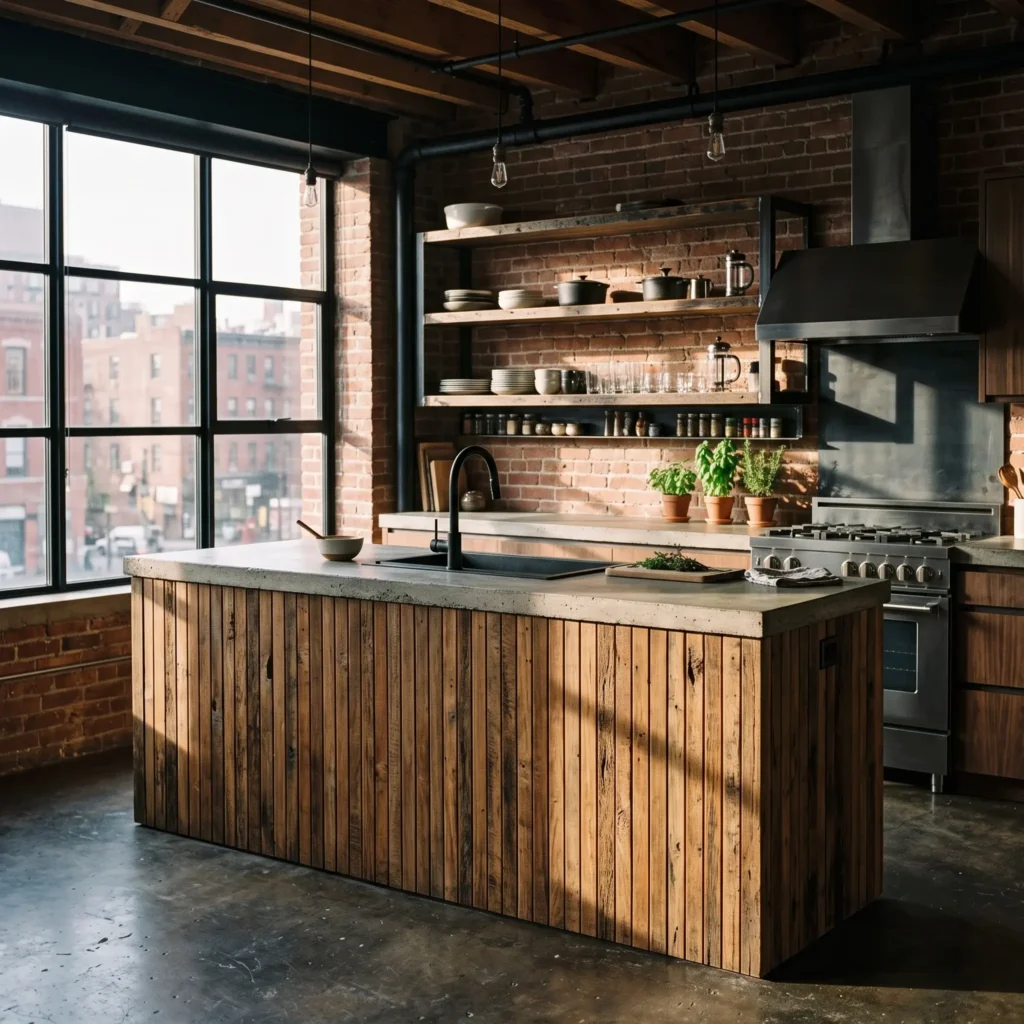
9. Reclaimed Teak Slat Island with Terrazzo and Concrete
Reclaimed timber brings rich history and warm character into modern homes. Weathered teak boards are milled into narrow slats on the island face. The natural oil content of teak resists daily spills around preparation sinks.
- Products and Materials Used:
- Island Cladding: Reclaimed teak narrow vertical slats with clear matte sealer
- Wall Cabinets: Matte dark charcoal laminate with timber edge banding
- Countertops: Light gray cast concrete with sealed matte finish
- Backsplash: Raw exposed brick wall sealed with matte clear coat
- Hardware: Integrated touch-to-open cabinet latches
- Lighting: Industrial black steel cord pendants with exposed filament bulbs
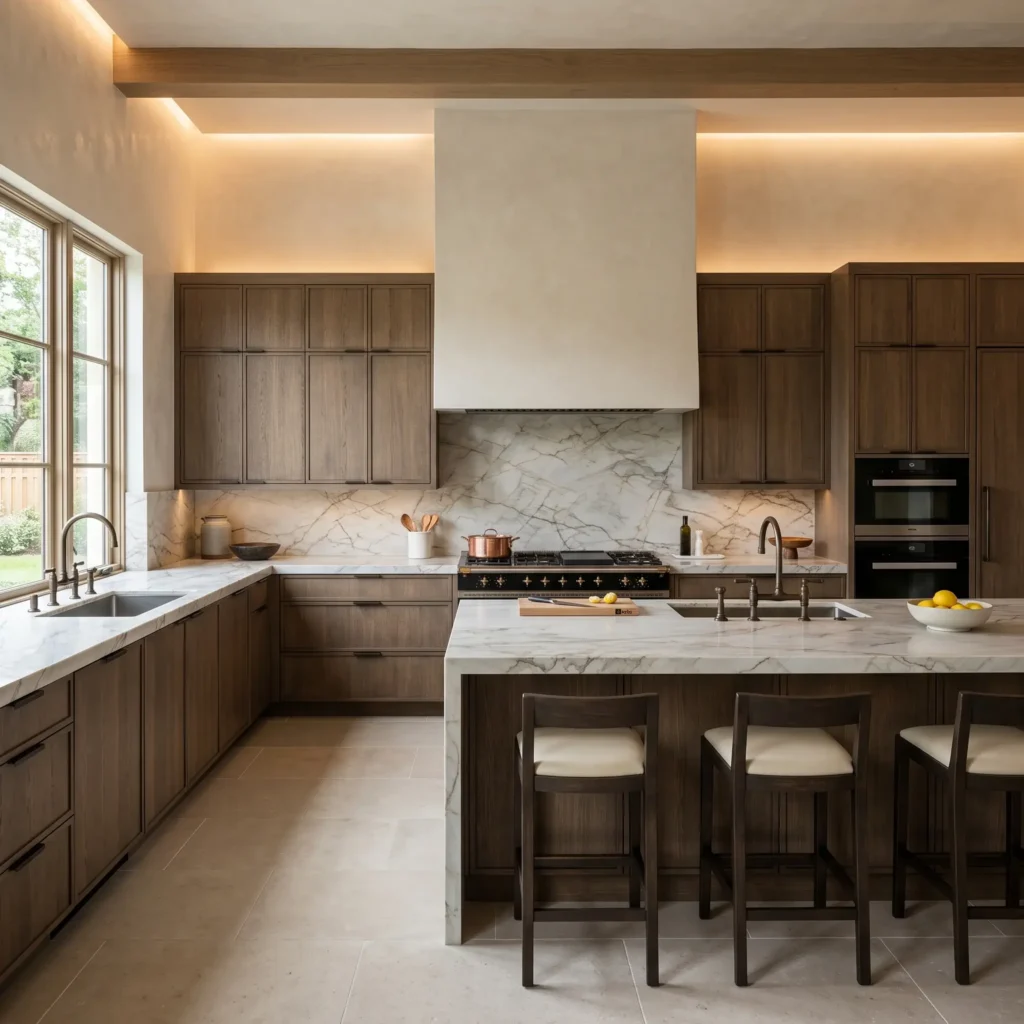
10. Smoked Oak Cabinets with Full-Height Quartzite Backsplash
Smoking or fuming oak reacts with natural tannins inside the wood to darken the fibers without obscuring the grain. The result is a smoky taupe tone without red or orange casts. Running stone slabs up to the ceiling creates a clean, monolithic backdrop.
- Products and Materials Used:
- Cabinetry: Fumed European oak veneer on moisture-resistant MDF core
- Door Style: Modern three-eighths-inch micro-shaker
- Countertops and Backsplash: Honed Taj Mahal quartzite full-height slab
- Hardware: Antique bronze recessed edge pulls
- Range Hood: Custom plaster box hood matching wall color
- Flooring: Large format limestone floor tiles
Hardwood Species Selection: Hardness, Grain, and Stability
Choosing the right wood species involves more than picking a stain color. Hardwoods vary in cellular density, moisture absorption, and stability.
The Janka hardness scale measures timber dent resistance. It calculates the pounds-force (lbf) needed to embed an 11.28-millimeter steel ball halfway into the wood. Kitchen base cabinets require species with ratings above 1,000 lbf to withstand cookware impacts and heavy use.
| Hardwood Species | Janka Rating (lbf) | Cellular Porosity | Dimensional Stability | Stain & Finish Response | Recommended Kitchen Application |
| Hickory | 1,820 | Ring-porous (Coarse) | High density | Best with clear stains; difficult to paint | High-impact spaces, rustic modern islands |
| Hard Maple | 1,450 | Diffuse-porous (Closed) | Superior (0.12% movement) | Excellent for paint; dark wipe stains blotch | High-wear modern slabs, painted shaker frames |
| White Oak | 1,360 | Ring-porous (Tyloses-rich) | High across humidity shifts | Superior for cerusing and desaturated stains | Scandinavian, Japandi, transitional slab runs |
| White Ash | 1,320 | Ring-porous (Open) | Moderate to High | Excellent for clear coats and light Nordic stains | Modern flat panels, pale bleached runs |
| Red Oak | 1,290 | Ring-porous (Open pores) | Moderate | Absorbs stain quickly; strong grain lines | Value-engineered runs, traditional styles |
| Black Walnut | 1,010 | Semi-diffuse (Medium) | High once cured | Optimal with clear topcoats; avoid stains | Modern flat slab runs, feature islands |
| Black Cherry | 950 | Diffuse-porous (Satiny) | High seasonal stability | Naturally darkens with sun; clear coats best | Transitional runs, traditional cabinetry |
| Red Alder | 590 | Diffuse-porous (Uniform) | Low to Moderate | Absorbs stains evenly to mimic other woods | Secondary low-wear cabinetry runs |
Anatomical Differences That Matter in Kitchens
White oak and red oak behave differently around moisture. White oak contains tyloses, which are microscopic cellular growths that block its vascular tubes. This internal structure makes white oak naturally resistant to moisture rot and liquid spills.
Red oak lacks tyloses. Its open vascular pores act like hollow straws that pull in liquids and dark spills. Red oak also features heavy pink undertones that clash with neutral modern paints.
Hard maple features closed, ultra-fine pores. It has a tiny 0.12% seasonal deformation rate, making it an exceptional substrate for painted face frames. However, dark wipe-on stains absorb unevenly across maple, resulting in a blotchy appearance unless sealed first.
Black walnut is softer than oak but offers exceptional dimensional stability once kiln-dried. Sunlight gradually lightens walnut over several years, softening rich chocolate tones into warm bronze hues. In contrast, black cherry oxidizes rapidly, shifting from light pinkish-tan to deep reddish-amber within twelve months of exposure to natural light.
Structural Substrate Engineering: Solid Wood vs. Engineered Cores
Many homeowners assume solid hardwood is the superior choice for every part of a cabinet. In architectural millwork, that assumption leads to warped doors.
Wood expands and contracts across its grain in response to seasonal indoor humidity shifts. A standard 24-inch solid flat hardwood panel will expand and contract between 2 and 4 millimeters throughout the year. If glued rigidly into a flat frameless cabinet door, that movement forces the panel to cup, twist, or bind against adjoining doors.
| Cabinet Component | Recommended Substrate | Structural Reason |
| Modern Slab Doors | Architectural Veneer on MDF Core | Isotropic core prevents warping across seasonal humidity swings. |
| Five-Piece Shaker Doors | Solid Hardwood Stiles and Rails with Veneer Center | Floating center panel allows natural seasonal movement inside grooves. |
| Cabinet Box / Carcass | 18mm Baltic Birch Multi-Ply Plywood | Cross-laminated veneer layers provide maximum screw retention and shelf strength. |
| Drawer Boxes | Solid Hard Maple or Birch (Dovetail Joinery) | High tensile strength and impact resistance against heavy cookware loads. |
| Open Shelves | Solid White Oak or Walnut | Resists sagging across long unsupported spans while showing authentic edge grain. |
For large, flat-panel cabinet doors, architectural veneer on a Medium-Density Fiberboard (MDF) core is the industry standard. MDF is isotropic, meaning it exhibits uniform physical properties in all directions. It does not move with humidity changes. Bonded face veneers deliver genuine wood grain while the engineered core keeps the door flat.
Reserve solid hardwood for five-piece door frames, visible face frames, and open floating shelving. In five-piece doors, the center panel sits unglued in perimeter grooves, allowing it to expand and contract naturally without damaging the door frame.
Protective Coating Chemistry: Stopping Yellow and Orange Tones
The common complaint regarding older wood cabinets is their yellow or orange discoloration. This issue stems from finish chemistry rather than the wood itself.
Why Wood Turns Orange
Traditional oil-based polyurethanes contain drying oils that oxidize over time. Exposure to ambient oxygen and ultraviolet light causes these resins to amber into a strong orange cast.
White oak also contains high levels of hydrolyzable tannic acid. When standard water-based finishes are sprayed directly onto raw oak, the water draws soluble tannins to the surface. This chemical reaction, known as tannin pull, creates greenish-brown or yellowish blotches on the timber face.
The Protective Coating Standard
To keep wood looking natural and raw for decades, finish specifications must include two elements:
- Stain-Blocking Barrier Sealers: A solvent-based washcoat or specialized acrylic primer locks tannic acids inside the cellular pores before the final topcoat application.
- 2K Acrylic Conversion Varnish: This two-component finish cures through chemical crosslinking when an acid catalyst is mixed into an acrylic resin base. Modern commercial conversion varnishes contain benzotriazole ultraviolet absorbers. These compounds filter out sunlight rays, preventing both the wood fibers and the protective clear coat from yellowing.
For homeowners who prefer a raw, tactile wood feel, two-part hardwax oils offer an open-pored alternative. These formulations bond directly to cellulose fibers and buff to an ultra-matte sheen. While hardwax finishes require gentle cleaning, they allow homeowners to spot-repair scuffed areas using a buffing pad without stripping the entire cabinet door.
Two-Tone Color Dynamics and Surface Pairings
Combining natural wood with painted cabinets or stone surfaces requires careful undertone coordination. Natural timber acts as a strong visual element; adjacent surfaces should complement its warmth rather than compete with it.
Two-Tone Layout Formulas
- Ground the Base: Place wood cabinetry on base cabinets and islands. Lower cabinets endure foot kicks, spills, and vacuum bumps. Hardwoods resist scuffs better than painted surfaces. Keep upper cabinets light using creamy whites or pale greiges to keep the room feeling open.
- The Monochromatic Island Anchor: In open-concept spaces, finish perimeter cabinets in a solid neutral paint like soft mushroom or warm white. Wrap the central island in rich walnut or fluted oak. This treatment turns the island into a piece of architectural furniture that ties into adjoining dining and living areas.
Pairing Wood Cabinets with Hardwood Flooring
Installing wood cabinets over hardwood flooring creates a risk of visual monotony. If the wood tones are too similar, surfaces blend together awkwardly.
- Apply the Two-Shade Contrast Rule: Select a floor color that is at least two shades lighter or darker than the cabinetry. Pair natural white oak cabinets with dark fumed oak flooring, or pair dark walnut cabinets with pale, natural ash floors.
- Break the Ground Plane: If the cabinets and flooring share identical wood species, separate them visually using an island with a contrasting stone waterfall edge, or introduce a perimeter border of neutral stone floor tile.
Hardware Temperature Pairings
- Cool Black Walnut: Pairs naturally with unlacquered brass, satin bronze, and polished nickel.
- Warm White Oak: Pairs well with matte black iron, brushed graphite, and aged bronze.
- Blonde Hard Maple: Complements satin brushed nickel, pewter, and matte white pulls.
Durability Standards and Cabinet Maintenance
High-performance kitchen millwork must withstand humidity spikes, high heat, and food acid spills. Verifying cabinet construction quality starts with official industry testing benchmarks.
ANSI/KCMA A161.1 Performance Benchmarks
The Kitchen Cabinet Manufacturers Association (KCMA) establishes durability guidelines under the ANSI/KCMA A161.1 standard. Cabinets earning this certification pass rigorous laboratory stress tests:
- Thermal Shock Resistance: Cabinet doors endure five continuous cycles of two hours at 120 degrees Fahrenheit and 70 percent humidity, followed immediately by one hour in a cold box at -5 degrees Fahrenheit. Finishes must show zero blistering, cracking, or checking.
- Chemical Spot Resistance: Finishes withstand 24 hours of exposure to lemon juice, vinegar, 100-proof alcohol, olive oil, and coffee without staining or softening.
- Structural Weight Loads: Wall cabinet box joints must support 600 pounds of distributed weight without joint separation. Drawers must complete 25,000 mechanical extension cycles under loaded weight without hardware failure.
Real-World Kitchen Protection Rules
- Install Heat Deflector Shields Near Ovens: Self-cleaning oven cycles push internal temperatures above 900 degrees Fahrenheit. Escaping heat can peel finish edges on adjacent cabinet boxes. Install metal heat-deflector strips along cabinet face frames next to built-in wall ovens and ranges.
- Manage Countertop Appliance Steam: High-pressure steam from coffee makers, electric kettles, and pressure cookers penetrates wood joints and causes premature finish failure. Pull small steam-generating appliances forward past the front edge of upper wall cabinets before turning them on.
- Maintain Indoor Relative Humidity: Keep indoor humidity levels between 35 and 55 percent at 68 to 75 degrees Fahrenheit. Stable humidity keeps joinery seams tight and prevents door warpage.
- Safe Surface Cleaning: Clean wood cabinetry using a soft microfiber cloth dampened with warm water and mild, pH-neutral dish soap. Dry the surface immediately with a clean cotton towel. Avoid cleaning sprays containing ammonia, bleach, or silicone oils. Silicone penetrates protective coatings, making future touch-ups impossible.
Final Project Checklist
When planning a wood kitchen remodel, keep these core principles in mind:
- Check the Janka Rating: Select domestic hardwoods rated above 1,000 lbf for base runs and feature islands.
- Match Construction to Door Style: Use solid hardwood for five-piece floating frame doors. Insist on architectural veneer on an engineered core for modern flat-slab doors.
- Verify the Protective Coating: Avoid traditional ambering polyurethanes. Require a commercial conversion varnish with UV blockers to protect the raw timber tone.
- Balance Adjoining Surfaces: Offset cabinet wood tones from hardwood flooring by at least two shades, and coordinate hardware temperatures to complement the natural wood grain.
Frequently Asked Questions
Are wood kitchen cabinets in style for 2026?
Yes. Natural wood cabinets represent one of the dominant kitchen design directions. Current styles focus on light rift-sawn white oak, walnut, and ash finished in ultra-matte clear coats. Traditional high-gloss finishes and heavy orange stains remain outdated.
What is the best wood species for kitchen cabinets?
White oak is the premier choice for overall durability, water resistance, and style flexibility. It holds a 1,360 lbf Janka hardness rating, resists daily impacts, and contains natural tyloses that resist water absorption. Hard maple is the preferred choice for painted surfaces due to its dense, closed-pore structure.
How do I stop my natural wood cabinets from turning yellow?
Specify a two-component (2K) acrylic conversion varnish formulated with benzotriazole UV inhibitors. Additionally, apply a stain-blocking washcoat to white oak before applying topcoats. This barrier stops tannic acids from reacting with topcoats and prevents discoloration over time.
Are solid wood slab cabinet doors better than veneer doors?
No. Large flat slab doors made from solid wood will cup, warp, and bind because solid timber expands 2 to 4 millimeters across its grain with seasonal humidity shifts. High-quality slab doors use genuine hardwood veneer pressed over an engineered MDF or multi-ply core to ensure permanent structural stability.
What countertop color looks best with natural wood cabinets?
Honed white quartz, Calacatta marble, and pale quartzites like Taj Mahal work exceptionally well with natural wood. For high contrast, dark charcoal soapstone and honed black granite anchor light wood cabinets and add clean architectural definition.