8 Timeless Bathroom Aesthetic Ideas and How to Build Them
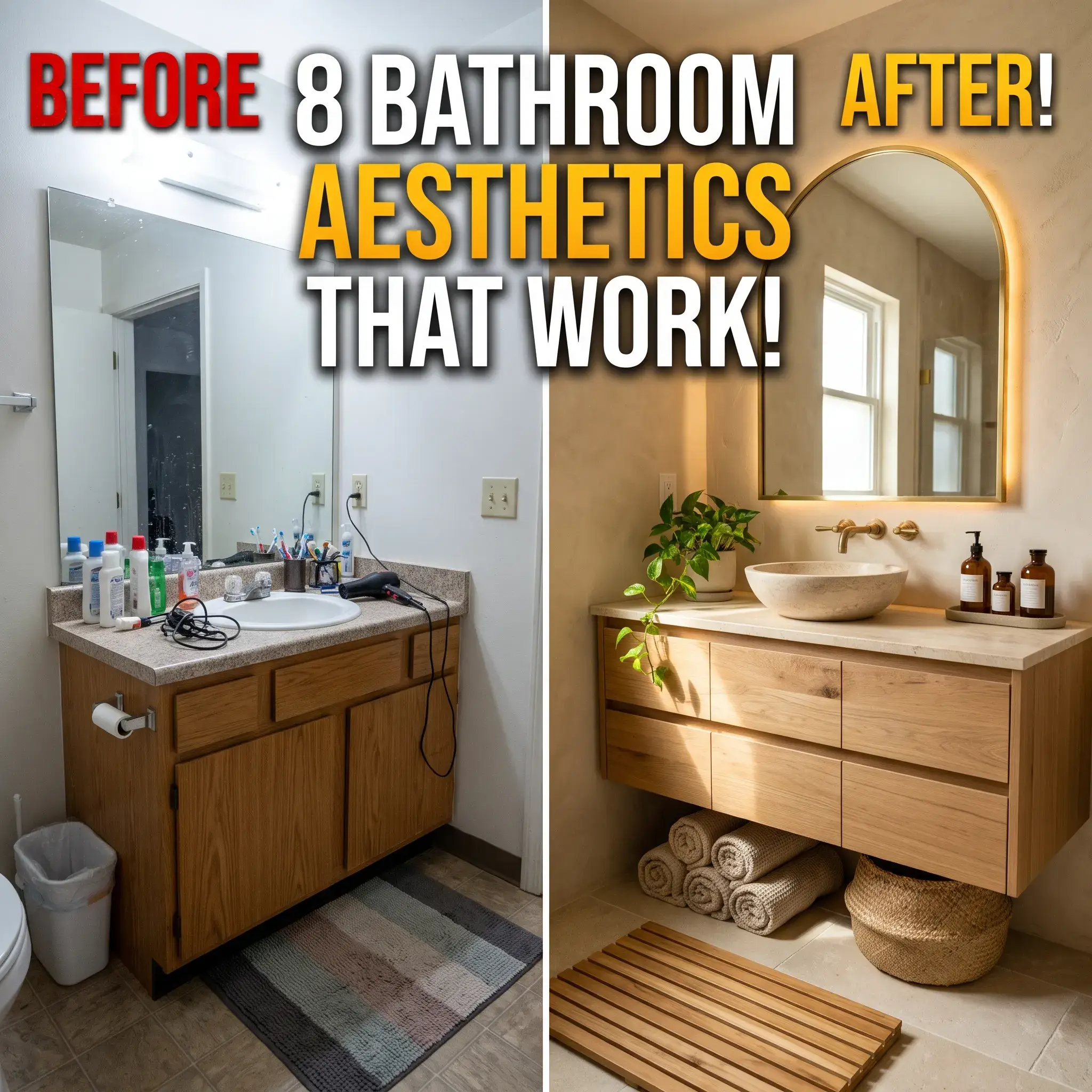
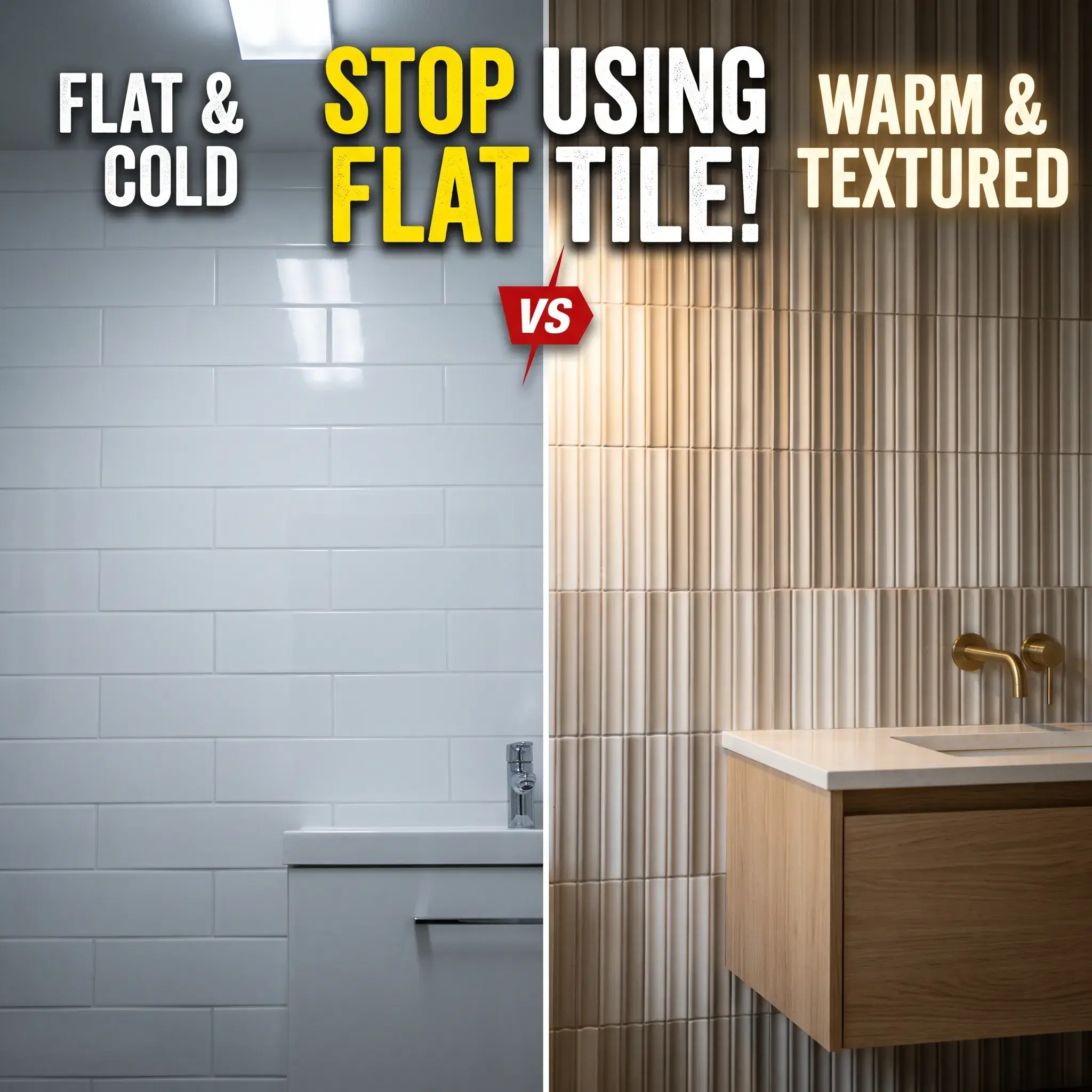
Most bathrooms feel cold, sterile, and cluttered. Standard builder mirrors, harsh overhead lights, and generic white subway tiles turn what should be a personal sanctuary into a purely functional wash box.
Creating a beautiful space does not require a massive budget or a full demolition crew. It requires a clear formula. Every successful space balances four specific elements: a tactile wall and floor base, a consistent hardware finish, warm natural millwork, and one anchor object that pulls your focus.
Here are 8 realistic bathroom aesthetic ideas you can adapt for your own home, complete with material formulas, shopping lists, and visual guides.
1. Modern Organic: Warm Limestone and Natural White Oak
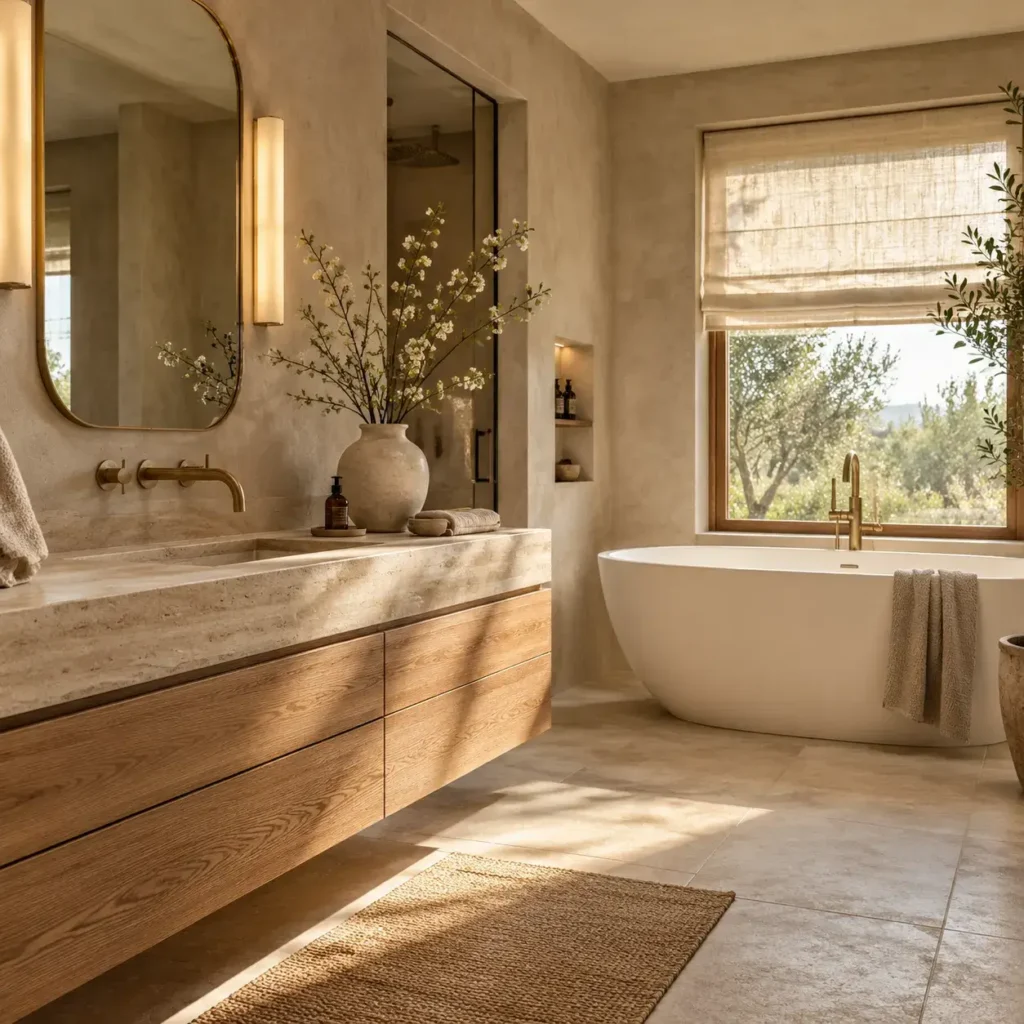
This design replaces cold gray surfaces with tactile, sun-warmed earth tones. It relies on natural stone textures and soft plaster finishes to make the room feel calm and grounded.
The design relies on a floating white oak vanity that keeps floor tiles visible from wall to wall. A thick-slab travertine countertop supports an undermount basin. Smooth, hand-troweled lime plaster coats the walls, catching soft natural light without any artificial shine.
- Base Envelope: Warm beige lime plaster walls, honed travertine countertops, and large-format ivory limestone floor tiles.
- Metal Hardware: Unlacquered brass widespread faucet and matching brass shower trim that develop a natural patina over time.
- Millwork: Rift-sawn white oak floating vanity with slab drawer fronts and finger-pull hardware.
- Anchor Object: A freestanding oval stone-resin soaking tub placed beneath a window.
Products Used in This Look
- Kohler Purist wall-mount or widespread faucet in unlacquered brass
- Custom or semi-custom rift-sawn white oak floating vanity (60-inch single sink)
- Honed ivory travertine vessel sink or slab countertop
- Badeloft freestanding stone-resin soaking tub (matte white)
- Handcrafted textured ceramic wall sconces with warm 2700K LED bulbs
- Heavyweight waffle-weave Turkish bath sheets in natural oat
2. Japandi Sanctuary: Minimalist Microcement and Cedar Accents
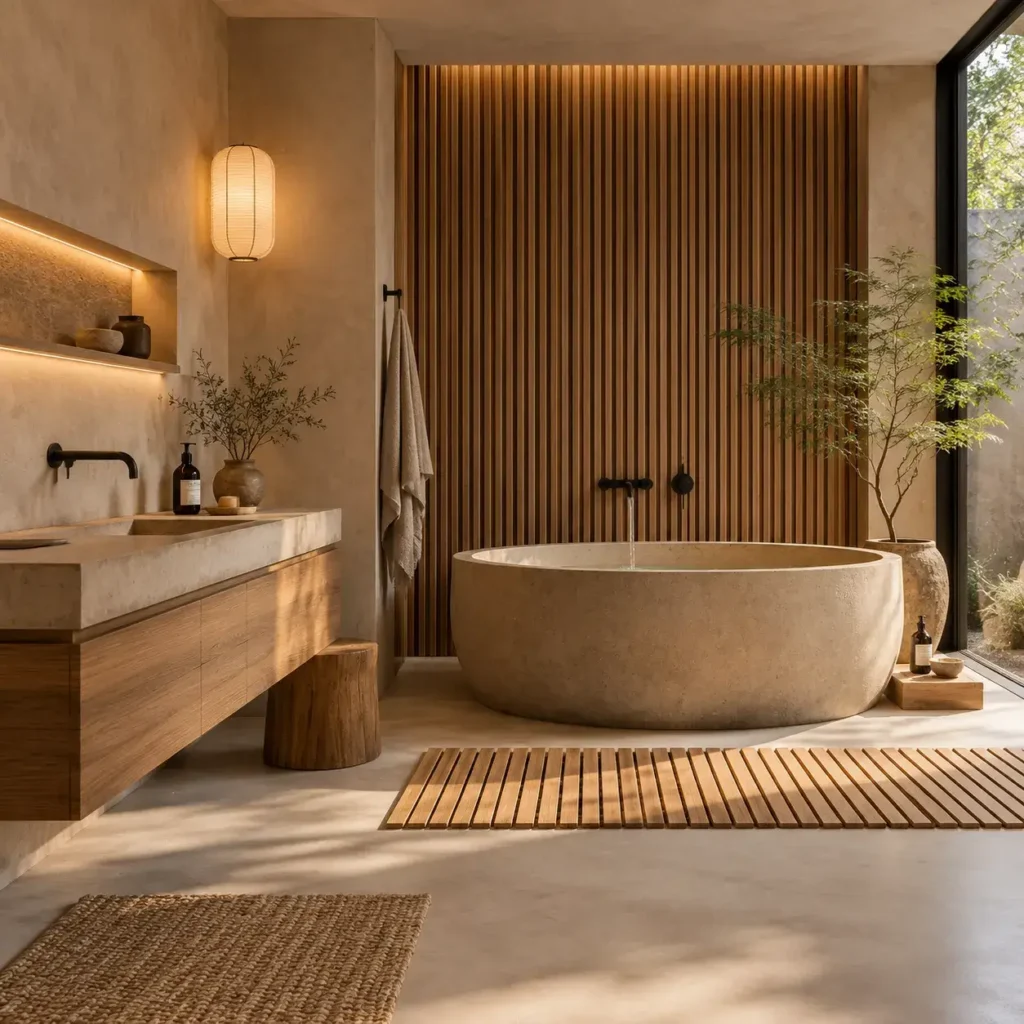
Japandi blends Scandinavian comfort with Japanese wabi-sabi principles. It focuses on visual quiet, functional storage, and organic imperfection.
This style uses joint-free microcement across both the walls and the floor. This eliminates busy grout grids entirely. Cedar duckboards and vertical timber slats add organic warmth, while dark matte metal fixtures give the neutral palette a crisp, modern outline.
- Base Envelope: Seamless oat-colored microcement across walls and floors with an accent wall of sealed Hinoki cedar slats.
- Metal Hardware: Blackened steel or deep gunmetal wall-mounted basin mixer.
- Millwork: Handleless wall-hung timber vanity with a concealed push-to-open drawer system.
- Anchor Object: A deep circular Japanese-style soaking tub paired with a slatted cedar floor mat.
Products Used in This Look
- Wall-mounted minimalist cylindrical basin faucet in ultra-matte gunmetal
- Round freestanding matte stone soaking tub (48-inch diameter)
- Custom waterproof cedar vertical wall paneling
- Slatted teak or hinoki cedar bath runner
- Concealed in-wall medicine cabinet with a frameless mirrored door
- Washi paper lantern wall sconce with a warm dimmable driver
Check out more Bathroom Ideas
3. Minimalist Spa: Monolithic Slabs and Walk-In Wet Zone
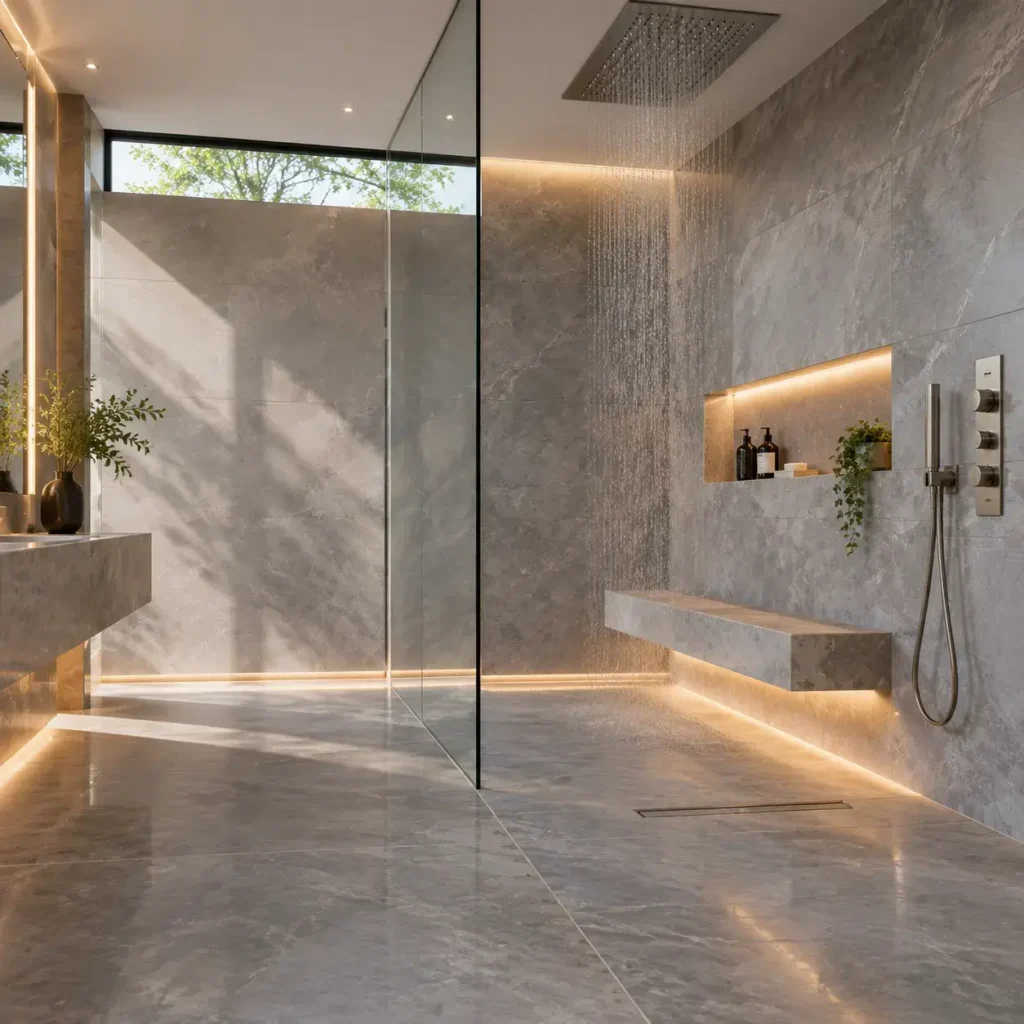
This style strips away decorative distractions. It mimics a high-end luxury resort spa by using unbroken stone surfaces and concealed fixtures.
The layout centers on an open curbless shower and bathtub zone framed by extra-large porcelain slabs. Standard shower curbs and framed glass doors disappear in favor of a single fixed panel of low-iron glass. Countertops remain completely clear by placing everyday items inside deep vanity drawers equipped with internal power outlets.
- Base Envelope: 24×48 inch matte porcelain wall slabs in mist gray with matching epoxy grout.
- Metal Hardware: Brushed platinum or matte stainless steel flush-mount thermostatic shower controls.
- Millwork: Push-to-open vanity finished in light stone composite with an integrated trough sink.
- Anchor Object: A ceiling-flush rainfall shower plate centered beside a floating solid-stone bench.
Products Used in This Look
- Flush ceiling-mounted square rainfall shower head (16-inch, brushed stainless steel)
- Linear wall-to-wall stainless steel shower channel drain
- Single-panel 1/2-inch thick frameless glass shower partition
- Integrated Corian or engineered stone double-trough vanity sink
- Concealed under-cabinet LED light channels (warm 2700K)
- Stone soap dish and matte stoneware pump bottles
4. English Cottage Revival: Sage Beadboard and Checkerboard Marble
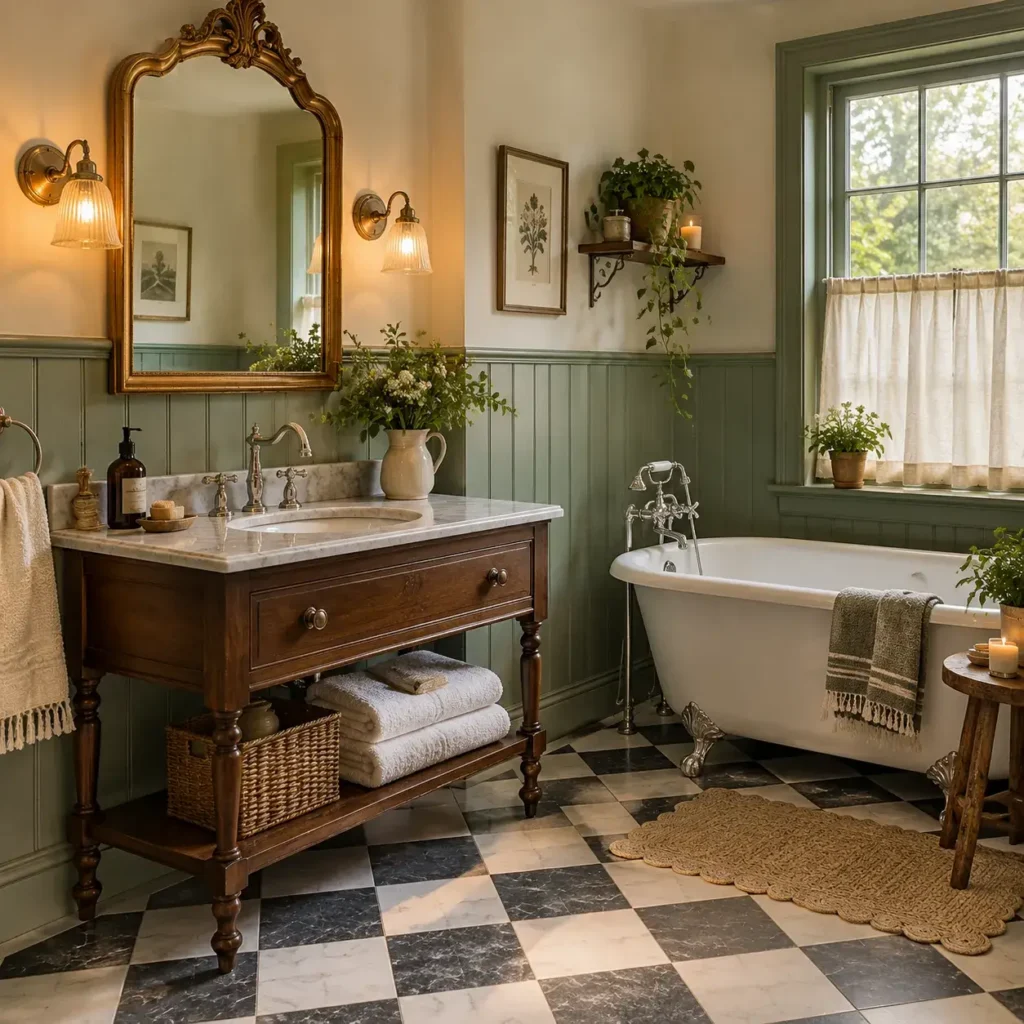
This aesthetic brings heritage warmth, color, and character back into the bathroom. It avoids stark modern lines in favor of classic proportions and traditional craftsmanship.
Beadboard wainscoting runs along the lower third of the room, painted in an earthy sage green. The floor features a classic checkerboard pattern using honed Carrara white and Nero Marquina black marble tiles. An antique wooden washstand serves as the vanity, crowned with a heritage bridge faucet.
- Base Envelope: Lower wall painted wood beadboard in sage green, soft cream upper walls, and honed marble checkerboard flooring.
- Metal Hardware: Polished nickel or aged brass bridge faucet with ceramic hot and cold indices.
- Millwork: Converted vintage mahogany or oak dresser with a drop-in marble sink.
- Anchor Object: A cast-iron double-ended clawfoot tub with an exterior painted in deep forest green.
Products Used in This Look
- Sherwin-Williams Clary Sage or Farrow & Ball French Gray paint for wainscoting
- Honed 12×12 inch Carrara and Black Marquina marble floor tiles
- Heritage deck-mount or wall-mount bridge faucet in polished nickel
- Cast-iron roll-top clawfoot tub with ball-and-claw feet
- Gathered linen cafe curtain on a slender brass sash rod
- Pair of pleated silk mini-sconces flanking an ornate gilded wood mirror
5. Dark and Moody: Charcoal Zellige and Rich Walnut
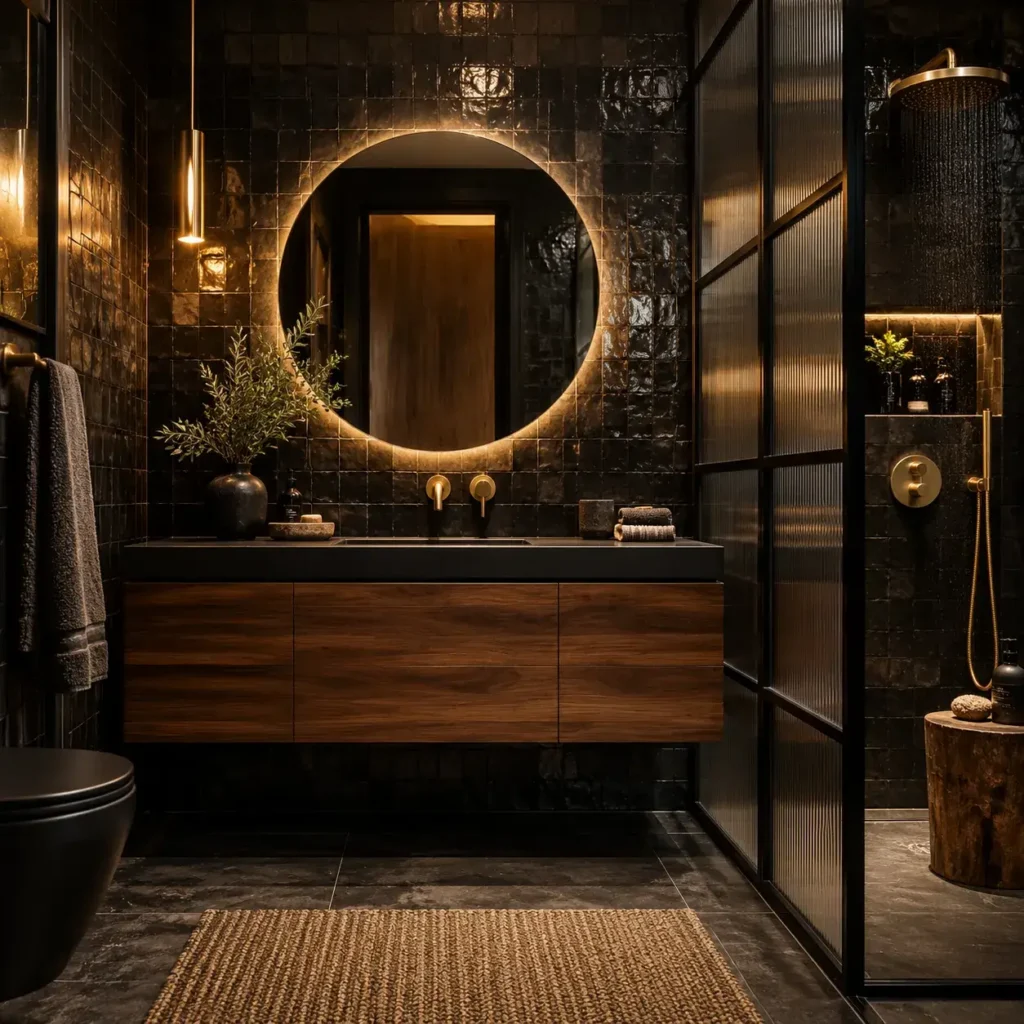
Dark bathrooms create an immediate sense of quiet luxury. Rather than feeling small or dingy, a dark room with layered lighting feels intimate, warm, and intentional.
Hand-glazed Moroccan zellige tiles in deep graphite cover the shower walls. Because each tile is handmade, the uneven surfaces catch light like moving water. A rich American walnut vanity brings organic warmth, preventing the dark tiles from feeling stark or cold.
- Base Envelope: Hand-molded charcoal zellige ceramic wall tiles paired with dark slate or charcoal concrete floor tiles.
- Metal Hardware: Warm brushed brass or satin gold faucets that pop against the dark tile backdrop.
- Millwork: Custom American walnut vanity with rich grain matching across horizontal slab drawers.
- Anchor Object: A walk-in shower framed by a black metal Crittall-style door with reeded glass panels.
Products Used in This Look
- 4×4 inch hand-glazed Moroccan charcoal zellige wall tiles
- Kohler or Delta wall-mounted widespread sink faucet in brushed modern brass
- Natural American walnut floating vanity with soft-close dovetail drawers
- Custom black iron shower partition door with vertical reeded safety glass
- Backlit circular mirror with warm 2200K perimeter LED lighting
- Charcoal gray ribbed cotton towels
6. Mid-Century Modern: Warm Walnut, Terrazzo, and Opal Glass
This look captures the clean geometry and playfulness of 1960s architecture while maintaining modern plumbing performance.
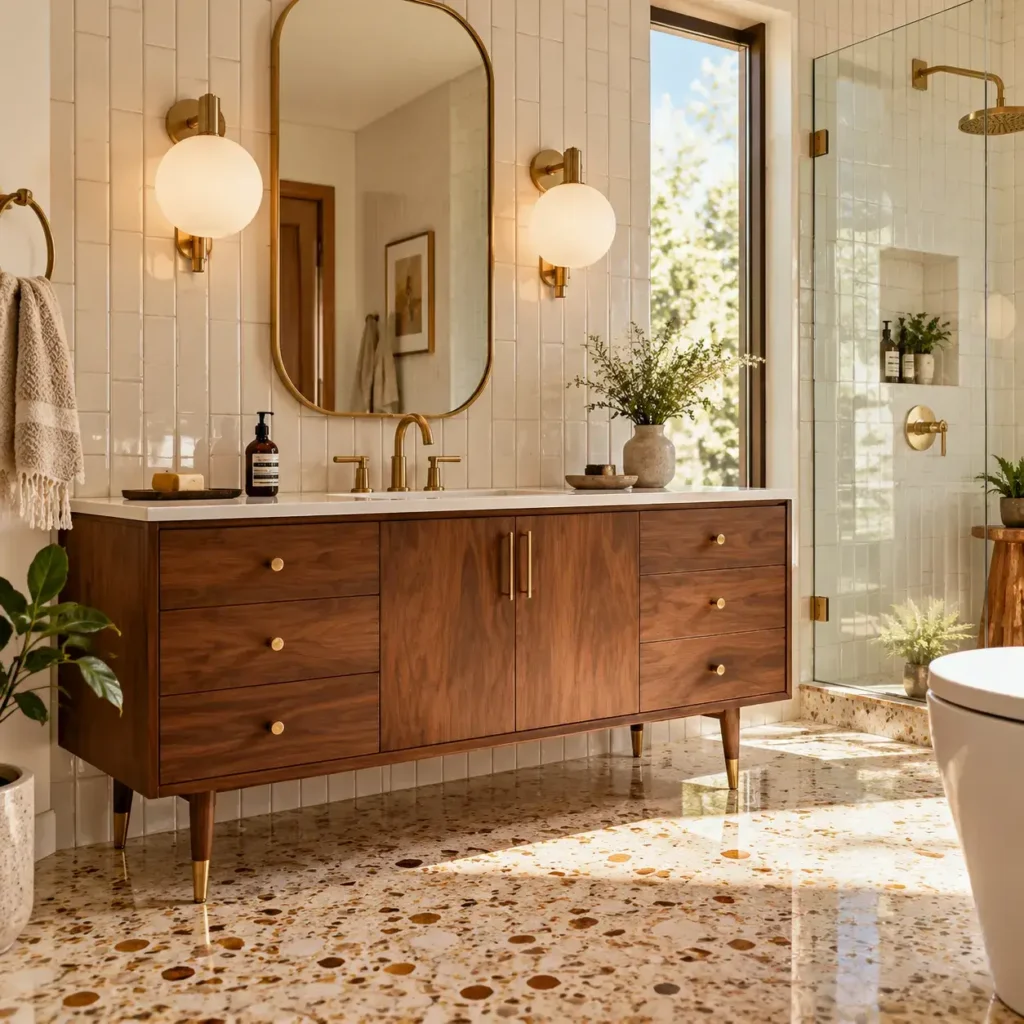
The floor features composite terrazzo filled with marble chips in tones of cream, terracotta, and soft gray. The vanity stands on iconic tapered dowel legs with recessed brass finger pulls. Matte white stack-bond ceramic tiles line the walls, creating a crisp geometric background for brass globe sconces.
- Base Envelope: White terrazzo floor tiles with warm aggregate paired with vertically stacked white matte tiles.
- Metal Hardware: Brushed gold or period-accurate warm brushed bronze fittings.
- Millwork: Freestanding American walnut vanity featuring tapered legs and integrated slatted shelving.
- Anchor Object: A pair of frosted opal glass globe sconces flanking a rounded-corner rectangular mirror.
Products Used in This Look
- Freestanding mid-century walnut vanity with tapered legs (48-inch single sink)
- 16×16 inch composite terrazzo floor tiles with warm aggregate
- 2×8 inch matte white ceramic tiles set in a straight vertical stack
- Mid-century modern frosted opal glass globe wall lights with brass mountings
- Rounded-corner rectangular mirror framed in solid brass
- Linen shower curtain with a thin horizontal terracotta accent stripe
7. The Jewel Box Powder Room: Color-Drenched Small Space
Powder rooms do not endure the daily steam and moisture of a full shower. This makes them the perfect place to use bold design choices that might overwhelm a larger room.
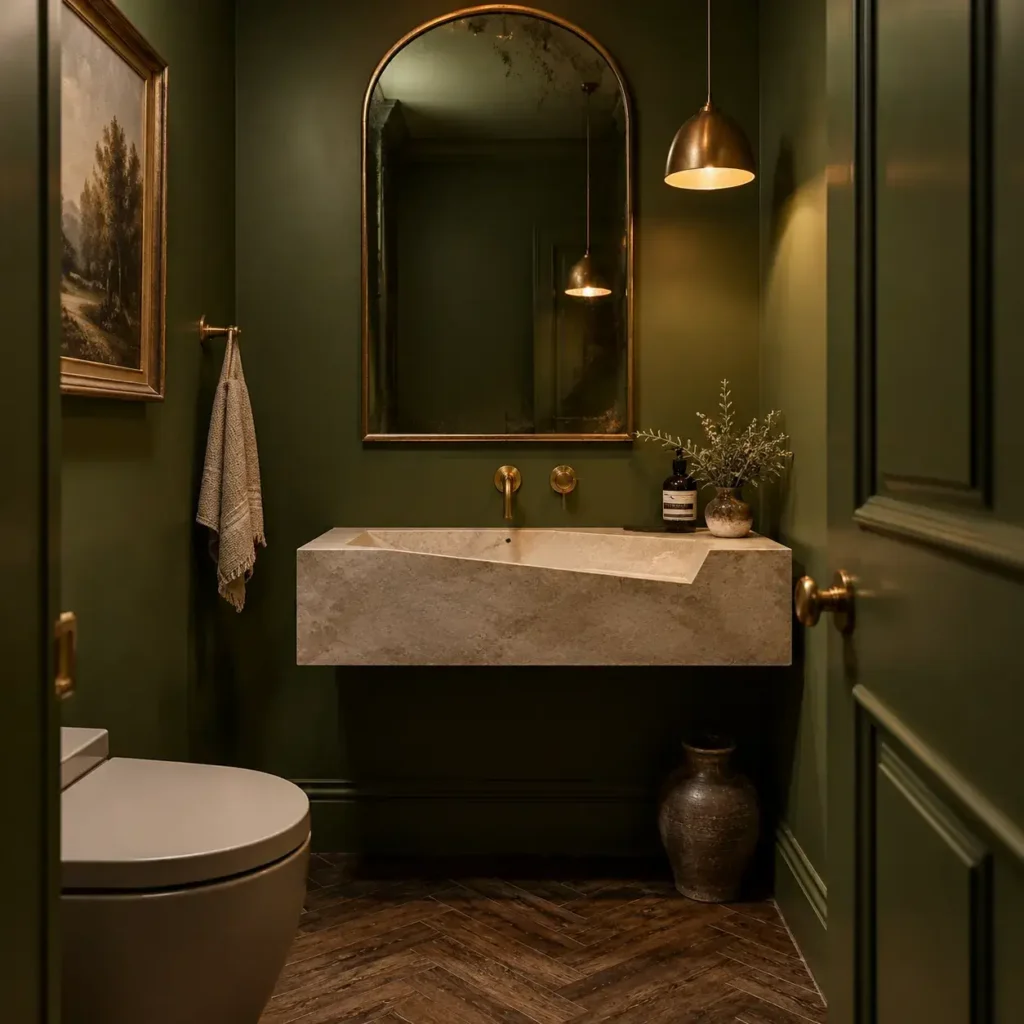
Color drenching unifies the space. Painting the ceiling, walls, baseboards, and window trim in a single saturated tone removes harsh visual breaks. In a small space, this makes the walls visually recede, creating an intimate, jewel-box atmosphere.
- Base Envelope: Monochromatic paint drenching in deep olive, rich terracotta, or midnight navy across all walls, trim, and ceiling surfaces.
- Metal Hardware: Aged unlacquered brass wall-mounted faucet.
- Millwork: Cantilevered raw stone sink basin mounted directly to wall framing studs with no cabinet underneath.
- Anchor Object: An oversized floor-to-ceiling antiqued mirror that reflects ambient hallway light.
Products Used in This Look
- Benjamin Moore Essex Green or Farrow & Ball De Nimes in a low-sheen eggshell finish
- Wall-hung, compact solid concrete or limestone ramp sink
- Wall-mount concealed lavatory faucet in aged brass
- In-wall toilet with a flush-mount dual actuator plate
- Solid brass gooseneck picture light mounted directly above wall art
- Small woven rattan trash basket and linen guest hand towels
8. Rental-Friendly Warm Minimalist: High-Impact, Zero-Demolition
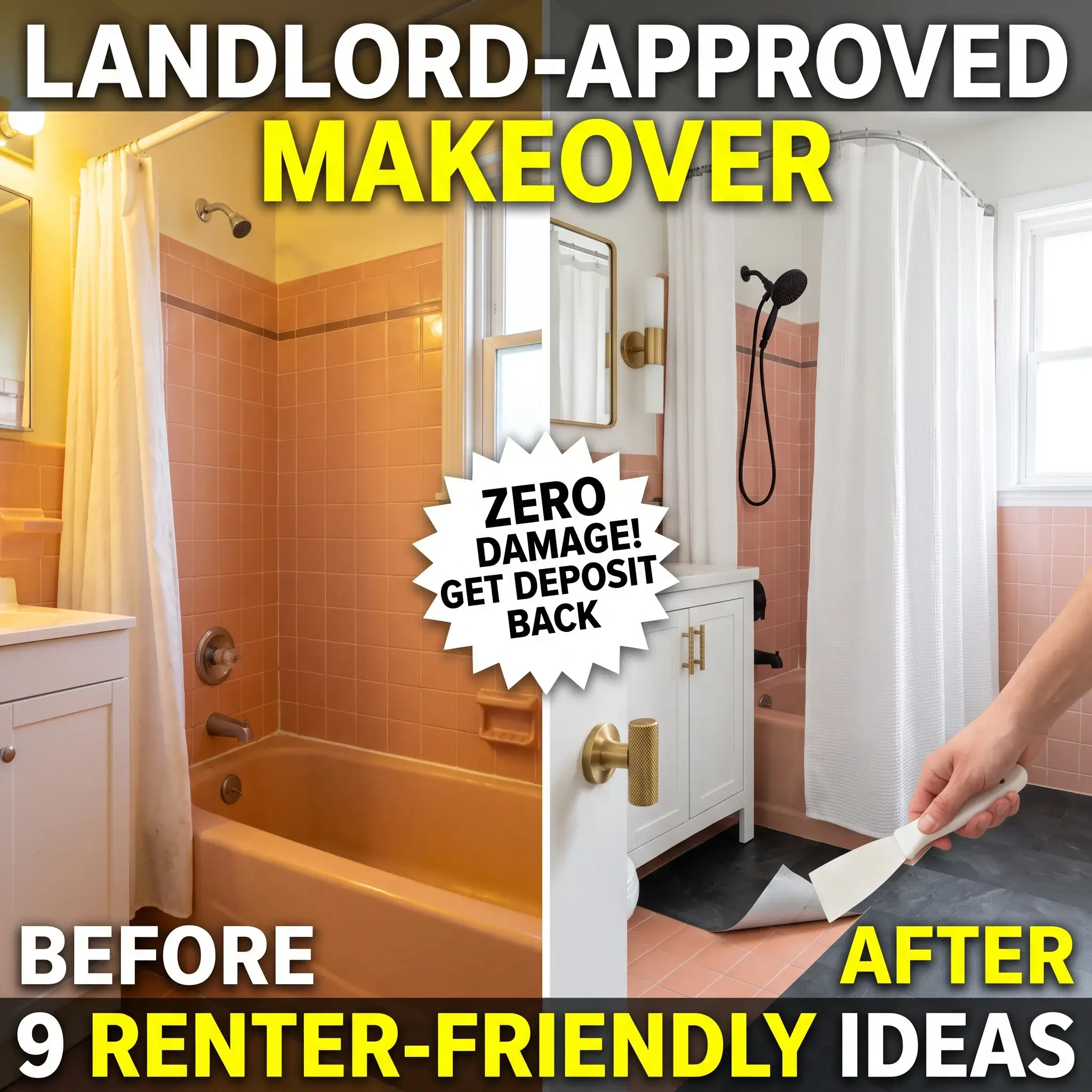
You do not need to own your property or swing a sledgehammer to fix an uninspired bathroom. This concept uses fully reversible swaps that protect your security deposit.
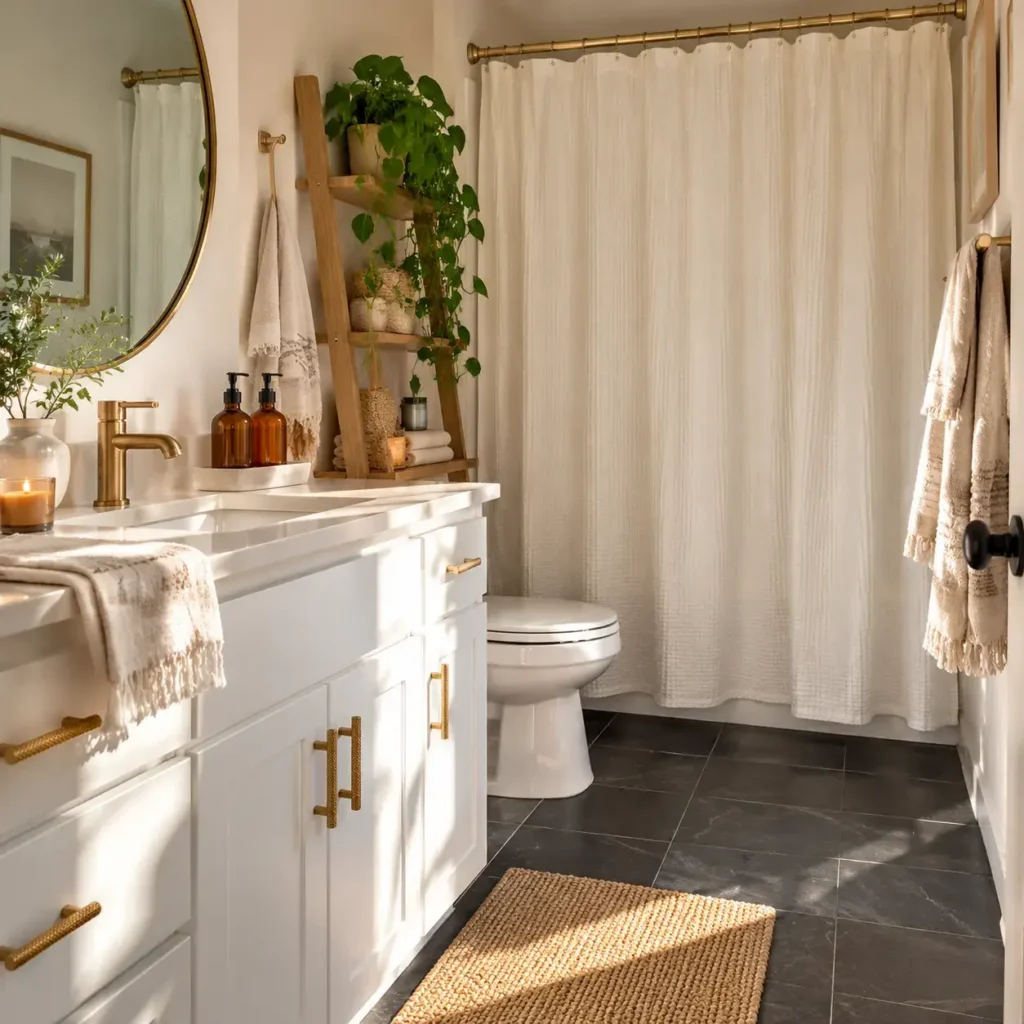
Water-resistant vinyl peel-and-stick tiles cover dated ceramic floors without damaging the tiles underneath. Swapping out cheap chrome cabinet pulls for solid brushed brass hardware takes fifteen minutes. Replacing the harsh ceiling bulb with warm 2700K lighting completely changes how the surfaces look and feel.
- Base Envelope: Neutral builder-grade ceramic tile refreshed with renter-safe slate-look peel-and-stick vinyl tiles.
- Metal Hardware: Temporary brushed brass hardware pulls and a handheld rainfall shower head swap.
- Millwork: Leaning bamboo or sealed white oak ladder shelf for vertical towel storage over the toilet.
- Anchor Object: A custom-length heavy linen shower curtain hung near the ceiling line on a tension rod.
Products Used in This Look
- FloorPops peel-and-stick moisture-resistant vinyl floor tiles in charcoal or stone
- Solid knurled brass drawer pulls (standard 3-inch or 4-inch hole center)
- High-pressure filtered handheld rainfall shower head in brushed bronze
- Extra-long (84-inch) heavy textured waffle shower curtain
- Amber glass apothecary bottles with waterproof minimalist labels
- Free-standing slatted teak duckboard to cover old shower pans
The Technical Design Rules: Lighting, Moisture, and Spacing
A great design fails if the plumbing leaks, the wood warps, or the lighting casts heavy shadows under your eyes. When planning your space, follow these practical installation rules.
1. The Lighting Formula (Kelvin and CRI)
Most homeowners make the mistake of using standard 4000K or 5000K daylight LED bulbs. These produce a cold, clinical blue light that washes out skin tones and exaggerates tile imperfections.
- Color Temperature: Always use 2700K warm white bulbs for vanity sconces and ambient lighting. This mimics the warm spectrum of morning sunlight. If you prefer dimmable controls, choose dim-to-warm LED drivers that drop to 2200K as you dim them for evening baths.
- Color Rendering Index (CRI): Specify LED bulbs with a CRI of 90 or higher. This ensures that skin tones, makeup colors, and textiles appear accurate.
- Sconce Placement: Do not place a single horizontal light bar directly over the mirror. It casts downward shadows under your eyes, nose, and chin. Instead, mount two wall sconces on either side of the mirror at eye level, roughly 60 to 66 inches from the finished floor.
2. Moisture-Resistant Materials
Bathrooms endure heavy steam cycles. Choosing the wrong wood or wall finish leads to peeling, warping, and mold growth within months.
- Wood Species: Only use moisture-stable hardwoods in full bathrooms. White oak, teak, cedar, and bamboo resist humidity well. Avoid softwoods like pine, poplar, or untreated MDF for vanities and shelving. Always seal natural wood with a water-resistant, matte polyurethane or hard-wax oil finish.
- Paint Sheen: Never use flat or matte latex paint in rooms with a shower. Moisture sinks into the drywall, leaving permanent water drip streaks. Use a satin or semi-gloss finish on walls and ceilings. These sheens form a washable moisture barrier that sheds steam easily.
3. Clearances and Wet-Zone Slope
Good flow prevents bathrooms from feeling cramped, regardless of their square footage.
- Walkways: Keep a clear circulation path of at least 36 inches between the vanity edge and the opposite wall or shower door.
- Bathtub Clearances: Maintain at least 30 inches of open floor space around a freestanding tub for comfortable access and cleaning.
- Curbless Shower Slope: If you are building a barrier-free walk-in shower, the floor must slope toward the drain at a rate of 1/4 inch per horizontal foot (roughly a 2.08% grade). Use a wall-to-wall linear channel drain along the back wall. This allows you to install large-format floor tiles without making awkward relief cuts.
- Slip Resistance: Ensure all wet-floor tiles carry an ANSI A326.3 Dynamic Coefficient of Friction (DCOF) rating of 0.42 or higher when wet. Reserve polished marble for vertical wall surfaces.
Low-Demolition Value Engineering: Big Impact on a Budget
You do not need to spend tens of thousands of dollars to change your bathroom atmosphere. Use this cost matrix to choose upgrades that fit your budget and project timeline.
| Project Layer | Practical Intervention | Target Finishes | Cost Range | Visual Impact |
| Cabinetry | Sand and coat existing vanity; install solid brass pulls | Sage green, soft taupe, mushroom enamel; knurled brass | $100 to $350 | High (Refreshes dated builder wood without cabinet replacement) |
| Plumbing Fixtures | Direct-swap sink faucets and shower trim kits | Unlacquered brass, matte black, or brushed bronze | $150 to $600 | High (Creates an intentional, high-end metallic theme) |
| Wall & Tile Surfaces | Apply moisture-rated epoxy paint or peel-and-stick tile accents | Clean warm biscuit, slate gray, or light stone | $100 to $400 | Medium (Covers discolored grout lines and dated colors) |
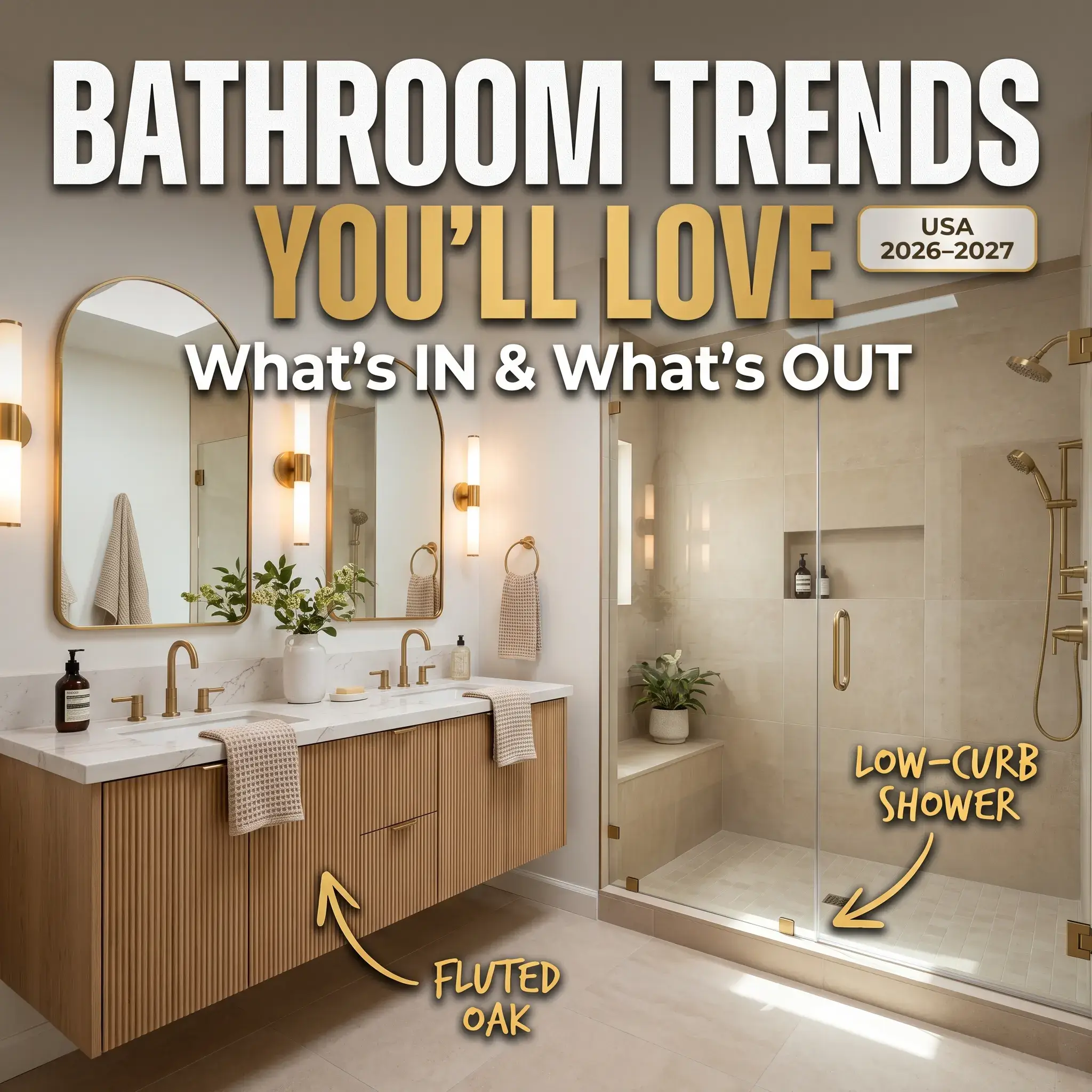
| Mirror & Lighting | Replace flat plate glass with an arched mirror and 2700K LED strips | Antiqued bronze, fluted oak, or concealed halo LED | $80 to $300 | High (Eliminates harsh shadows and lifts ceiling lines) |
| Everyday Accessories | Decant toiletries into matching stoneware bottles; add linen towels | Amber glass, natural stoneware, oat waffle linen | $50 to $200 | Medium (Removes commercial visual noise immediately) |
Frequently Asked Questions
How can I make my bathroom look aesthetically pleasing on a tight budget?
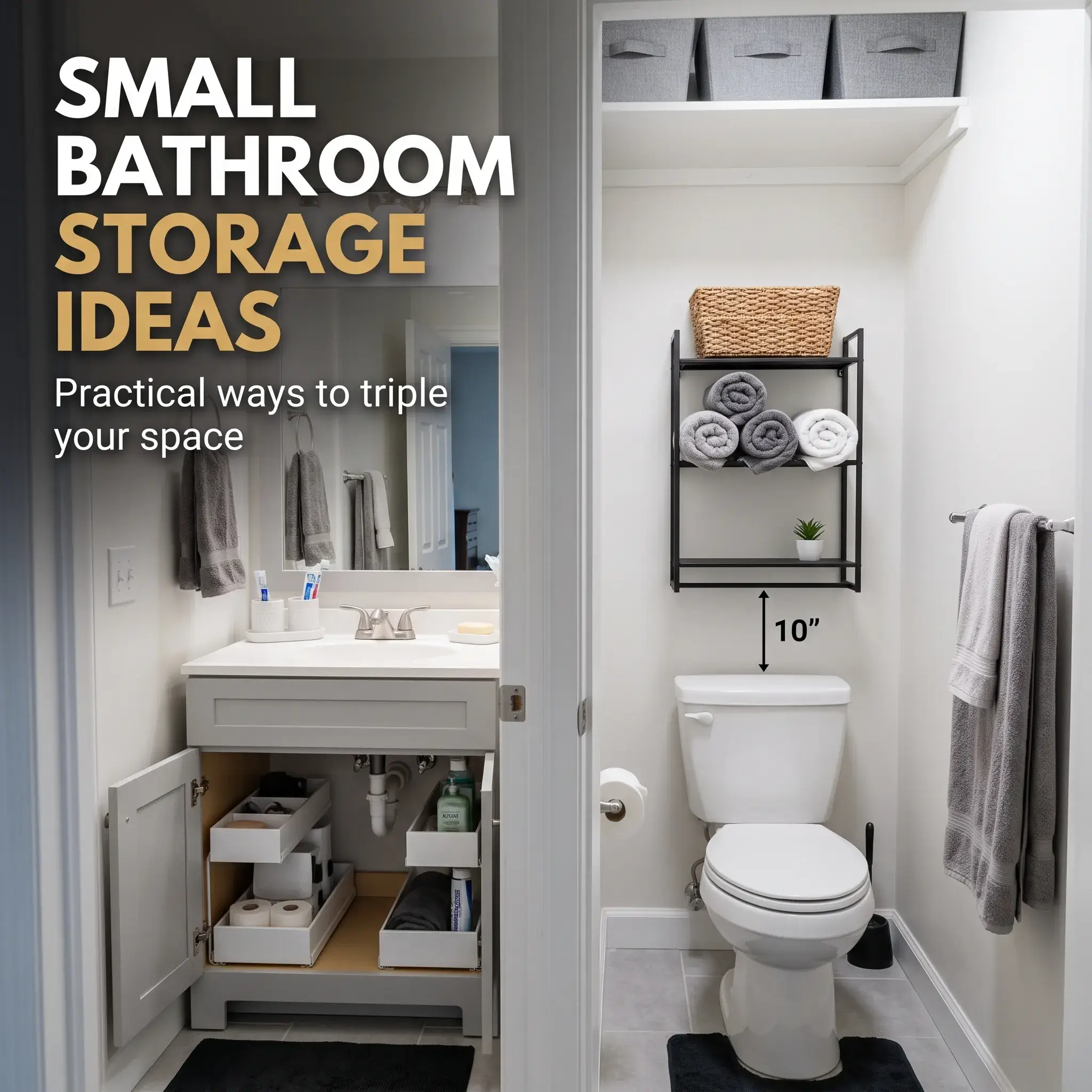
Start by removing visual clutter. Decant mismatched shampoo and hand soap containers into matching amber glass or ceramic pump bottles. Swap your standard bath mat for a natural teak duckboard or an oat-colored waffle linen towel. Replace cold, bright ceiling bulbs with 2700K warm white bulbs. These three simple changes cost under $100 total and immediately create a calm, cohesive environment.
What is the best bathroom aesthetic for a small space?
The modern organic or color-drenched styles work best in compact footprints. Modern organic designs use floating vanities that reveal the floor underneath, which tricks the eye into seeing more square footage. Alternatively, deep color drenching in a small powder room coats the walls, trim, and ceiling in a single dark shade like olive green or navy. This hides tight wall corners, turning a small space into an intentional jewel box.
Can I mix different metal hardware finishes in the same bathroom?
Yes, but limit your palette to two finishes. Use the 80/20 rule to maintain visual order. Make one finish dominant across 80% of the fixtures, such as matte black for your widespread faucet, shower trim, and towel bars. Then use a secondary warm metal, like brushed brass, across the remaining 20% for mirror frames and vanity sconces. Keep the undertones balanced so the metals look deliberate rather than accidental.
What is the most durable countertop material for a luxury bathroom?
Engineered quartz and honed quartzite offer the best combination of beauty and durability. While natural Carrara marble looks stunning, it is porous and etches easily when exposed to acidic skincare products, perfumes, and harsh bathroom cleaners. Quartz provides the soft veining of natural marble but resists stains, moisture absorption, and surface scratches without requiring annual chemical sealers.
A well-designed bathroom does not rely on expensive structural changes or chasing short-lived social media trends. Focus on authentic materials that age gracefully, warm 2700K lighting placed at eye level, and practical storage that keeps countertops clear. Choose one aesthetic formula that matches your home, start with a simple hardware or lighting swap this weekend, and build your space from there.