
Stop Building Sterile Bathrooms: 8 Textured Neutral Tile Ideas That Add Warmth
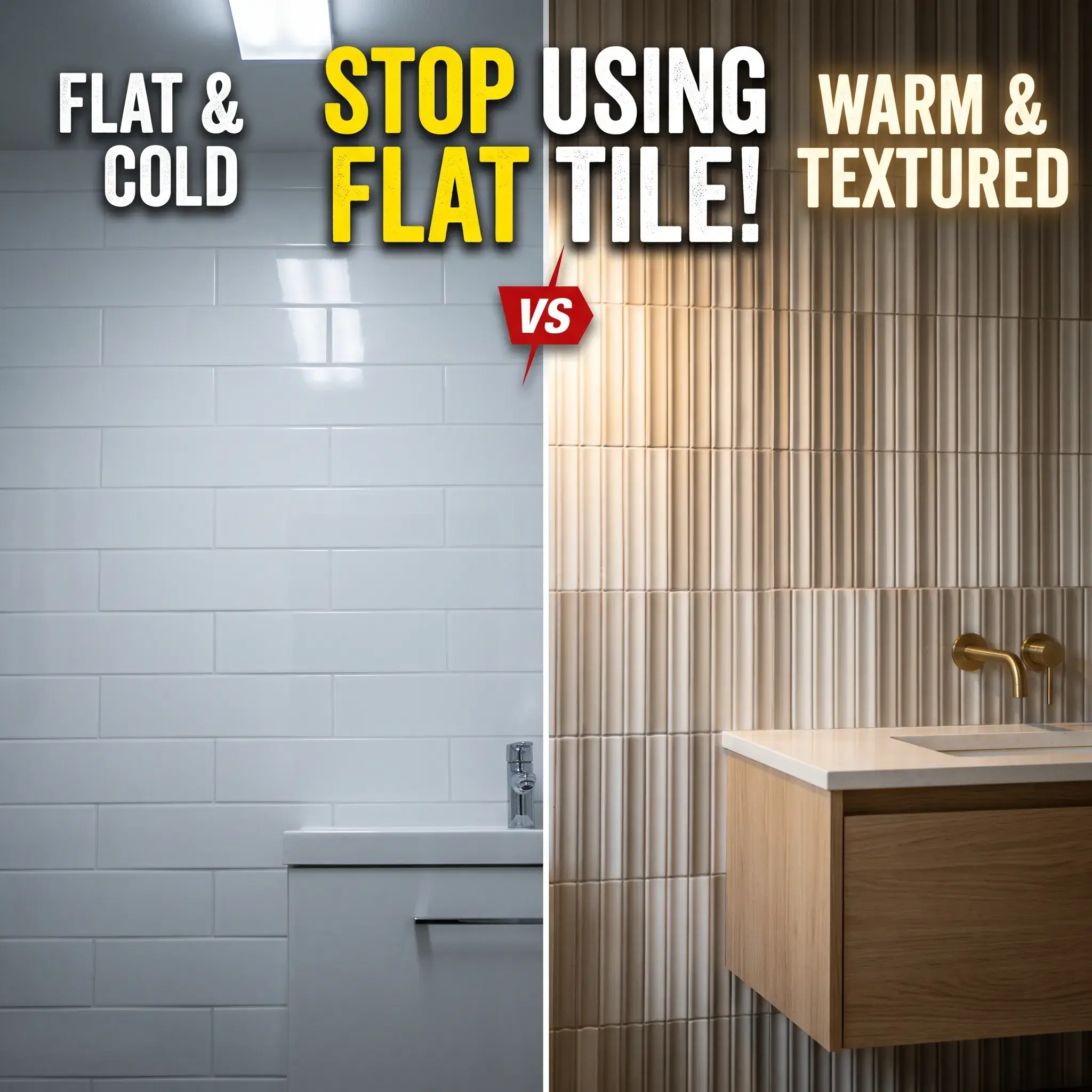
A neutral bathroom can easily feel sterile. When you remove color and use flat, glossy white tiles, the space quickly resembles a medical clinic or a generic builder flip.
You do not need loud colors to fix this problem. You need physical texture.
Texture introduces micro-shadows, varied light reflection, and tactile grip. It turns pale creams, warm greiges, and soft taupes into rich, welcoming surfaces.
Below are eight practical tile concepts that bring tactile warmth into your home. Each concept includes real material specifications, exact product lists, and realistic photo prompts for your mood boards.
1. Vertically Stacked Fluted Porcelain in Chalk White
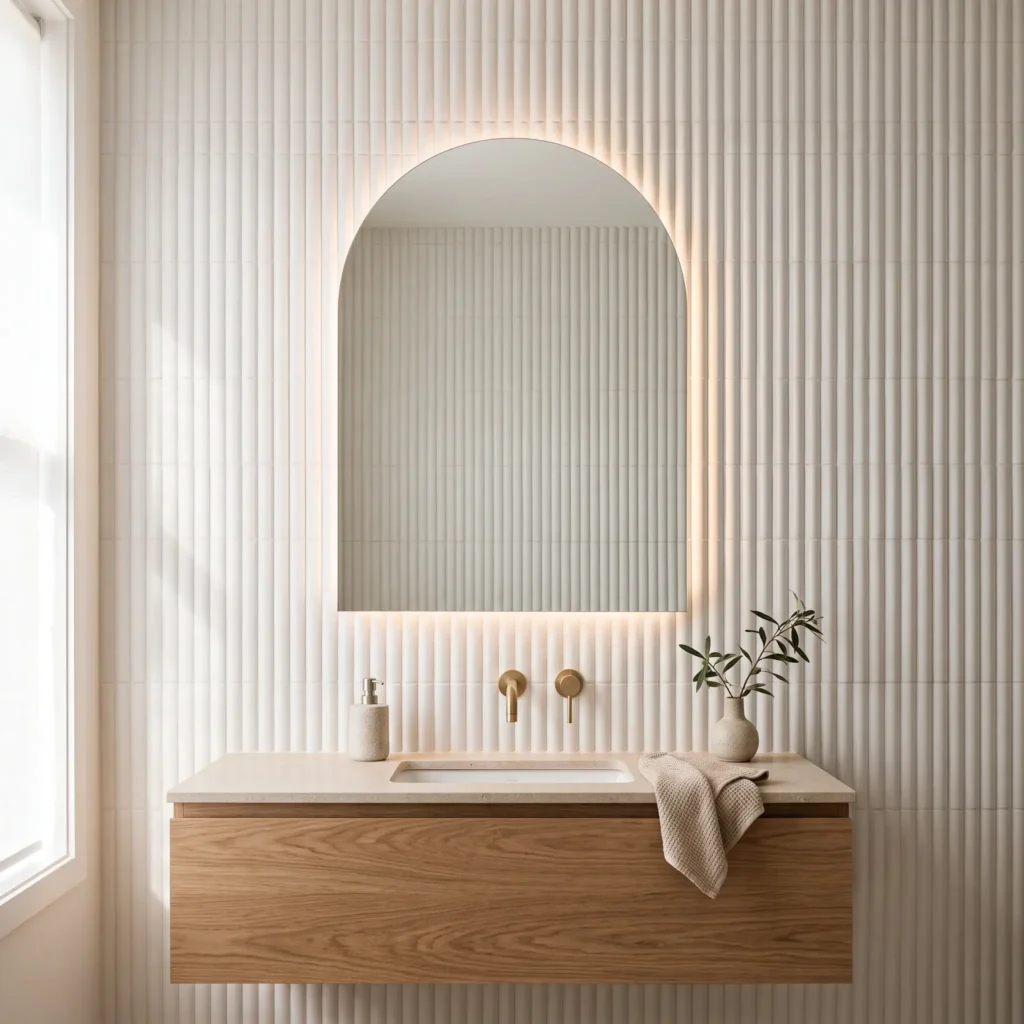
Linear ridges create architectural structure. This design uses three-dimensional ceramic ribs, often called canneté, running straight up the wall.
Vertical fluting pulls the eye upward. This simple trick makes low bathroom ceilings feel noticeably taller. The rounded ribs catch ambient light on top and cast slender shadows into the grooves below.
In wet areas, always orient fluted tiles vertically. Vertical channels let water drain straight down with gravity. Horizontal channels trap pooling water, which leaves mineral rings and soap scum along the bottom edges.
- Best Location: Vanity feature walls, powder room accents, and dry shower walls outside direct spray.
- Maintenance Profile: Moderate. Use a soft nylon brush to wipe down the grooves.
Products and Materials in This Design:
- Wall Tile: 12×24 inch fluted matte porcelain field tile in Chalk White.
- Grout: Non-sanded cementitious grout matched tone-on-tone in Alabaster.
- Cabinetry: Custom floating vanity in rift-sawn white oak with a clear matte sealer.
- Plumbing Fixtures: Wall-mounted single-handle faucet in brushed brass.
- Countertop: 2 cm engineered quartz in warm ivory with faint warm flecks.
2. Handcrafted Moroccan Zellige in Bone White
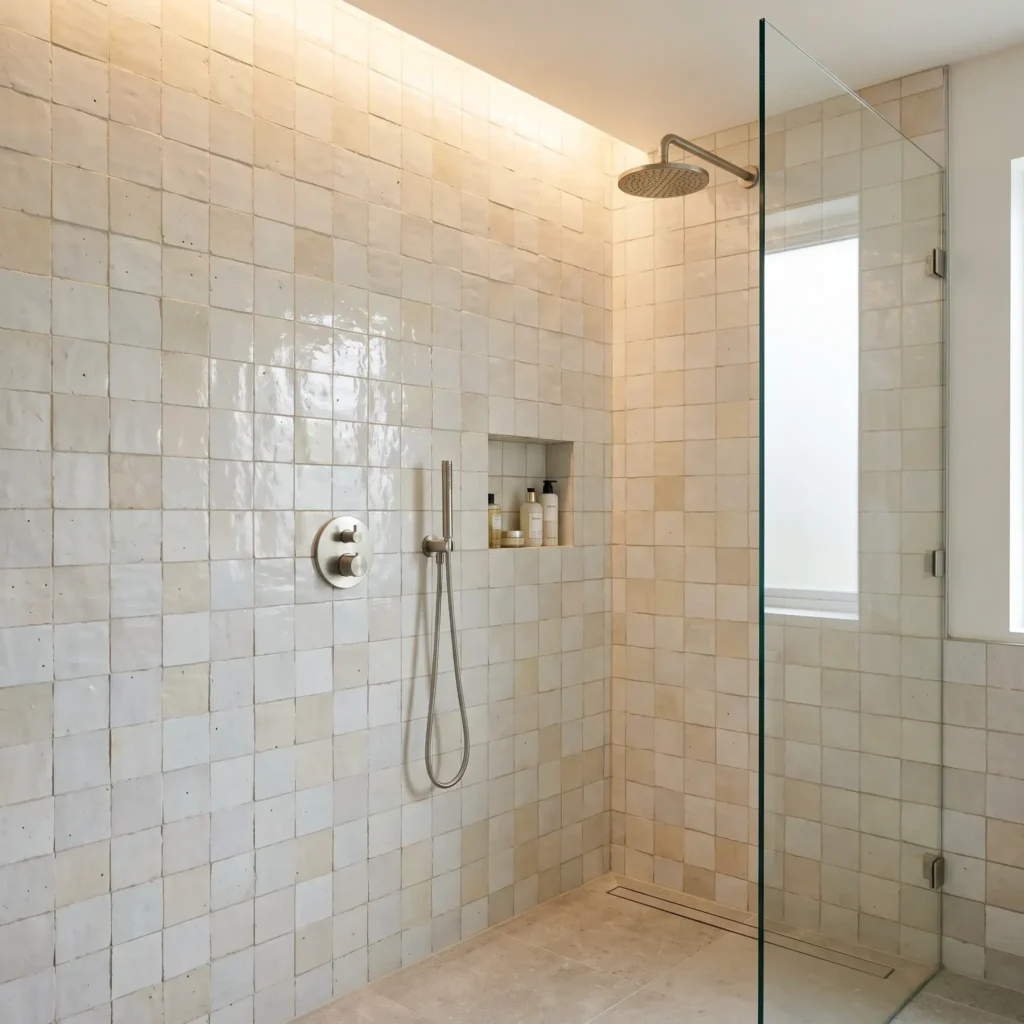
Zellige tiles are made by hand in Morocco from raw, pale clay. Artisans hand-chisel the fired clay edges, which creates subtle variations in thickness and beveling.
No two Zellige tiles sit perfectly flat. When you lay them across a wall, the uneven faces catch light at slightly different angles. This irregularity creates a shimmering, water-like surface without needing decorative patterns or color shifts.
Do not install authentic Zellige on a shower floor. The chiseled edges and uneven surfaces create sharp corners that hurt bare feet. Save Zellige for vertical planes where you can appreciate its gloss and movement safely.
- Best Location: Shower surround walls, wet-room backdrops, and tub alcoves.
- Maintenance Profile: Easy to wipe clean. The glassy surface repels water, but the raw clay base needs a proper soak before installation.
Check out more Bathroom Ideas
Products and Materials in This Design:
- Wall Tile: 4×4 inch authentic Moroccan glazed terracotta Zellige in Bone White.
- Mortar: White polymer-modified medium-bed mortar with back-buttering.
- Grout: High-performance unsanded grout in Warm Ivory, installed with 1 mm joints.
- Fixtures: Thermostatic shower column in brushed nickel.
- Glass Enclosure: 3/8 inch low-iron clear tempered glass with brushed nickel channel clips.
3. Honed and Tumbled Travertine in Warm Cream
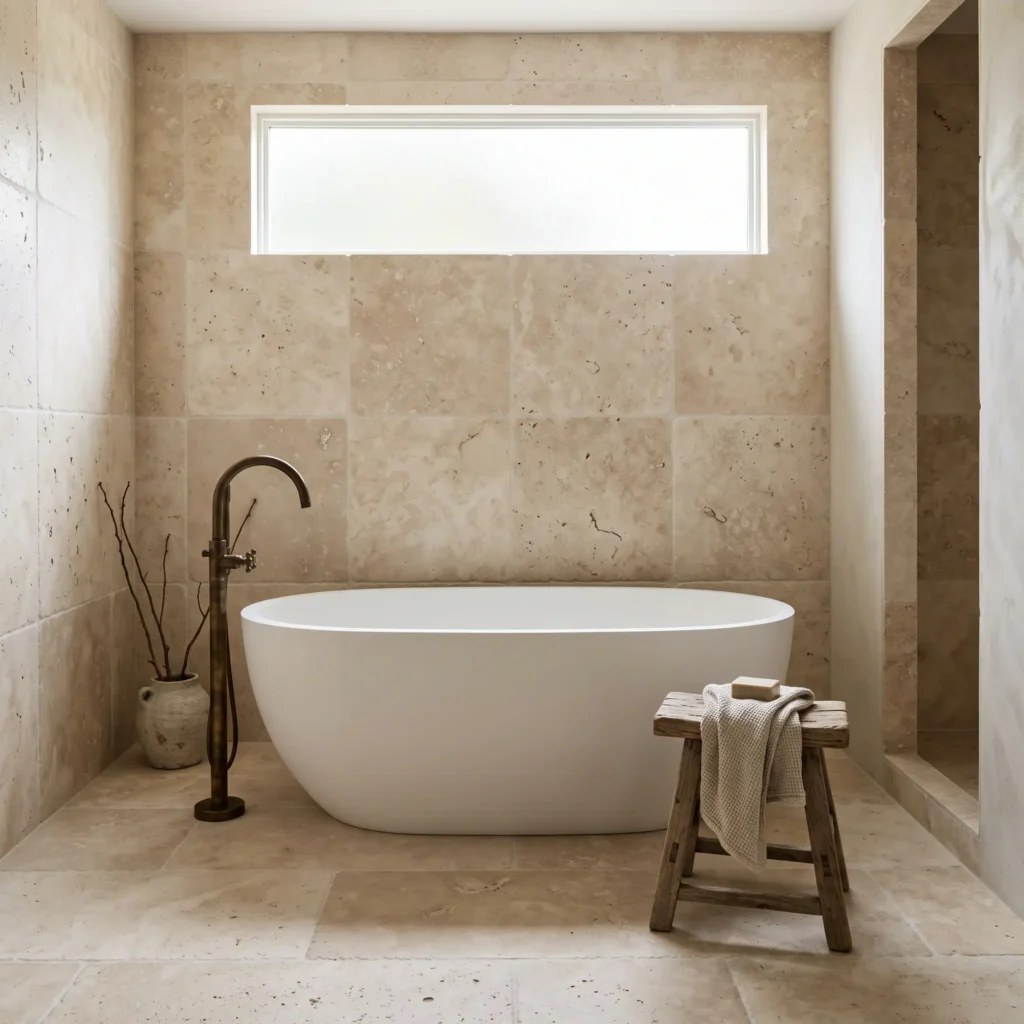
Travertine is formed by mineral springs that trap geothermal air bubbles. These bubbles leave soft pockets and irregular fissures across the stone slab.
Tumbled travertine undergoes mechanical processing with coarse abrasives. This treatment rounds the edges and softens the surface, giving the stone an inviting, antique appearance.
The muted cream and walnut undertones bring natural warmth to cold morning routines. Travertine feels comfortable under bare feet and naturally diffuses harsh glare from overhead downlights.
Always verify that your installer uses a penetrating fluoropolymer sealer on all raw travertine surfaces. Calcitic stone absorbs water and oils quickly, so high-grade sealing keeps stains from setting into the pores.
- Best Location: Bathroom floor fields, curbless shower transitions, and bathtub surrounds.
- Maintenance Profile: Moderate. Requires pH-neutral cleaners and annual resealing.
Products and Materials in This Design:
- Floor and Wall Tile: 16×24 inch cross-cut tumbled travertine field tile in Roman Cream.
- Grout: Polymer-modified flexible grout in Light Sand.
- Sealer: Breathable fluorochemical penetrating stone impregnator.
- Tub: 67 inch solid-surface resin freestanding oval tub in matte white.
- Tub Filler: Floor-mounted unlacquered brass tub filler with hand shower.
4. Stacked Kit Kat Finger Mosaics in Warm Greige
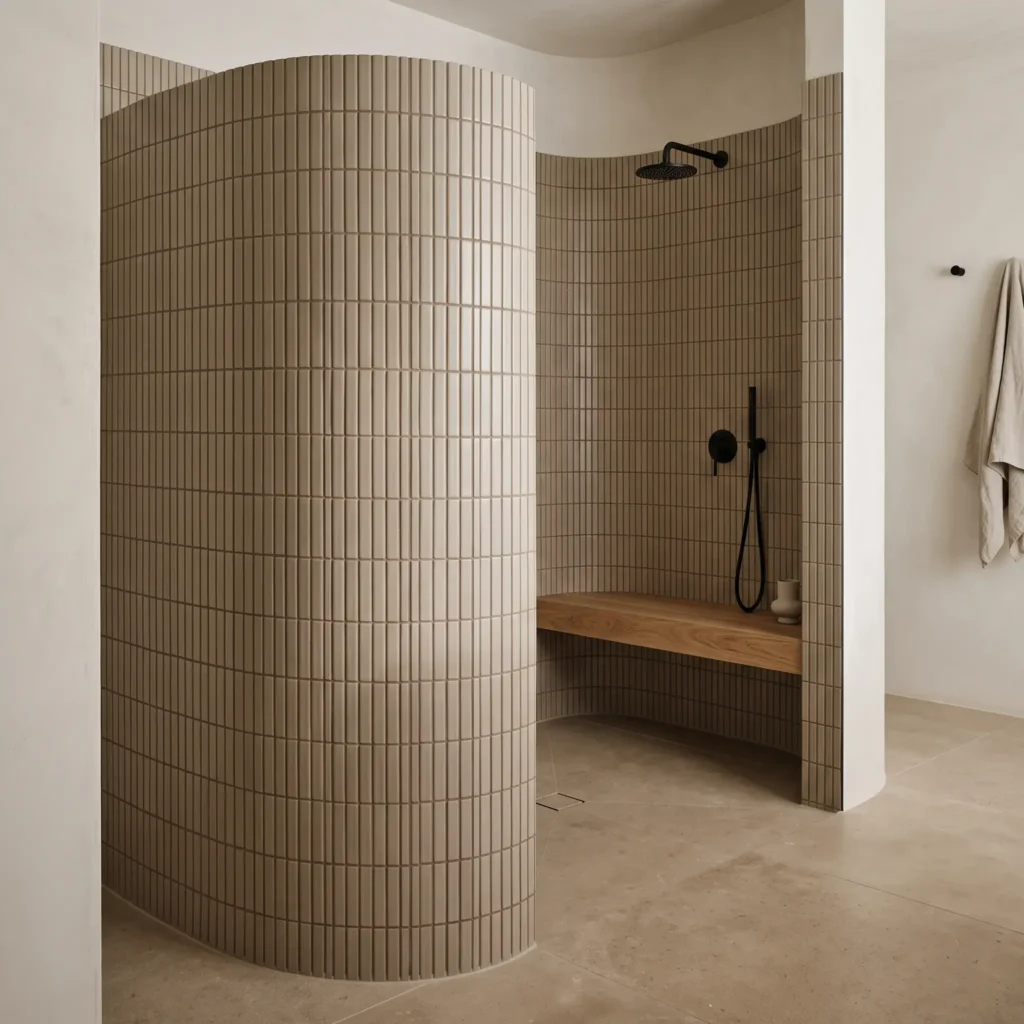
Kit Kat mosaics, also called finger tiles, consist of slender porcelain strips grouped on mesh backing sheets. Their appeal comes from rhythmic repetition.
The small size of each tile creates a dense grid of grout lines. In a neutral palette like greige or oatmeal, this grid provides tactile grip underfoot while breaking up flat sightlines on walls.
Finger mosaics bend smoothly around curved framing. If you are building a curved shower wall, a rounded vanity base, or an arched niche, these flexible sheets cover the curve without awkward jagged edges.
- Best Location: Curved shower entries, built-in shower benches, vanity backsplashes, and shower floor pans.
- Maintenance Profile: Easy to medium. Dense grout lines require high-performance epoxy grout to resist soap scum.
Products and Materials in This Design:
- Mosaic Tile: 0.8×5.7 inch matte porcelain finger mosaic sheets in Warm Greige.
- Grout: ANSI A118.3 waterproof epoxy resin grout in Taupe Mist.
- Fixtures: Minimalist thermostatic hand shower set in matte black.
- Bench Material: Solid white oak slab bench with marine-grade polyurethane finish.
- Waterproofing: High-density foam waterproof backer board scored for curved walls.
5. Combed and Bush-Hammered French Limestone
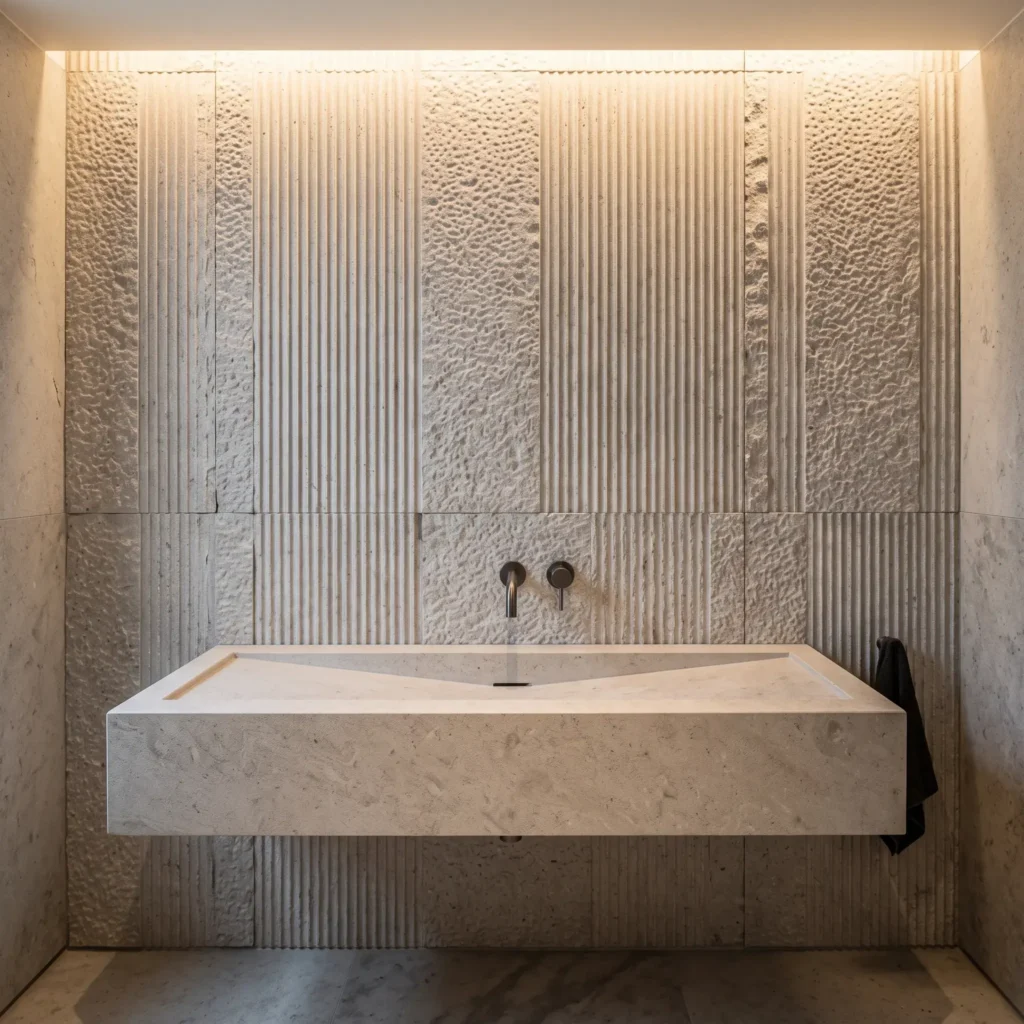
Bush-hammering uses mechanical tools to fracture and pit the surface of natural stone. Combing cuts narrow parallel grooves directly into the stone face.
These techniques strip away all sheen. You receive a rugged, velvety stone surface that scatters glare and provides physical traction.
Because combed stone features deep manual ridges, keep it away from areas with heavy soap and hard water residue. Install combed limestone on dry accent walls, behind mirrors, or around exterior-facing windows where it creates striking shadow lines.
- Best Location: Powder room powder walls, dry vanity backsplashes, and open wet-room floor fields.
- Maintenance Profile: High for combed walls; low to medium for flat bush-hammered floors.
Products and Materials in This Design:
- Feature Tile: 12×24 inch mechanically combed French limestone panels in Oat Shell.
- Base Floor Tile: 24×24 inch bush-hammered matching limestone pavers.
- Sink: Integrated floating trough sink carved from a single block of matching limestone.
- Faucet: Two-hole wall-mounted lavatory faucet in brushed gunmetal.
- Lighting: 2700K 95+ CRI ceiling-recessed linear graze light fixture.
6. Sliced River Pebble Shower Floor in Warm Sand
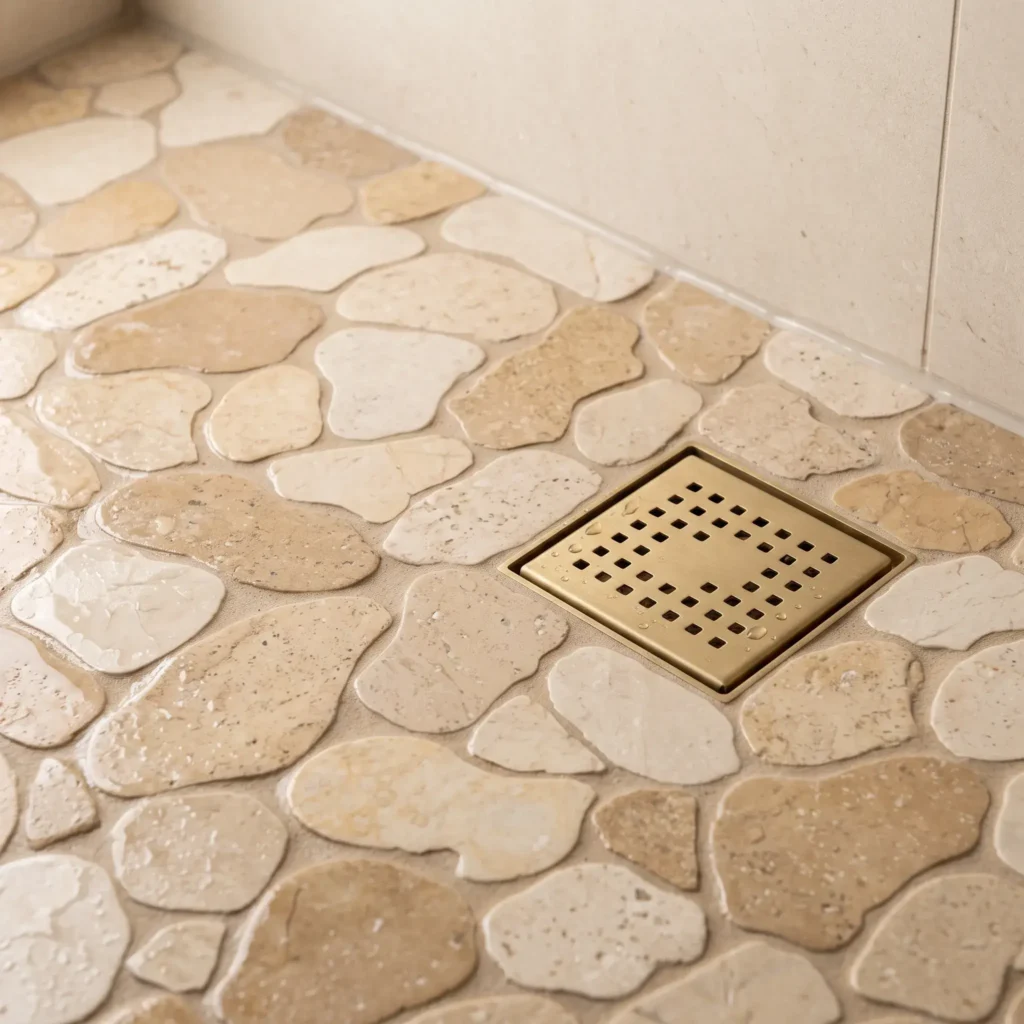
Pebble shower pans offer natural foot grip and a subtle foot massage. However, traditional rounded pebbles create deep gaps that trap soap scum, hair, and dirty standing water.
Sliced pebbles fix this problem completely. Fabricators slice round stones horizontally with diamond saws. You get a smooth, flat top plane that squeegees clean in seconds, combined with organic, wavy perimeter shapes.
The irregular gaps between the sliced stones provide mechanical traction under wet feet. Water flows smoothly across the surface directly toward the floor drain.
- Best Location: Walk-in shower pans, curbless entries, and steam room floors.
- Maintenance Profile: Easy. Squeegees flat without catching on round bumps.
Products and Materials in This Design:
- Floor Mosaic: Interlocking sliced flat river pebble mesh sheets in Warm Sand.
- Grout: Epoxy chemical-resistant grout in Buff Ivory.
- Drain: 4×4 inch flush square shower drain in brushed brass.
- Wall Tile: 24×48 inch honed porcelain panels in Cream Travertine look.
- Underlayment: Pre-sloped waterproof shower tray system with integrated drain flange.
7. Dragged Plaster Bas-Relief Porcelain
If you want delicate texture without scrubbing deep grooves, low-relief porcelain is an ideal choice.
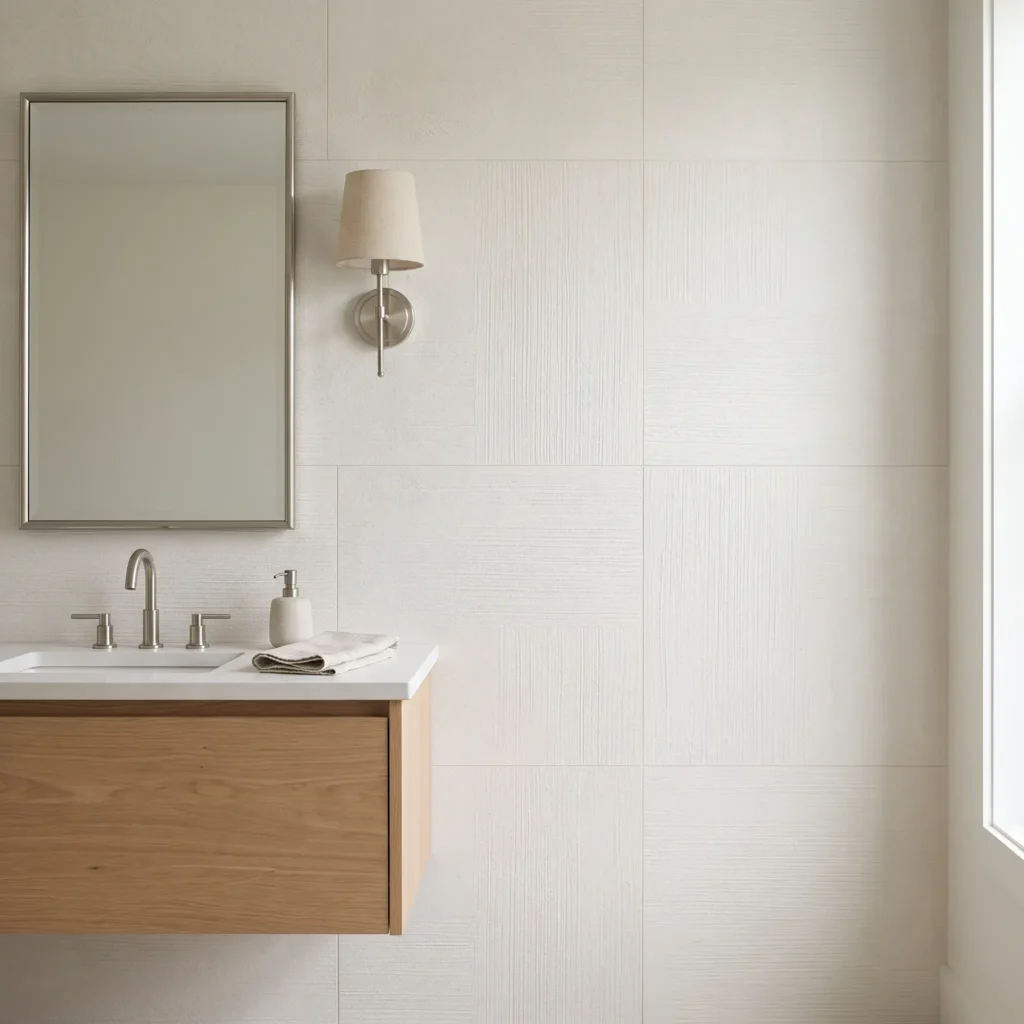
Hydraulic presses stamp shallow patterns directly into unglazed porcelain bodies. These patterns mimic coarse woven linen, combed lime wash, and dragged Venetian plaster.
The texture projects less than one millimeter from the surface. You get quiet shadow details that diffuse acoustic echo in large bathrooms. Because the depressions are so shallow, a standard microfiber mop cleans the surface quickly.
- Best Location: High-traffic bathroom floors, full shower surrounds, and small vanity backsplashes.
- Maintenance Profile: Very easy. Behaves just like standard flat porcelain.
Products and Materials in This Design:
- Wall Tile: 16×32 inch low-relief matte porcelain in Dragged Plaster Parchment.
- Grout: Color-matched polymer grout in Chalk.
- Vanity: White ash wood floating vanity cabinet with recessed finger pulls.
- Mirror: Rectangular brushed nickel pillowed metal frame mirror.
- Sconce: Wall-mounted vanity sconce in brushed nickel with an off-white linen drum shade.
8. Unglazed Blonde Terracotta Paviors
Terracotta does not always mean dark reddish-orange Mexican Saltillo tiles. Blonde terracotta is fired from pale, iron-poor clays to produce warm wheat, biscuit, and soft chamois colors.
Unglazed paviors feature a raw, porous, sand-like face. They add an earthy, grounded anchor to bathrooms with sleek modern features like white acrylic tubs, glass enclosures, and polished chrome hardware.
Because raw terracotta is naturally porous, you must seal it before applying grout. Without a pre-grout sealer, the clay will suck the dye and moisture right out of your wet grout mix, permanently staining the surface.
- Best Location: Main bathroom floors, powder room floors, and water closet zones.
- Maintenance Profile: Moderate. Requires periodic application of breathable floor sealers.
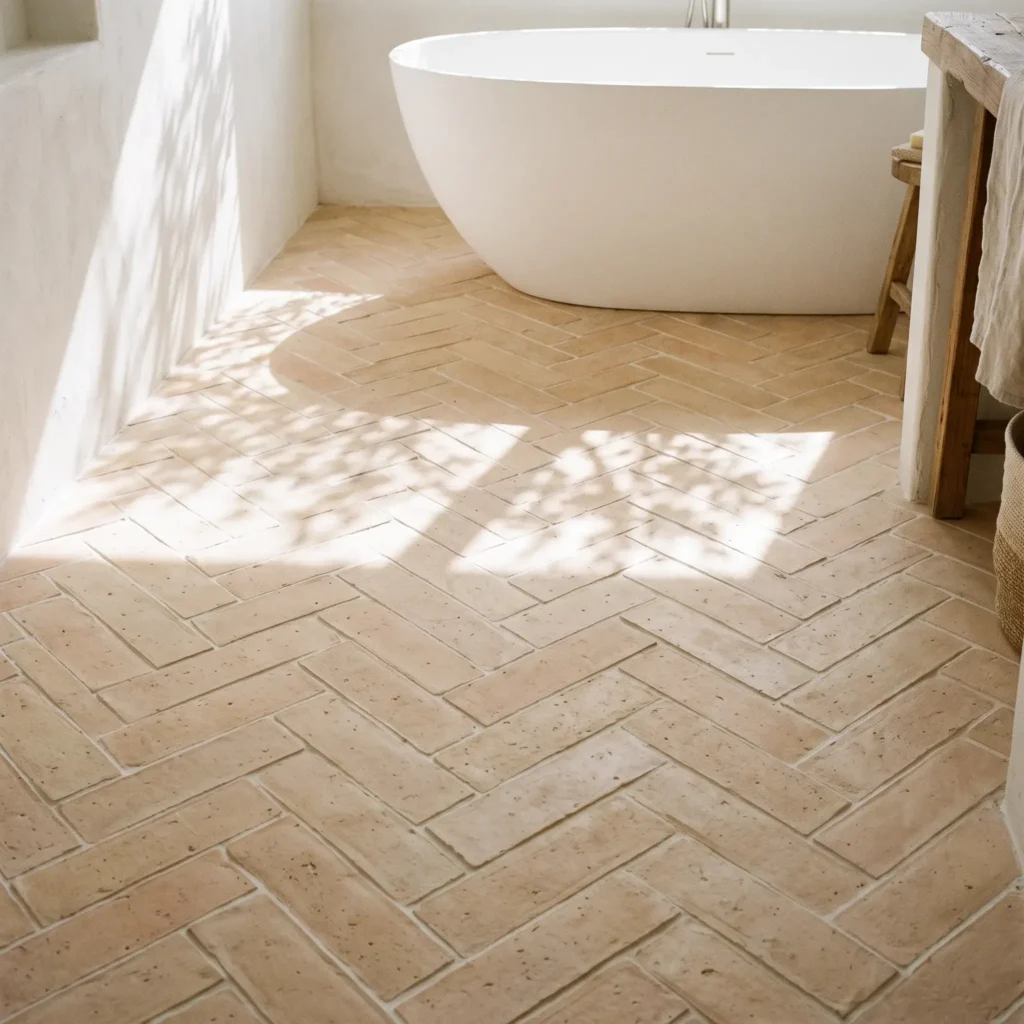
Products and Materials in This Design:
- Floor Tile: 3×8 inch unglazed blonde terracotta paviors in Wheat Straw.
- Pre-Grout Treatment: Water-based temporary grout release coating.
- Grout: Sanded cementitious architectural grout in Natural Cream.
- Sealer: Breathable sub-surface penetrating oleophobic stone and tile sealer.
- Walls: Smooth hand-troweled lime plaster in Warm Alabaster.
The Lighting Rule That Makes or Breaks Texture
Texture requires directional shadow to exist. If you install heavily textured tile under direct, flat light, the surface will look completely flat.
Most people use broad wall washing. They install wide-beam recessed lights two to three feet away from the wall. This floods the surface with uniform brightness and washes out subtle ridges, grooves, and stone pits.
To showcase texture, use wall grazing instead.
| Parameter | Recommended Specification |
|---|---|
| Distance from Wall | 6 to 12 inches |
| Beam Angle | Narrow (under 25 degrees) |
| Color Temperature | 2700K to 3000K (Warm White) |
| Color Accuracy | 90+ CRI (Color Rendering Index) |
Place narrow-beam luminaires close to the wall so the light hits the tile at an acute, skimming angle. The beams strike the high ridges of fluted tiles, chiseled stone, or wavy Zellige, casting distinct micro-shadows into the recesses below.
Always select light fixtures with a warm color temperature between 2700K and 3000K. Cool white bulbs above 4000K cast blue, sterile tones that make beige, cream, and greige tiles look dingy. Choose bulbs with a Color Rendering Index of 90 or higher to bring out the subtle mineral veining in natural stone.
Grout Strategy: Protect the Tile Texture
The wrong grout color will ruin an expensive textured tile installation.
Many homeowners use high-contrast grout, such as dark charcoal grout against pale ivory tiles. High contrast works well with flat subway tiles because it turns the grid into a graphic pattern.
On textured tiles, dark grout creates visual competition. The bold grid distracts the eye from the physical shadows of the tile relief, making the wall feel chaotic and cluttered.
Use a tone-on-tone grout strategy. Match your grout color directly to the dominant undertone of your tile.
| Tile Shade | Recommended Grout Tone |
|---|---|
| Chalk White | Alabaster or Pure White |
| Bone Zellige | Warm Ivory or Pale Biscuit |
| Cream Travertine | Light Sand or Pale Buff |
| Warm Greige | Warm Gray or Muted Taupe |
Matching the grout allows the joint lines to blend into the overall surface. Your eye registers the physical relief, natural stone cavities, and curved edges rather than a distracting checkerboard grid.
For high-texture areas like finger mosaics and pebble floors, select high-performance epoxy grout meeting ANSI A118.3 standards. Epoxy cures into a non-porous solid resin. It repels moisture, stops mold growth, and never requires periodic sealing.
Wet-Area Safety and Slip Ratings
You cannot pick bathroom floor tiles based on looks alone. Wet tile surfaces cause dangerous slips, especially in walk-in showers and curbless wet rooms.
Review testing data before buying floor tiles.
ANSI A326.3 Dynamic Coefficient of Friction (DCOF)
The North American standard measures friction by dragging an automated rubber sensor across a wet surface.
- Interior Wet (IW): Requires a minimum DCOF of 0.42. Suitable for general bathroom floors and splash zones near vanities.
- Interior Wet Plus (IW+): Requires a minimum DCOF of 0.50. This is the baseline rating for curbless wet-room entries and walk-in shower floors where you walk barefoot.
DIN 51097 Barefoot Ramp Standard
The ANSI test uses a flat mechanical foot, which can misread rough or irregular surfaces. The European DIN 51097 test measures real people walking barefoot on a wet, soapy ramp tilted at increasing angles.
- Class A (12 to 17 degree angle): Suitable for dry dressing areas only.
- Class B (18 to 23 degree angle): The standard for residential shower floors and wet-room pans.
- Class C (greater than 24 degree angle): Designed for pool steps and sloped commercial ramps.
Small mosaics, such as Kit Kat finger tiles or penny rounds, add natural safety. Even if the tile glaze itself feels smooth, the dense network of grout lines gives bare feet extra grip to stop slips.
Preventing Soap Scum in Grooves and Cavities
Textured tile captures dirt and soap film faster than flat glass or glazed subway tile. Understanding how soap residue forms helps you keep textured surfaces clean with minimal effort.
Soap scum is not just dried soap. It is an insoluble chemical precipitate.
When you use traditional bar soap, the fatty acid salts (sodium stearate) bind with calcium and magnesium in your tap water. This chemical reaction creates a sticky, alkaline film that cures inside tile flutes, stone pores, and textured recesses.
The Two-Step Prevention Routine
- Switch to liquid cleansers: Use liquid body washes and synthetic cleansers instead of traditional bar soaps. Liquid formulas use synthetic surfactants that do not react with hard water minerals, cutting soap scum buildup by over 80 percent.
- Use pH-neutral stone detergents: Never use vinegar, citric acid, or harsh supermarket descalers on travertine, limestone, or cement grout. Acid dissolves calcium carbonate on contact, etching dull spots into the surface. Clean stone using dedicated pH-neutral detergents (pH 7.0 to 8.0) and a soft nylon brush.
Frequently Asked Questions
Does textured tile make a small bathroom look smaller?
No. Textured tile adds visual depth that makes flat walls recede. Vertical fluted tiles create the optical illusion of higher ceilings. Low-relief tiles scatter ambient light, making compact powder rooms feel warmer and more open.
Can you install fluted tile on a shower floor?
No. Fluted and 3D relief tiles belong exclusively on vertical walls. Deep ridges make standing uncomfortable, create tripping hazards, and stop water from flowing down to the drain.
Is textured shower tile difficult to keep clean?
It is easy to maintain if you install it correctly. Run fluted wall tiles vertically so water drains away naturally. Treat porous stones with a penetrating fluoropolymer sealer, switch to liquid body wash, and clean surfaces using a soft-bristled brush instead of a flat sponge.
What is the safest tile for a curbless shower floor?
Sliced pebble mosaics and small finger mosaics offer reliable traction. Look for tiles meeting the DIN 51097 Class B rating or ANSI A326.3 IW+ standards with a wet DCOF of 0.50 or higher.
Final Recommendation
Before placing a tile order, ask your showroom for three full-size sample pieces of your favorite design.
Take them home and set them against your bathroom wall. Turn off the bright overhead lights and test them with warm directional light. Touch the surfaces with bare hands and wet your fingers to feel the traction.
Pairing tactile relief with tone-on-tone grout and warm grazing light gives you a timeless, calming bathroom that never feels plain or sterile.