8 European Patio Ideas: Classic Designs, Materials, and Layouts
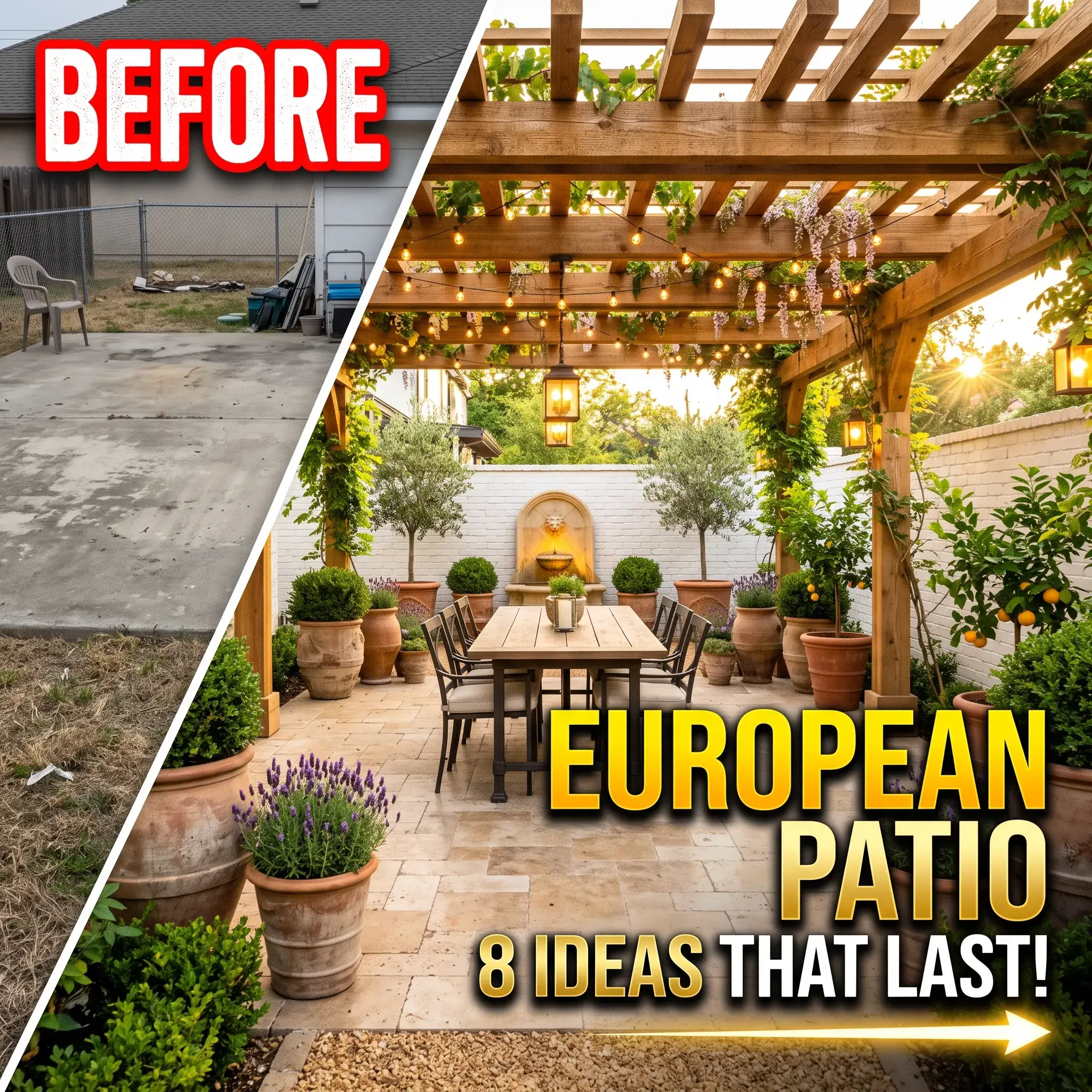
Most American backyards suffer from the same problem: a flat concrete slab, a patch of lawn, and a factory-made dining set. Within five years, the concrete stains, the furniture fades, and the yard feels lifeless.
European patios feel completely different. A courtyard in Provence or a stone terrace in Tuscany looks better after twenty years than it did on day one. These spaces succeed because they rely on natural stone, living shade, and regional craftsmanship. They treat the backyard as an outdoor living room rather than an empty yard.
Below are 8 practical European patio ideas you can build in your own yard. Each concept includes the layout formula, a list of real materials to source, and an architectural reference prompt. After the ideas, you will find engineering advice on drainage slopes, freeze-thaw protection, and cold-hardy plant substitutions for US growing zones.
8 Practical European Patio Ideas
1. The French Provençal Pea Gravel Terrace
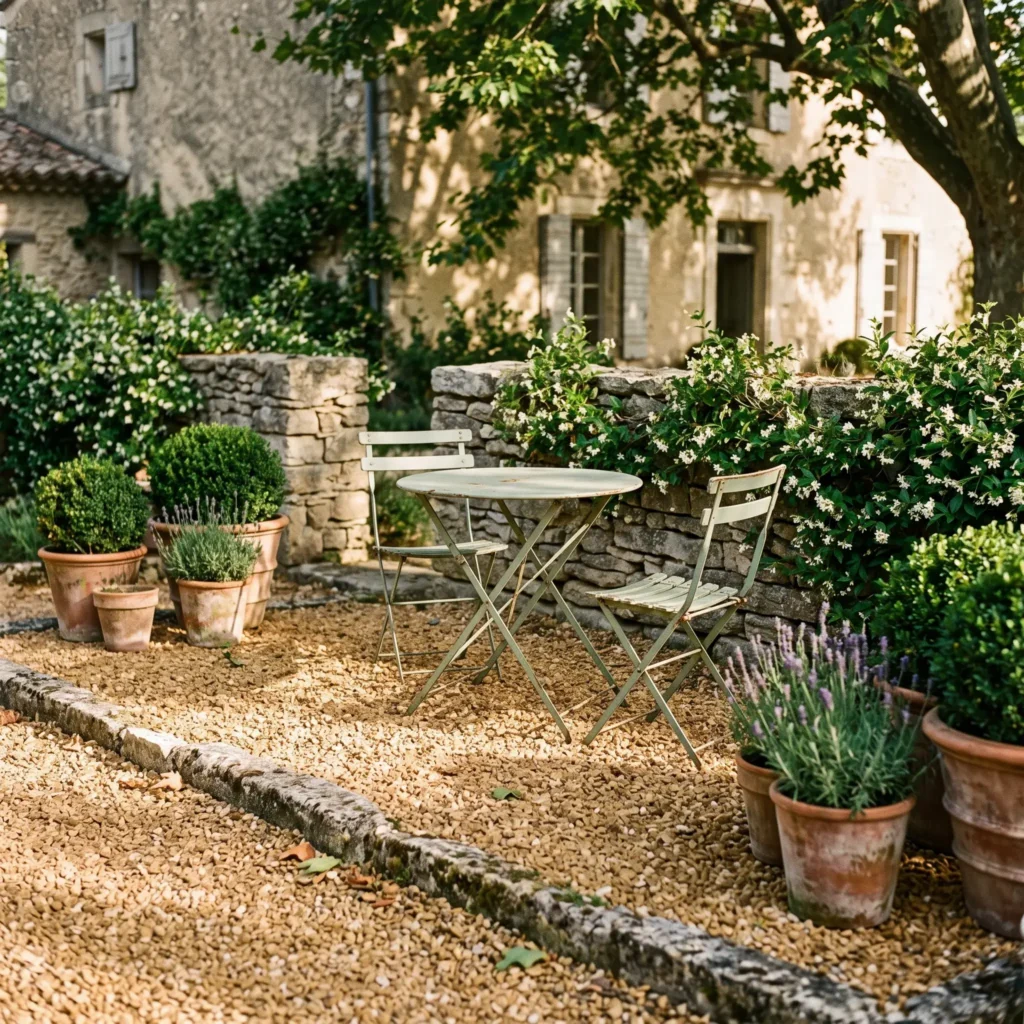
This design turns an open, sunny backyard into a casual dining terrace. Instead of pouring expensive concrete, you lay down a bed of loose pea gravel. The loose stone provides immediate drainage and makes a pleasant crunch under your shoes. Low stone walls border the gravel, while clipped boxwood spheres and fragrant lavender soften the perimeter. A classic metal bistro set provides an intimate spot for morning coffee.
Spatial Layout Breakdown:
- Foundation: 3/8-inch washed golden pea gravel contained by low limestone garden edging.
- Perimeter: Low dry-stack limestone retaining wall with climbing star jasmine.
- Center: Weathered round sage green bistro table with two folding wrought iron chairs.
- Greenery: Symmetrical unglazed terracotta pots with clipped boxwood globes and English lavender.
Sourcing List:
- 3/8-inch washed golden pea gravel
- Polypropylene honeycomb gravel stabilization grids
- French bistro folding metal table and chairs in antique sage
- Unglazed terracotta planters
- Corten steel or limestone perimeter landscape edging
- Plant materials: Lavandula angustifolia (English lavender), Buxus sempervirens (boxwood globes)
2. The Tuscan Villa Dining Terrace with Timber Pergola
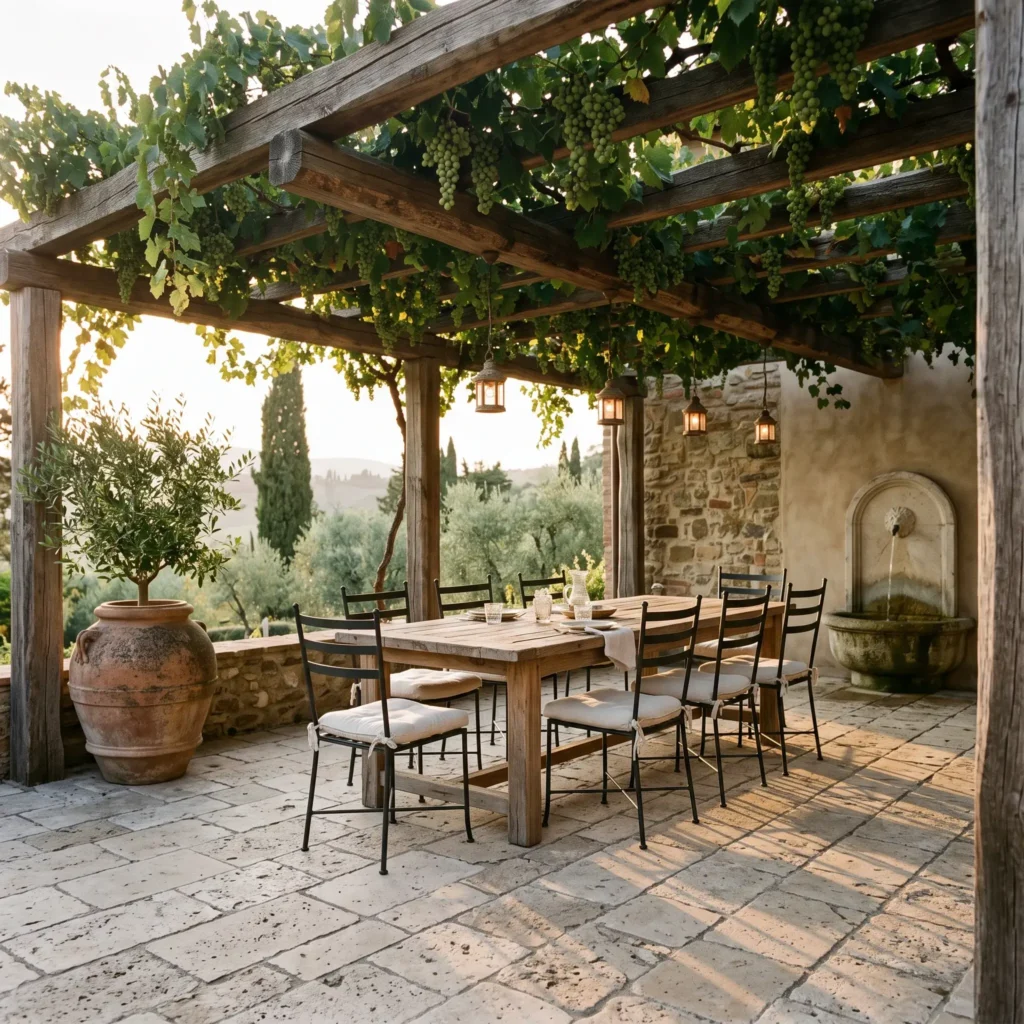
This layout focuses on evening meals with family and friends. The hardscape uses large tumbled travertine slabs with warm, earthy variations. Overhead, a rough-sawn cedar pergola provides structure and shade. Deciduous grapevines climb the posts to create a cooling green roof in midsummer. A long, weathered teak dining table anchors the center of the terrace, framed by dark iron chairs. An antique stone wall basin adds the calming sound of running water.
Spatial Layout Breakdown:
- Overhead Structure: Heavy rough-sawn cedar pergola covered with fruiting grapevines.
- Hardscape Base: Unfilled tumbled travertine pavers set with narrow sand joints.
- Dining Zone: Eight-foot reclaimed rustic teak dining table with six matte black iron armchairs.
- Focal Anchors: Carved limestone wall fountain on the back stone wall, paired with a large Impruneta terracotta jar holding an olive tree.
Sourcing List:
- Tumbled walnut or ivory travertine pavers (unfilled, exterior grade)
- Rough-sawn cedar or white oak 6×6 pergola posts
- 8-foot reclaimed teak outdoor dining table
- Matte black powder-coated iron dining chairs
- Hanging outdoor lantern with 2700K LED bulb
- Handcrafted Impruneta terracotta clay planter
- Plant materials: Vitis vinifera (grapevine), Olea europaea (olive tree)
Check out more Outdoor Decor Ideas
3. The Andalusian Enclosed Courtyard
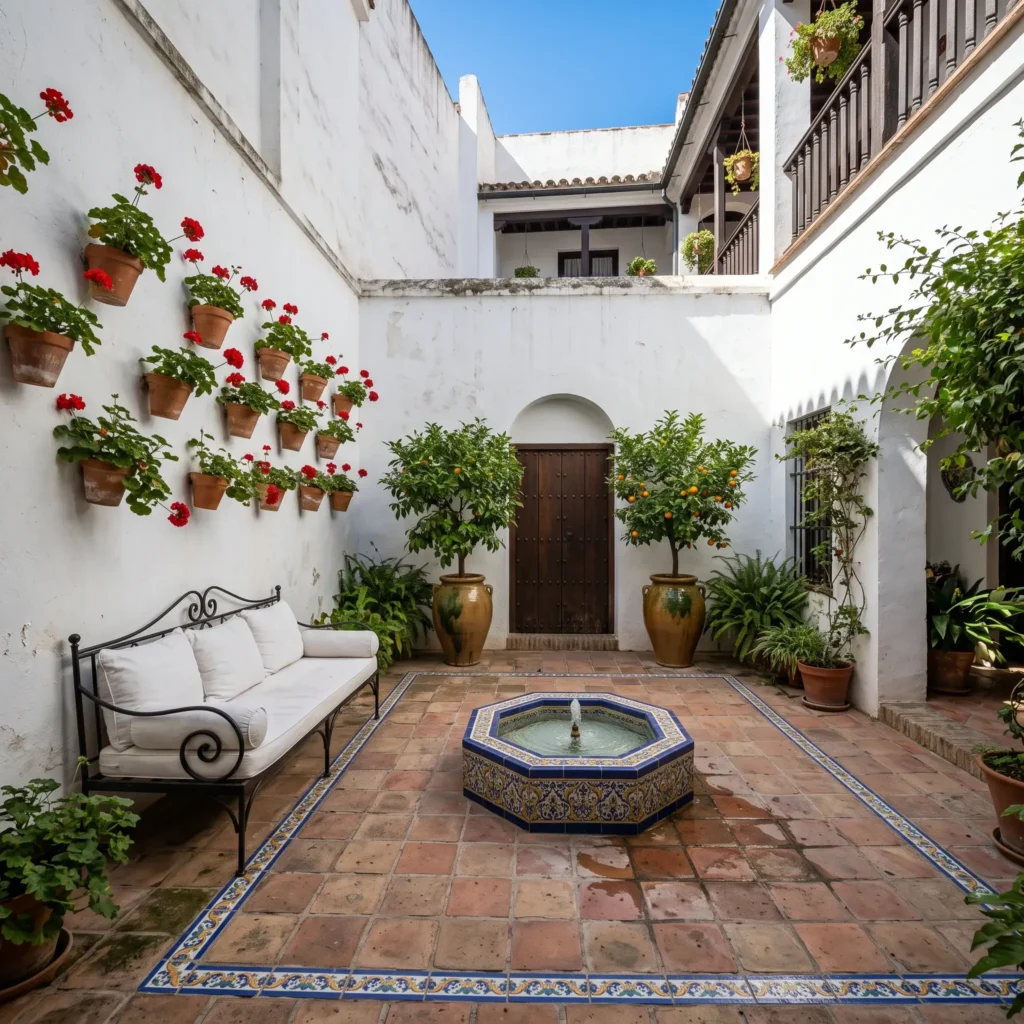
Inspired by southern Spain, this design fits enclosed urban backyards and zero-lot-line townhomes. High masonry walls finished in white lime wash block wind and reflect daylight into dark corners. The floor pairs warm terracotta tiles with cobalt blue glazed ceramic borders. In the center, a low octagonal fountain cools the air through evaporation. Bright red trailing geraniums hang in wall rings, turning vertical surfaces into lush gardens without taking up floor space.
Spatial Layout Breakdown:
- Boundary: Eight-foot perimeter masonry walls finished with matte white lime wash.
- Paving: High-fired clay terracotta tiles with cobalt blue and yellow hand-painted border inlays.
- Center Feature: Low octagonal cast-stone water basin with a gentle bubbling jet.
- Seating and Walls: Scrolled black wrought iron garden bench with off-white cushions, surrounded by wall-mounted terracotta pots.
Sourcing List:
- High-fired clay terracotta floor tiles
- Hand-painted Andalusian ceramic border tiles
- Traditional lime whitewash paint for exterior brick or stucco
- Cast-stone low garden fountain
- Wall-mounted iron pot ring brackets
- Scrolled wrought iron settee with Sunbrella ecru cushions
- Plant materials: Pelargonium peltatum (trailing geranium), Citrus limon (Meyer lemon), Trachelospermum jasminoides (star jasmine)
4. The English Arts and Crafts Stone Terrace
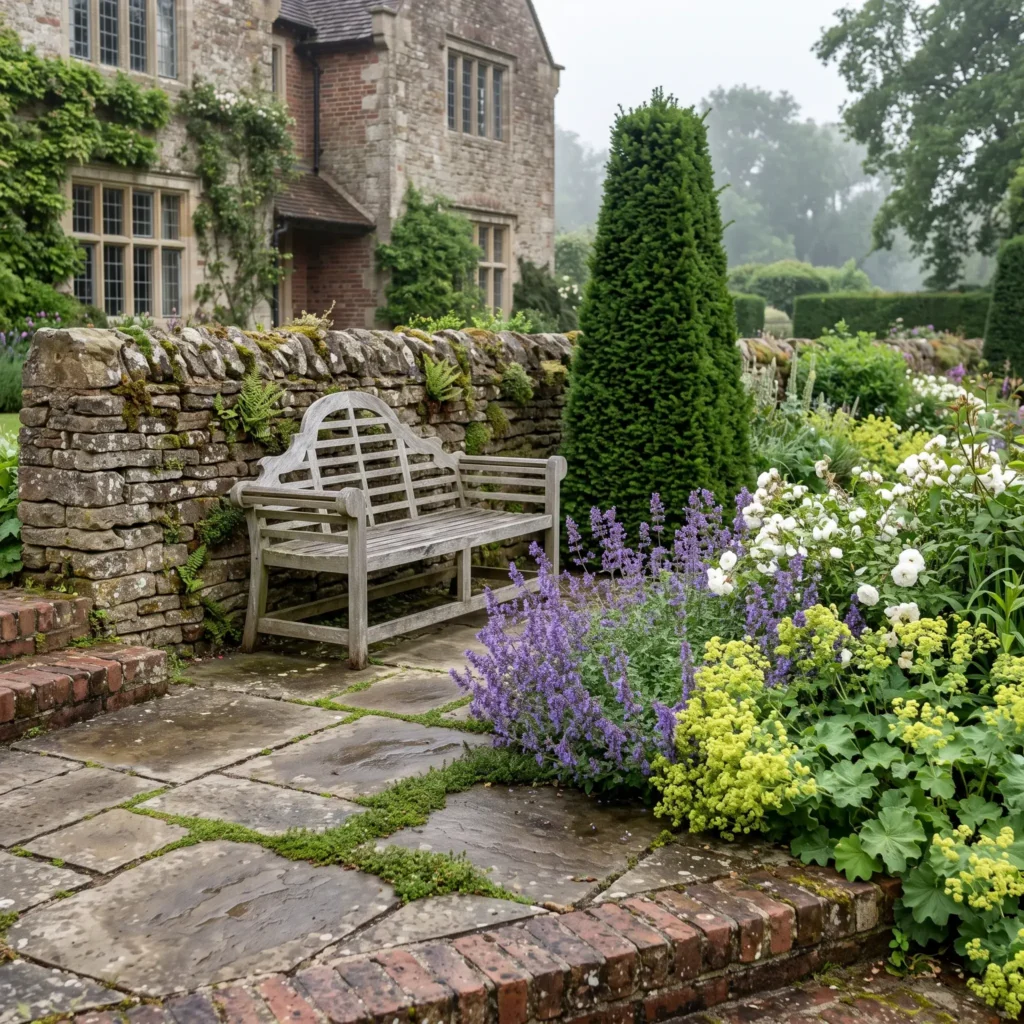
This style blends solid stonework with soft, informal planting. The patio uses irregular cleft flagstone bordered by antique red brick laid on edge. Instead of clean mortar joints, creeping thyme and moss grow inside the paver gaps, releasing scent when stepped on. A classic weathered teak bench sits against a low stone wall, overlooking deep perennial beds filled with catmint, English roses, and structural boxwood balls.
Spatial Layout Breakdown:
- Paving Surface: Irregular cleft Yorkstone or bluestone flagstones bordered by reclaimed red clay brick.
- Joints: Open soil joints planted with scented creeping thyme.
- Seating Area: Classic silver-gray teak garden bench set against a low sandstone wall.
- Garden Edge: Deep perennial border filled with purple catmint, white shrub roses, and a clipped yew cone.
Sourcing List:
- Cleft blue-gray or buff flagstone
- Reclaimed antique red clay brick pavers
- Solid teak Lutyens garden bench (left unfinished to weather gray)
- Cast-stone pedestal bird bath
- Permeable soil bedding mix for planted joints
- Plant materials: Thymus serpyllum (creeping thyme), Nepeta faassenii (catmint), Alchemilla mollis (lady’s mantle), heritage shrub roses
5. The Modern Mediterranean Limestone Lounge
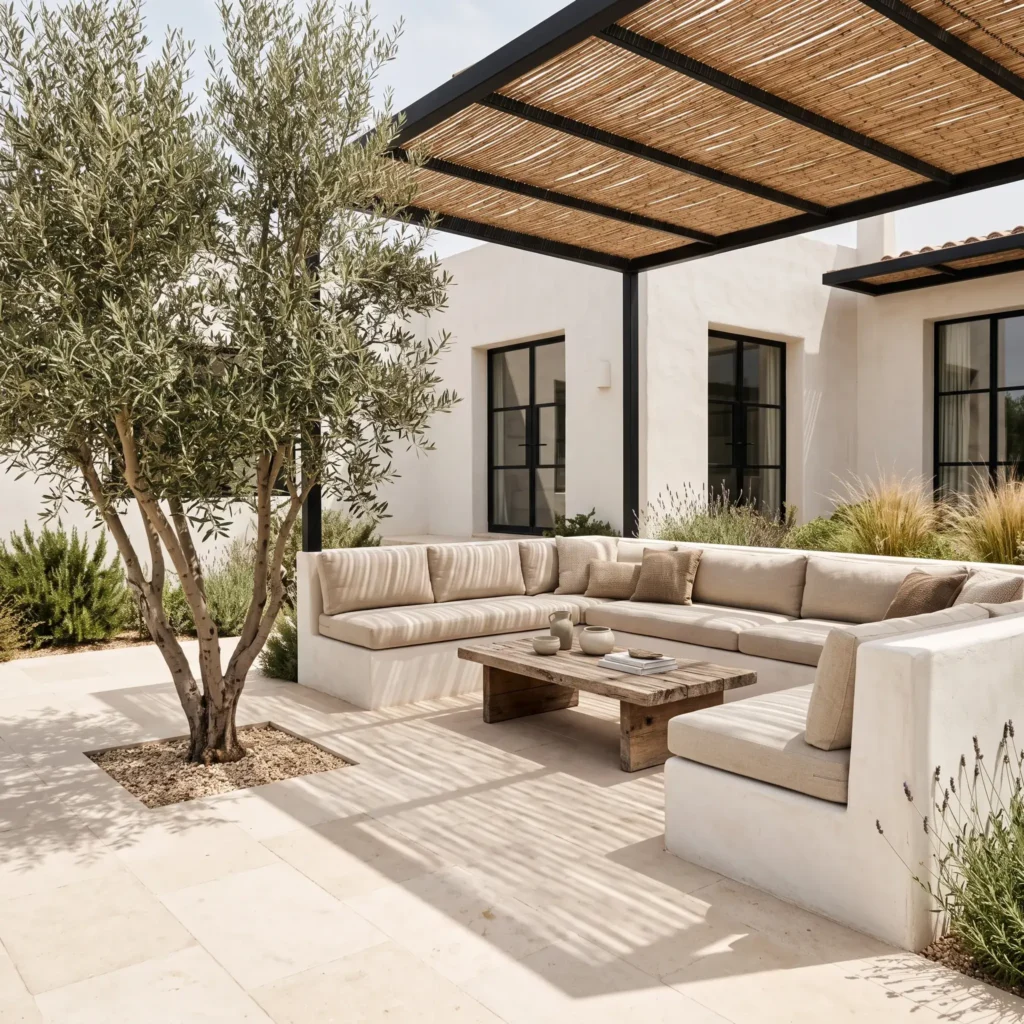
This concept adapts classic southern European materials for modern homes. It uses large-format, light cream limestone pavers with crisp saw-cut edges. A built-in masonry banquette runs along one perimeter wall, topped with thick stone-colored linen cushions. Overhead, a slim black steel pergola supports a natural split-reed screen, casting clean linear shadows across the floor. A sculptural, multi-stem olive tree anchors the corner in a simple bed of crushed stone.
Spatial Layout Breakdown:
- Paving Floor: Large 24×36 inch honed exterior cream limestone tiles with tight joints.
- Built-in Seating: White acrylic stucco corner banquette with thick oatmeal linen cushions.
- Shade Canopy: Slim matte black steel pergola frame with a split bamboo reed screen.
- Focal Accent: Multi-stem olive tree growing from a square cutout, surrounded by crushed stone.
Sourcing List:
- 24×36 inch honed exterior limestone tiles
- Concrete masonry block with white acrylic stucco finish for banquette
- Custom solution-dyed acrylic cushions in oatmeal slub texture
- Matte black structural steel or aluminum pergola frame
- Split bamboo or reed overhead roll roofing
- Salvaged timber slab low table
- Plant materials: Multi-stem Olea europaea (olive), Rosmarinus officinalis ‘Prostratus’ (creeping rosemary)
6. The Parisian Bistro Courtyard with Espalier Fruit Trees
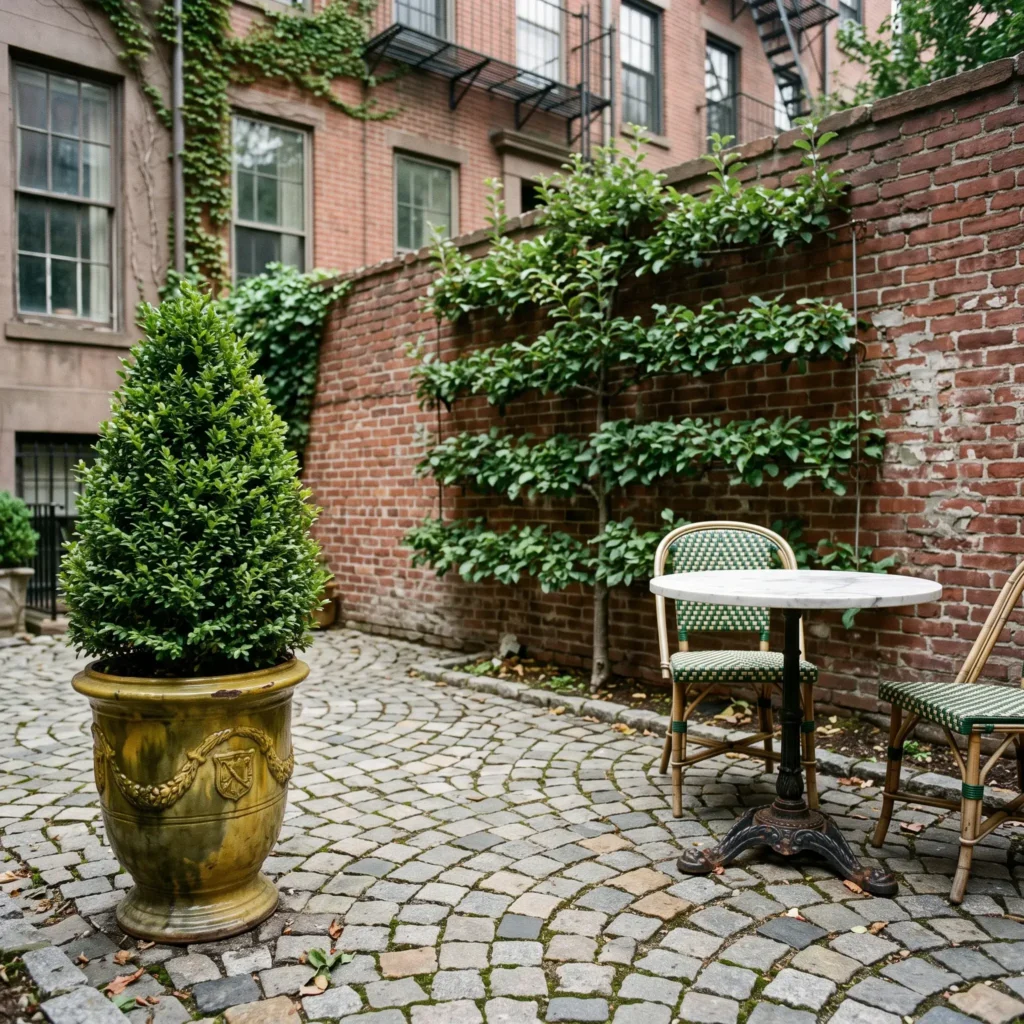
This layout turns a narrow side yard or small urban patio into a charming private dining nook. Reclaimed granite cobblestones pave the ground in traditional curved fan patterns. A tall brick wall supports espalier pear trees, trained flat against galvanized guide wires to save floor space while producing fruit. A round Carrara marble table with a heavy cast-iron base pairs with woven Parisian wicker cafe chairs. A classic glazed French planter adds historic character to the corner.
Spatial Layout Breakdown:
- Ground Surface: Salvaged granite cobblestones laid in interlocking curved fan arcs.
- Vertical Wall: Weathered red brick wall supporting a four-tier horizontal espalier pear tree.
- Dining Vignette: 30-inch round Carrara marble table with ornate cast-iron pedestal base and two woven cafe chairs.
- Planter Accent: Authentic olive and yellow flame glazed Vase d’Anduze holding a clipped boxwood cone.
Sourcing List:
- Salvaged granite cobblestones (granite setts)
- Heavy cast-iron pedestal table base with honed Carrara marble top
- Woven French cafe chairs (polyethylene weave on bent rattan frame)
- Ceramic Vase d’Anduze with flame glaze
- Stainless steel turnbuckles and guide wire kit for wall espalier
- Blackened iron wall-mount outdoor lantern
- Plant materials: Espalier Pyrus communis (pear) or Malus domestica (apple), Buxus sempervirens
7. The Italian Loggia with Brick Herringbone Floors
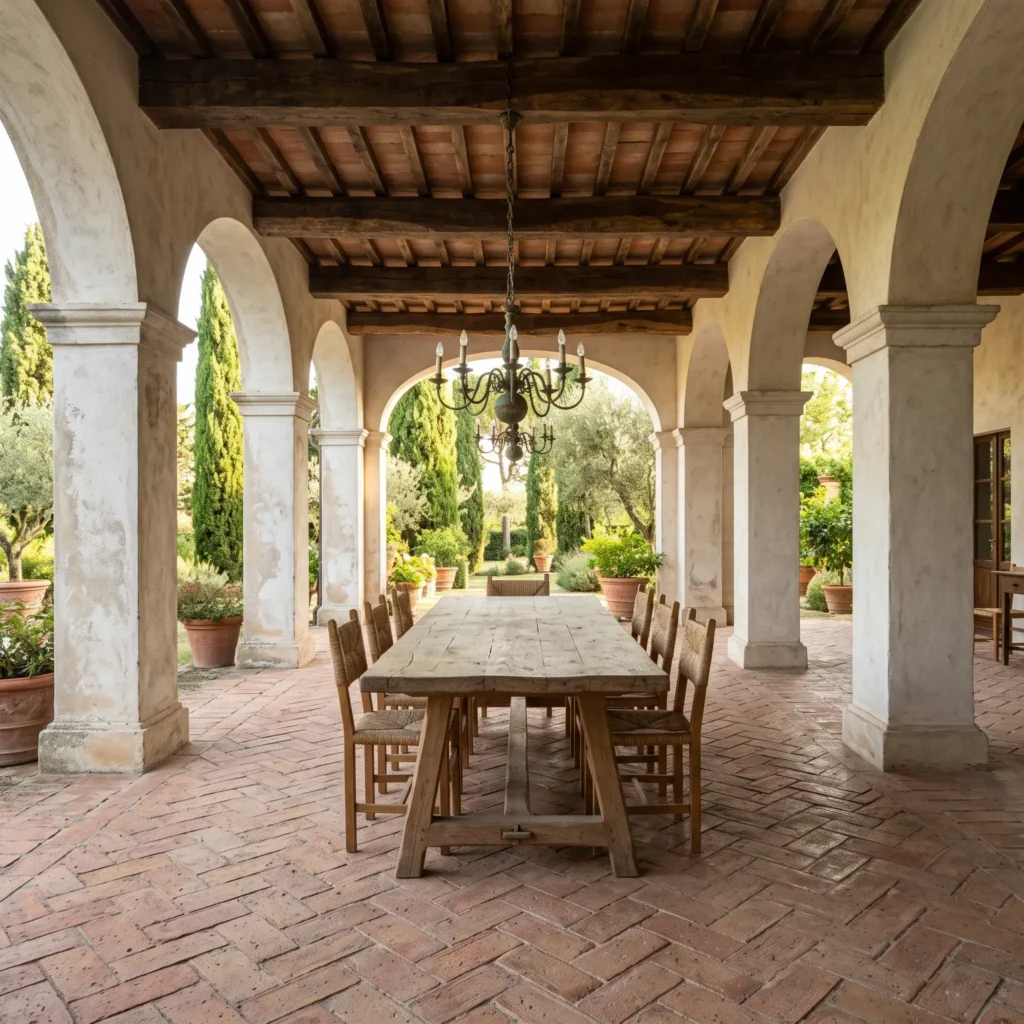
A loggia is an exterior covered room open to the outdoors on one or more sides. This design uses high-fired terracotta brick pavers laid in a classic 90-degree herringbone pattern. Masonry arches frame views into the garden while blocking midday heat and rain. A heavy solid white oak dining table with rush-seat chairs sits beneath the roof. In colder months, the covered roof holds heat, making this space usable through three full seasons.
Spatial Layout Breakdown:
- Shelter: Plastered stone columns supporting Roman arches with an exposed timber beam ceiling.
- Floor Paving: Wire-cut terracotta clinker bricks laid in a 90-degree herringbone pattern.
- Furnishing: Eight-seat rustic European white oak trestle table with woven rush dining chairs.
- Lighting: Antiqued unlacquered brass chandelier hanging directly above the table center.
Sourcing List:
- High-fired clay brick pavers (frost-proof clinker grade)
- Solid European white oak trestle dining table
- Hand-woven rush dining chairs with solid wood frames
- Heavy timber ceiling beams (Douglas fir or reclaimed white oak)
- Antiqued brass or dark bronze pendant chandelier
- Plant materials: Cupressus sempervirens (Italian cypress in background garden), Ficus carica (potted fig tree)
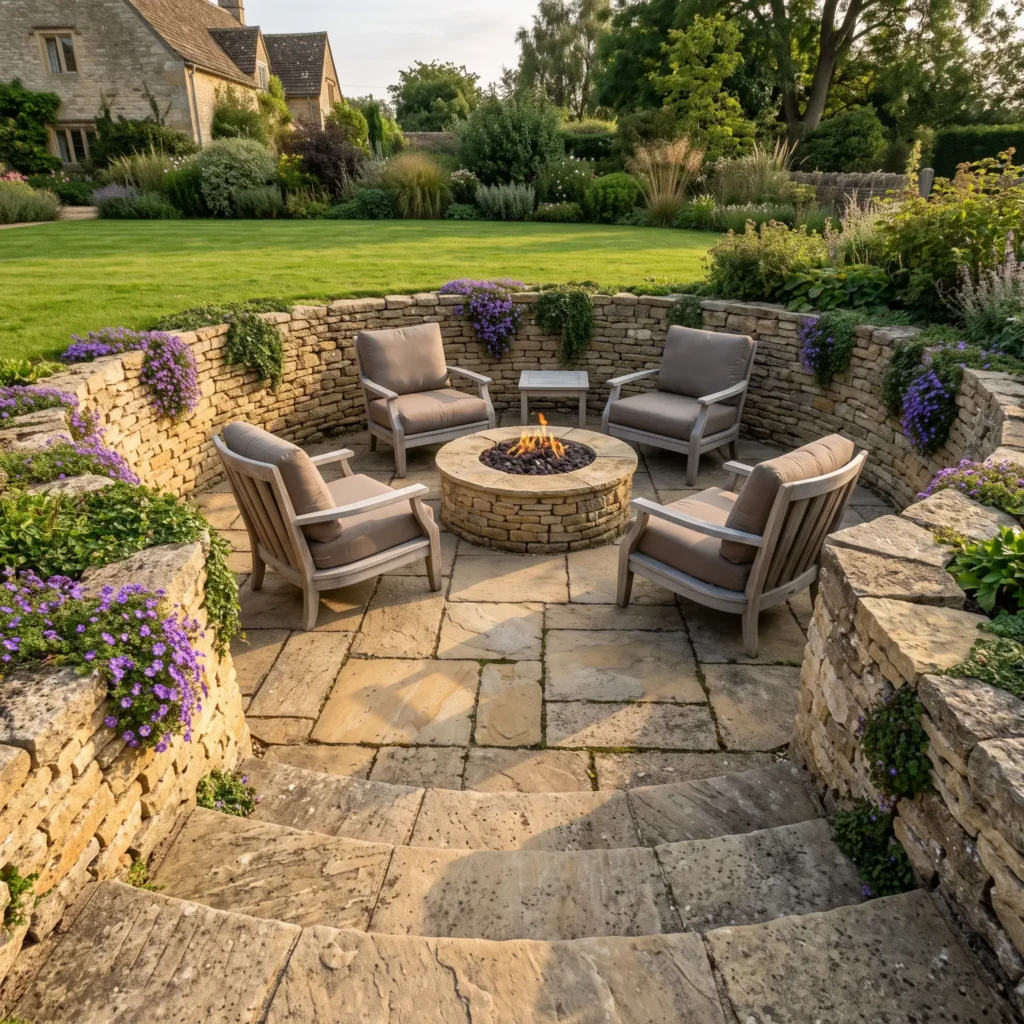
8. The Cotswold Sunken Garden Terrace
Lowering the patio two feet below lawn level creates an intimate, sheltered sanctuary. Dry-stack golden limestone walls retain the surrounding soil, acting as a windbreak and trapping daytime heat. Wide stone steps lead down to a sandstone-paved sitting area centered around a low stone fire table. Because the patio sits lower than the lawn, flowers and shrubs bloom at eye level when you sit down.
Spatial Layout Breakdown:
- Elevation: Sunken patio set two feet below grade, reached by three wide curving stone steps.
- Walls: Dry-stacked honey-colored Cotswold limestone retaining walls planted with purple rock cress.
- Paving: Natural cleft golden sandstone pavers with hand-dressed edges.
- Lounge Zone: Round stone fire table surrounded by four curved weathered teak deep-seating armchairs.
Sourcing List:
- Natural cleft golden sandstone or bluestone flagstones
- Dry-stack limestone walling stone
- Low-profile natural stone gas fire table
- Weathered teak deep-seating outdoor lounge chairs
- Low-voltage brass step lights mounted beneath wall coping
- Plant materials: Aubrieta deltoidea (rock cress), Campanula portenschlagiana (wall bellflower), dwarf boxwood edging
Civil Hardscaping Engineering: Why European Patios Endure
European stone patios survive for generations because their builders understood drainage and seasonal freeze cycles. If you copy only the surface look without proper base preparation, your patio will shift, crack, and puddle after one harsh winter.
Layered Installation Sequence
To build a stable patio, follow this layered profile from the ground up:
- Subgrade: Compacted soil sloped away from the foundation.
- Separation Membrane: Heavy-duty non-woven geotextile fabric to prevent stone from sinking into native mud.
- Base Layer: 4 to 6 inches of compacted open-graded crushed stone (3/4-inch aggregate without fines).
- Bedding Layer: 1 inch of sharp bedding sand or fine grit.
- Surface Pavers: Natural stone, clay clinker, or gravel locked in place with permeable joint sand.
1. Water Slope and Runoff Control
Standing water destroys stone patios. When water enters joints and freezes, it expands by roughly nine percent. This expansion cracks mortar joints, lifts pavers, and causes stone faces to spall off.
- Slope Ratio: Grade every patio away from your home foundation with a minimum fall of 1:60 to 1:80 (a 1.5% to 2.0% pitch). This means the surface drops 1/4 inch for every one foot of horizontal distance.
- Threshold Transitions: Where stone surfaces directly touch interior doorways, install a cast-bronze or black aluminum slot drain. This catches sheet runoff during heavy rains without requiring an ugly concrete step.
2. Freeze-Thaw Stone Selection
Not all natural stone works in cold US states (such as USDA Zones 4 through 6).
- Travertine Considerations: Cross-cut, unfilled travertine has internal air pockets that collect moisture. In freezing regions, ice expansion causes the surface to pit and crumble. If you live in the Northeast or Midwest, choose high-density, vein-cut travertine with a tumbled finish. Alternatively, use dense French limestone (like Burgundy stone) with water absorption under 1.5%.
- Terracotta Alternatives: Standard decorative terracotta pots crack in freezing temperatures. For reliable frost resistance down to -20°F, use certified Italian terracotta made from galestro clay (such as Impruneta). For the floor, choose high-fired vitrified clay clinker pavers or frost-proof exterior porcelain tile that replicates aged cotto.
3. Stabilizing Loose Pea Gravel
Loose pea gravel looks great, but walking on three inches of unconstrained round stone feels like walking in deep beach sand. Patio chair legs sink, and wheels get stuck.
- The Honeycomb Solution: Excavate four inches of dirt, lay a non-woven geotextile fabric, and compact three inches of crushed aggregate road base. Lay polypropylene honeycomb stabilizing grids directly on top. Fill the honeycomb cells with 3/8-inch pea gravel, leaving only 1/4 inch of loose stone across the top. The honeycomb locks the stones in place, letting you roll carts and sit on dining chairs without sinking.
Plant Selection: Getting the European Look in American Climates
Classic Mediterranean plants often struggle in humid southern summers or freezing northern winters. Use the table below to find cold-hardy, climate-appropriate plants that provide the same historic European silhouette.
| Classic European Species | Look & Function | Best European Zone | Cold-Hardy / Resilient US Alternative | Suitable US Zones |
| Olea europaea (Olive Tree) | Dappled shade, silver foliage, architectural gnarled trunk | Zone 8–10 (Mild winters) | Elaeagnus commutata (Silverberry) or potted ‘Arbequina’ Olive brought indoors for winter | Zones 2–6 (for silverberry); Zones 7–10 (outdoor olive) |
| Cupressus sempervirens (Italian Cypress) | Tall, slender vertical green accents flanking doorways | Zone 7–10 (Dry summers) | Juniperus virginiana ‘Taylor’ (Taylor Juniper) or Ilex crenata ‘Sky Pencil’ | Zones 4–9 (Taylor Juniper has identical pencil-thin shape) |
| Buxus sempervirens (English Boxwood) | Clipped spheres, low geometric hedging, parterre beds | Zone 6–8 | Ilex glabra ‘Gem Box’ (Inkberry Holly) or Microbiota decussata (Russian Cypress) | Zones 3–9 (Resists boxwood blight and winter bronzing) |
| Lavandula angustifolia (English Lavender) | Low fragrant purple borders, silvery leaves | Zone 5–8 (Dry alkaline soil) | Nepeta x faassenii ‘Walker’s Low’ (Catmint) or Salvia nemorosa | Zones 3–9 (Handles heavy clay soils and wet winters easily) |
| Vitis vinifera (Wine Grape) | Broad overhead leaf canopy over timber pergolas | Zone 7–9 | Vitis labrusca ‘Concord’ or Parthenocissus tricuspidata (Boston Ivy) | Zones 4–9 (Survives severe northern freezes without dieback) |
Authentic Historic Planters
Because historic European courtyards sat directly over bedrock, cisterns, or wine cellars, gardeners used large portable vessels instead of planting in the ground. Three historic container styles anchor an authentic design:
- The Impruneta Terracotta Urn (Italy): Crafted in Tuscany from iron-rich galestro clay and fired above 1000°C. These pots resist freeze-thaw cycles down to -20°F. Over time, the porous clay absorbs mineral salts and develops a chalky, natural patina that softens stone walls.
- The Vase d’Anduze (France): First designed in 1610 in southern France, this pot has an inverted bell shape on an elevated pedestal. It features stamped crests and an uneven flame glaze in olive, amber, and dark brown slips. It provides an immediate focal point on stone terraces.
- The Caisse de Versailles (France): Created in the 17th century for King Louis XIV’s orangery. Built from solid white oak planks inside a cast-iron frame with turned ball finials, it features removable side panels. This lets gardeners root-prune large citrus and bay laurel trees without unseating the heavy specimen.
Lighting, Metals, and Outdoor Textiles
Modern LED floodlights and bright white strip lighting wash out the warm tones of natural stone. Authentic European outdoor living spaces rely on warm, low-glare illumination and materials that age gracefully outdoors.
- Color Temperature: Keep all outdoor lighting between 2200K and 2700K. This warm spectrum replicates the soft glow of candles, fireplaces, and historic gas lamps, highlighting the natural amber tones in stone and brick.
- Uncoated Living Metals: Avoid shiny chrome, raw aluminum, or glossy black powder coats. Choose unlacquered brass, raw copper, and blackened iron. Over months of rain and sun, copper turns to dark brown and soft green verdigris, while brass takes on an antique bronze tone.
- Textiles: Stay away from bright, saturated geometric patterns. Choose earth tones like unbleached ecru, chalk white, weathered olive, and raw terracotta. Look for solution-dyed acrylics woven with irregular slubbed yarns that look and feel like raw flax linen while resisting UV rays and mildew.
Frequently Asked Questions
What are the main elements of a European-style patio?
A European-style patio relies on four core elements: natural hardscaping that develops a patina (such as pea gravel, tumbled travertine, or reclaimed brick), a defined boundary wall or pergola that creates an enclosed outdoor room, a cooling water feature like a stone wall basin, and layered container plants in terracotta urns.
What is the best gravel for a European patio?
The best gravel is 3/8-inch washed pea gravel or decomposed granite in golden-tan, buff, or warm gray tones. Unlike sharp crushed gravel, rounded pea gravel is comfortable underfoot, compacts cleanly over a crushed stone base, and drains surface water immediately.
How do you stop furniture from sinking into a gravel patio?
To prevent chair legs from sinking, install polypropylene honeycomb stabilization grids underneath the gravel layer. Lay the grids over a compacted road-base layer, fill the honeycomb cells with pea gravel, and leave only 1/4 inch of loose stone across the surface. The grids distribute weight evenly while keeping the loose stone look.
How much does it cost to build a European-style patio?
A loose pea gravel terrace with timber edging costs between $6 and $12 per square foot for a DIY installation. A high-end stone terrace using tumbled travertine, reclaimed brick, or natural flagstone installed by a masonry contractor typically costs between $25 and $45 per square foot, depending on soil excavation and site grading needs.
How do you give a small backyard a European courtyard feel?
Focus on vertical surfaces to maximize floor space. Paint boundary walls in light lime wash to reflect natural light. Mount espalier fruit trees or trellises with star jasmine against the walls. Replace bulky outdoor sectionals with a compact two-person French folding bistro set, and install a wall-mounted tiered stone fountain to add relaxing sound without taking up square footage.
Final Recommendations
Building a European-style patio is about choosing materials that age with character rather than items that look modern for one season.
Start from the ground up:
- Grade your soil to a 1.5% to 2% slope away from your foundation to prevent water damage.
- Pick a foundation that fits your budget: use stabilized pea gravel for an affordable DIY option, or tumbled natural stone for a permanent masonry terrace.
- Add architectural shade with a cedar pergola or an espalier wall.
- Finish the space with unlacquered metal fixtures, warm 2700K lighting, and cold-hardy plant varieties that thrive in your local climate.
By investing in natural materials and proper drainage today, your patio will become a peaceful outdoor retreat that grows more beautiful with every passing year.