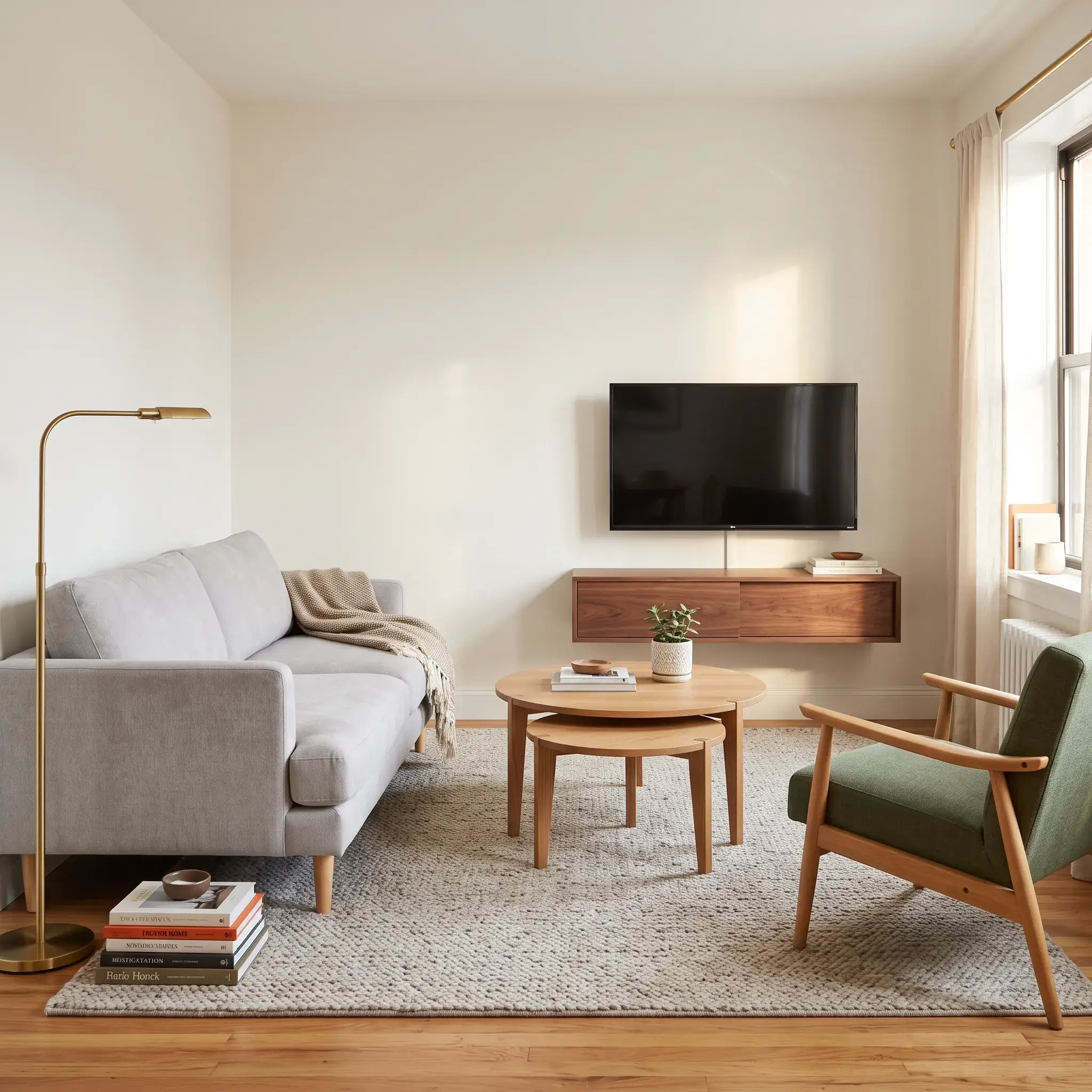
8 Primary Bedroom Decor Pieces That Make the Room Feel Finished

You bought the bed frame, the mattress, and two matching nightstands. Your clothes are put away in the dresser. Yet when you walk into the room, something feels off. The space feels hollow, sterile, and disconnected, almost like an uncurated showroom floor.
Designers call this the 85 percent finished trap. Most homeowners stop once the large furniture arrives. Large furniture only provides utility. What makes a room feel finished are the secondary layers: correct scale, acoustic dampening, light temperature, and surface boundaries.
Here are 8 visual decor ideas with exact measurements, styling rules, and product guides to turn an empty room into a finished primary retreat.
8 Practical Decor Pieces That Complete a Primary Bedroom
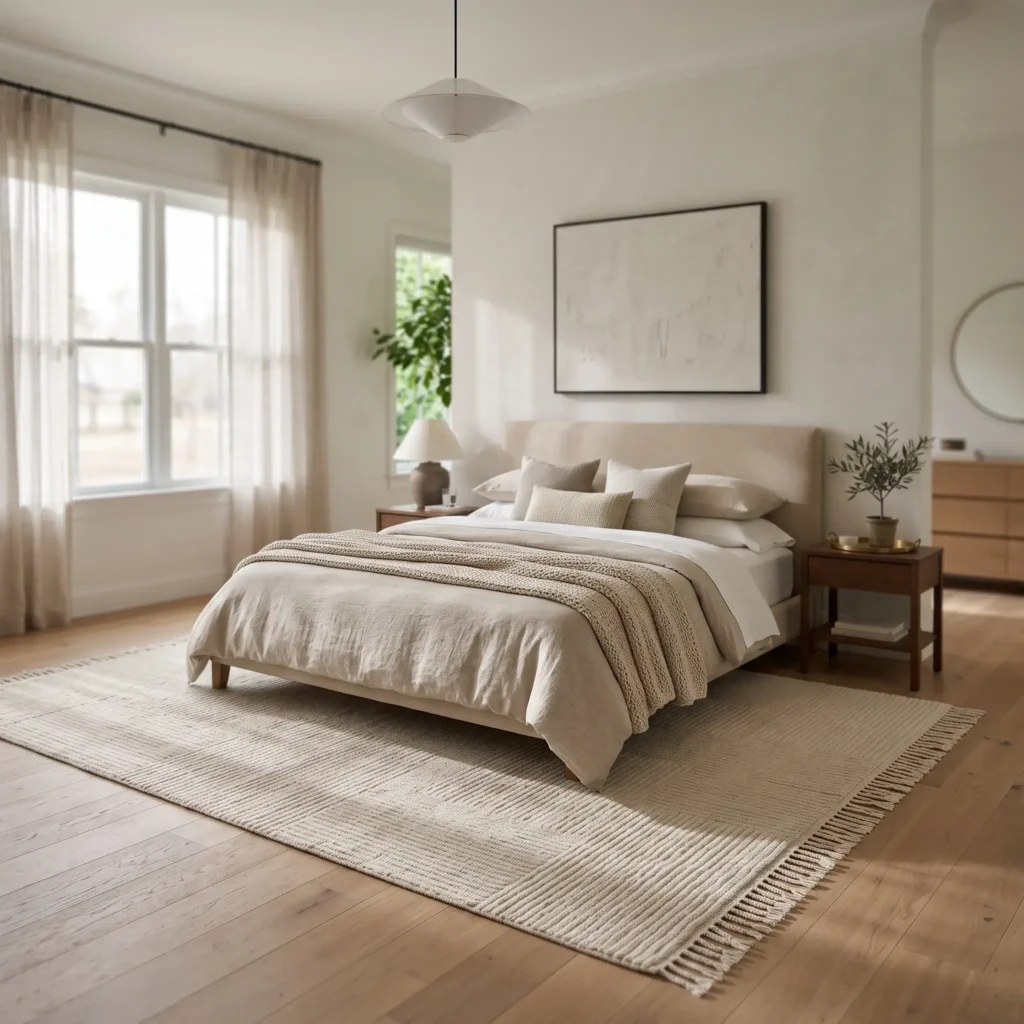
1. The Anchoring Area Rug with an 18-to-24-Inch Margin
An undersized floor covering leaves the bed floating like a raft on bare flooring. A properly scaled rug anchors the bed, foot bench, and nightstands into one unified visual footprint while absorbing room echo.
- Placement Rule: Orient the rug perpendicular to the bed. Leave 18 to 24 inches of visible soft rug on both sides and at the foot. A Queen bed needs at least an 8×10 foot rug. A King bed requires a 9×12 foot rug so the nightstands and foot bench rest on the textile.
- Featured Products for This Setup:
- 9×12 foot hand-tufted wool loop area rug in warm ivory
- Non-slip felt rug pad (1/4 inch thickness)
- White oak platform bed frame
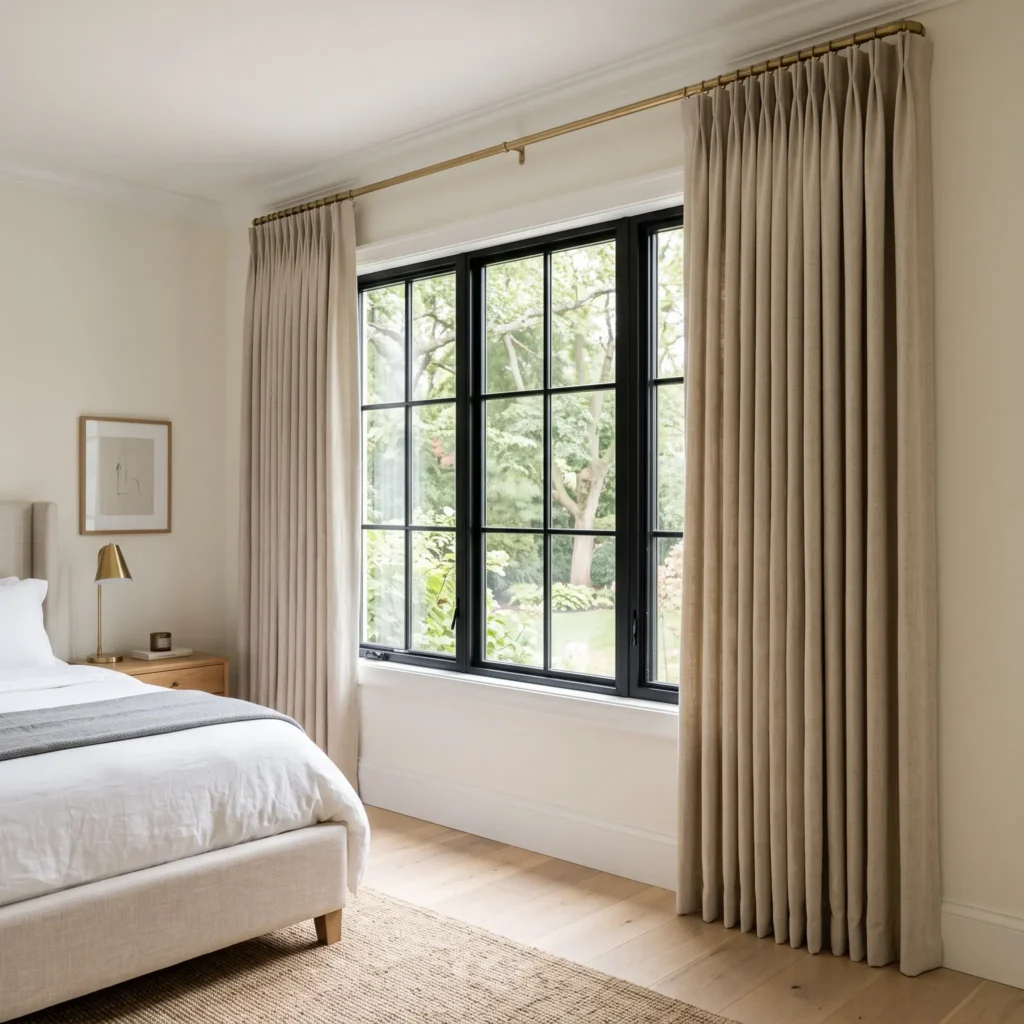
2. High-and-Wide Pinch-Pleat Linen Drapery
Bare window glass and standard blinds make walls look stark and short. Floor-length drapery softens the drywall, insulates against outside noise, and visually lifts low ceilings.
- Placement Rule: Mount the curtain rod 6 to 10 inches above the window frame, or right below the ceiling molding. Extend the rod 8 to 16 inches past the sides of the window trim. This lets the panels rest completely off the glass when open, making the window look twice its actual size. The fabric hem should touch the floor or break by a half inch.
- Featured Products for This Setup:
- Custom pinch-pleat lined Belgian linen curtain panels (96 or 108 inches)
- Heavy-duty unlacquered brass curtain rod with French return brackets
- Brass curtain rings with quiet nylon glides
Check out more Decor Styles
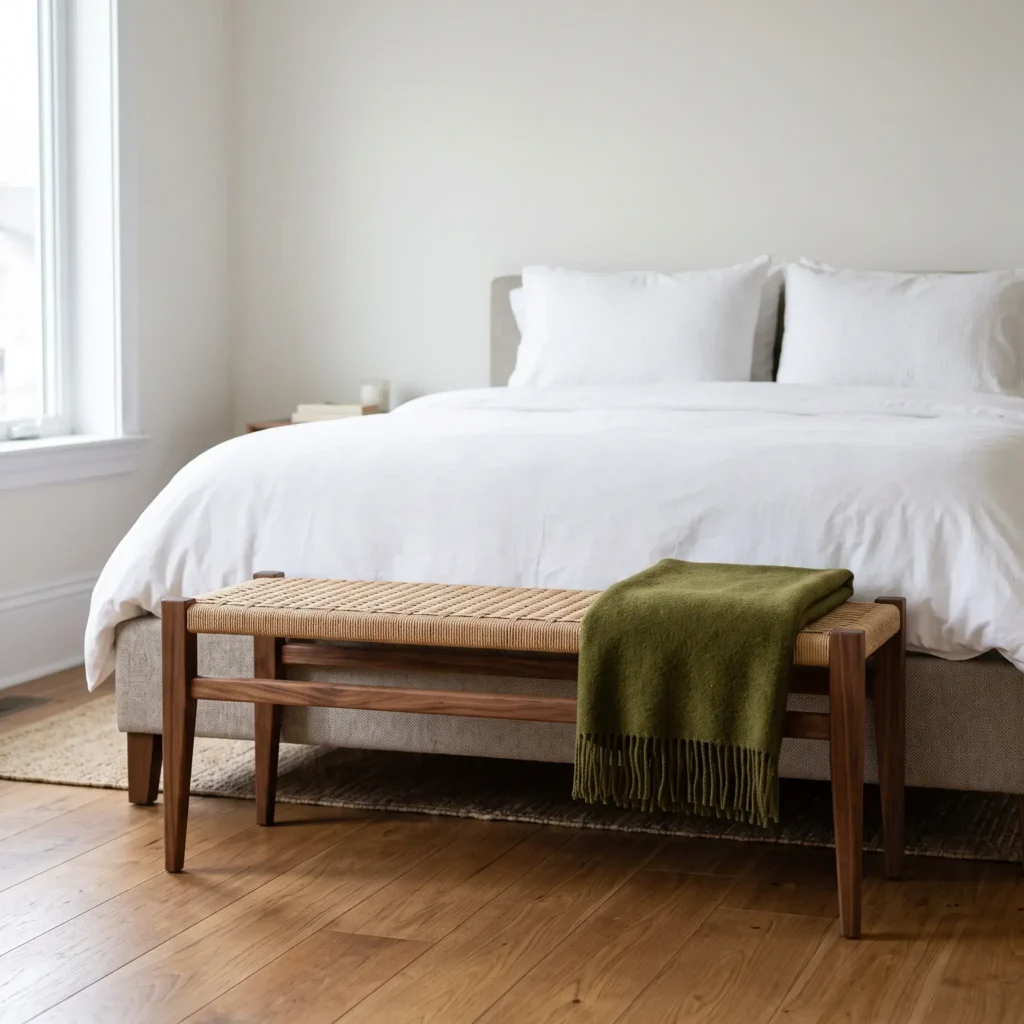
3. The Three-Quarter Scale Foot-of-Bed Bench
The foot of the bed often feels like an abrupt drop-off into empty space. A low bench caps the mattress length, adds utility for morning dressing, and introduces a contrasting texture like leather, rush, or bouclé.
- Placement Rule: Choose a bench that measures roughly three-quarters (65 to 75 percent) of your bed’s total width. Leave 6 to 8 inches of exposed frame on each side. The top of the bench should sit 2 to 4 inches lower than the top of the made mattress.
- Featured Products for This Setup:
- Solid walnut bench with natural rush or woven cord seat
- Boiled wool or alpaca accent throw blanket
- Low ceramic pedestal bowl
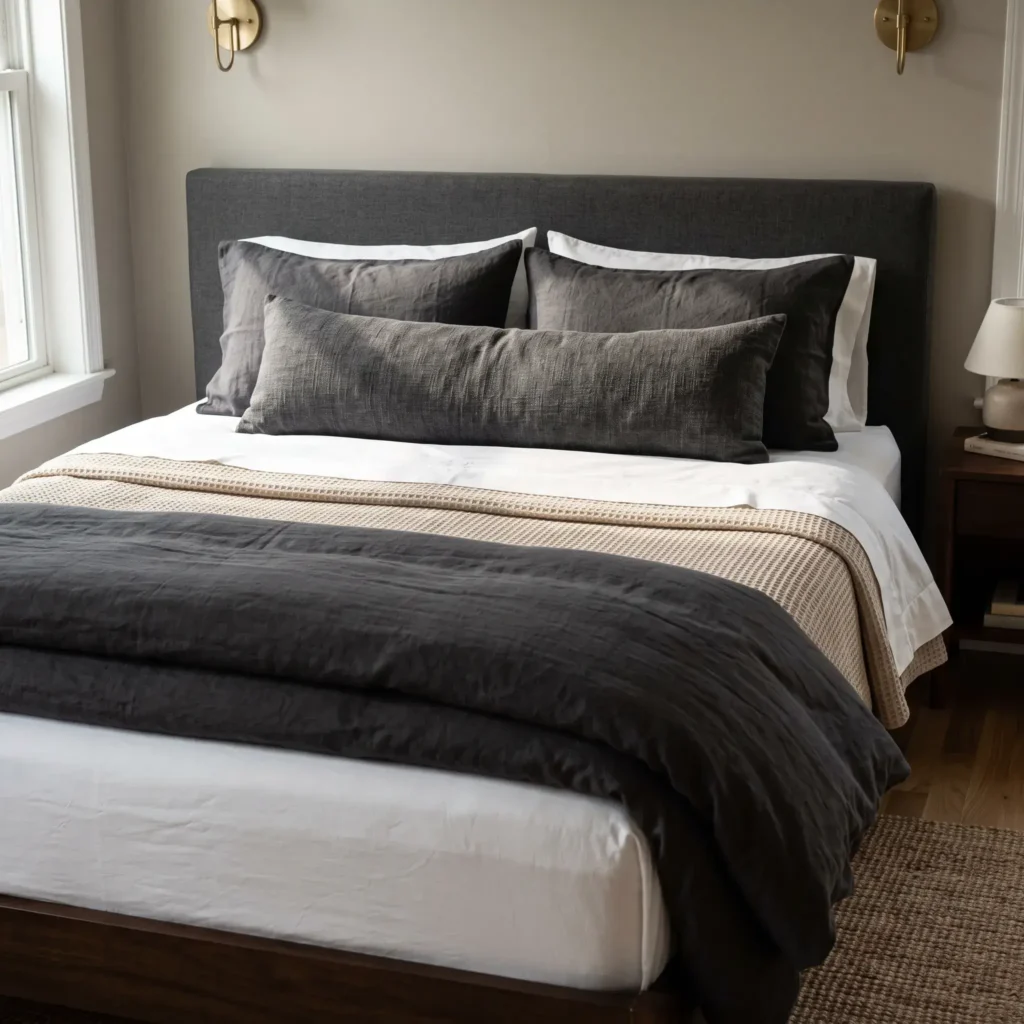
4. Tri-Tier Bedding with a Folded Loft Duvet
Pulling a single thin bedspread flat across your pillows flattens the visual weight of the room. A hotel-quality bed uses multiple fabric layers, varied densities, and folded loft.
- Placement Rule: Use crisp percale or linen base sheets. Layer a tightly tucked waffle-weave coverlet over the flat sheet. Fold a fluffy down duvet down to the bottom third of the bed with a double accordion fold. Replace six small decorative pillows with standard sleeping pillows laid flat, topped with a single wide lumbar pillow (14×36 or 14×48 inches).
- Featured Products for This Setup:
- 300-thread-count washed cotton percale sheet set
- Heavyweight waffle-weave cotton coverlet
- All-season European down comforter insert
- 14×36 inch textured linen lumbar pillow cover
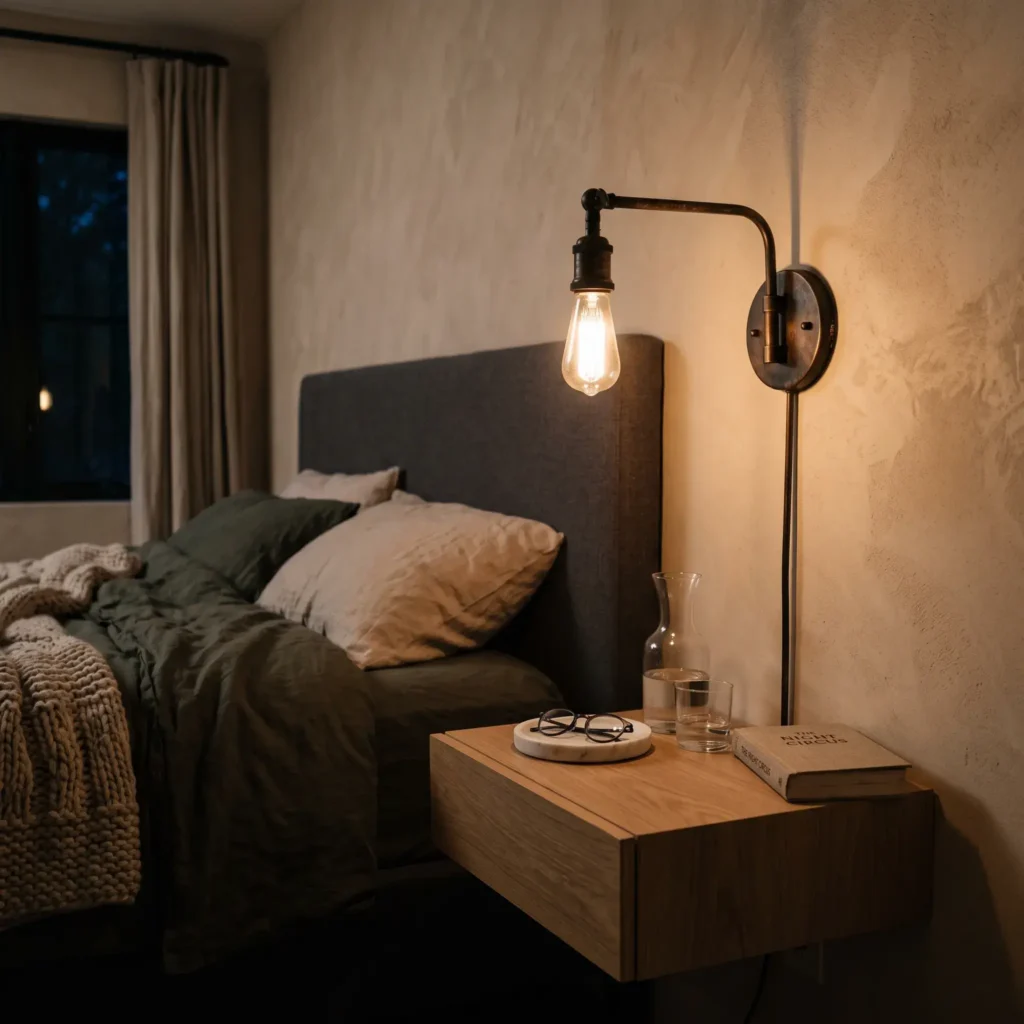
5. Eye-Level Bedside Wall Sconces (2700K Warm Light)
Relying on overhead ceiling fixtures creates harsh glare and casts unflattering downward shadows. Wall sconces clear clutter off your nightstand tops while casting warm pools of light directly at eye level.
- Placement Rule: Mount sconces 60 to 65 inches above the finished floor, or 12 to 18 inches above the top of the mattress. Use dimmable warm LED bulbs rated strictly between 2200K and 2700K to support evening circadian rest.
- Featured Products for This Setup:
- Articulated swing-arm pin-up or hardwired wall sconce in blackened bronze
- 2700K warm white dimmable E26 LED filament bulb
- Hand-blown glass bedside water carafe with drinking glass
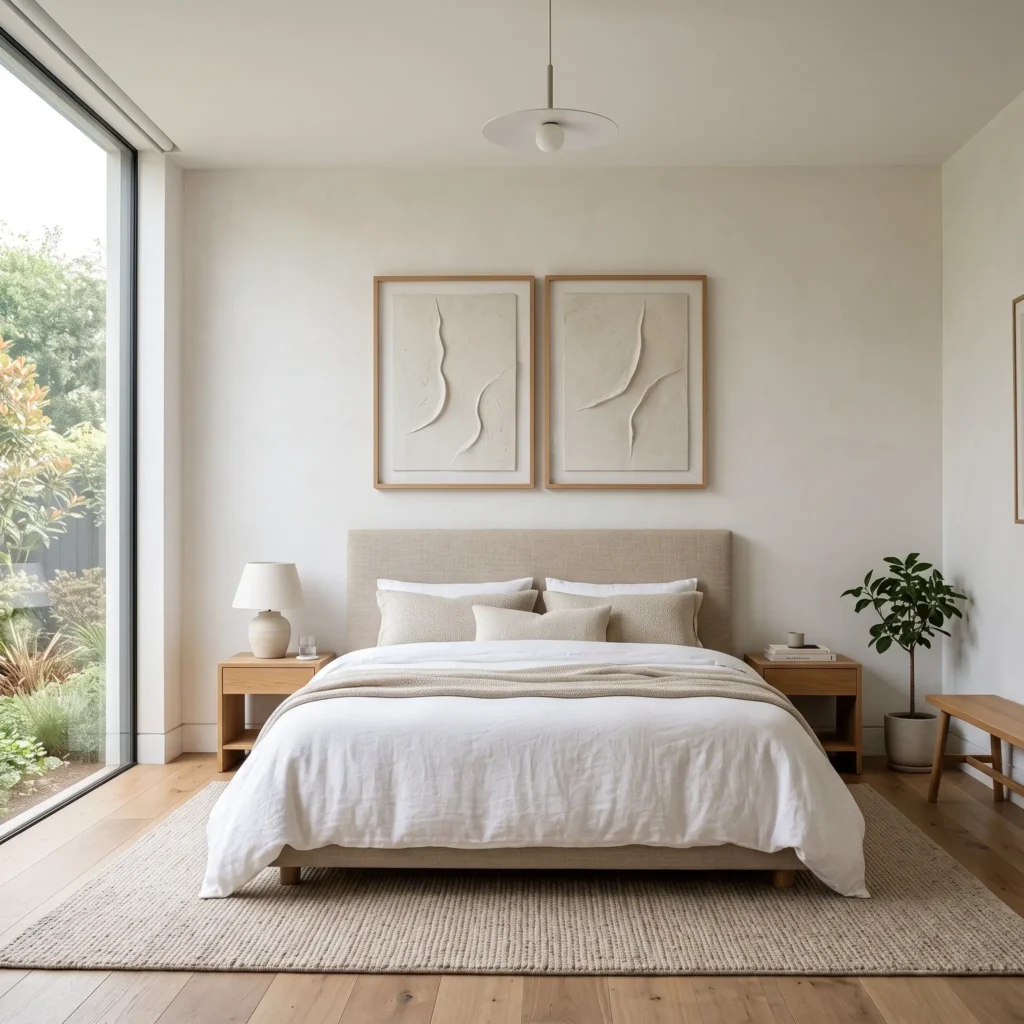
6. The Two-Thirds Headboard Horizon Wall Art
A tiny picture frame hanging high above a wide headboard looks lost on the wall. Proportional art anchors the vertical plane and grounds the bed as the central architectural focal point.
- Placement Rule: The total width of your artwork should cover 60 to 75 percent of the headboard width. For a 60-inch Queen bed, aim for 40 to 45 inches of art. For a 76-inch King bed, target 50 to 58 inches. Hang the bottom edge of the frame 6 to 10 inches above the crown of the headboard. Never hang it at standing museum height.
- Featured Products for This Setup:
- Set of two 24×36 inch minimalist plaster relief framed canvases
- Custom thin white oak gallery frames with UV museum acrylic
- Heavy-duty picture hanging cleat system
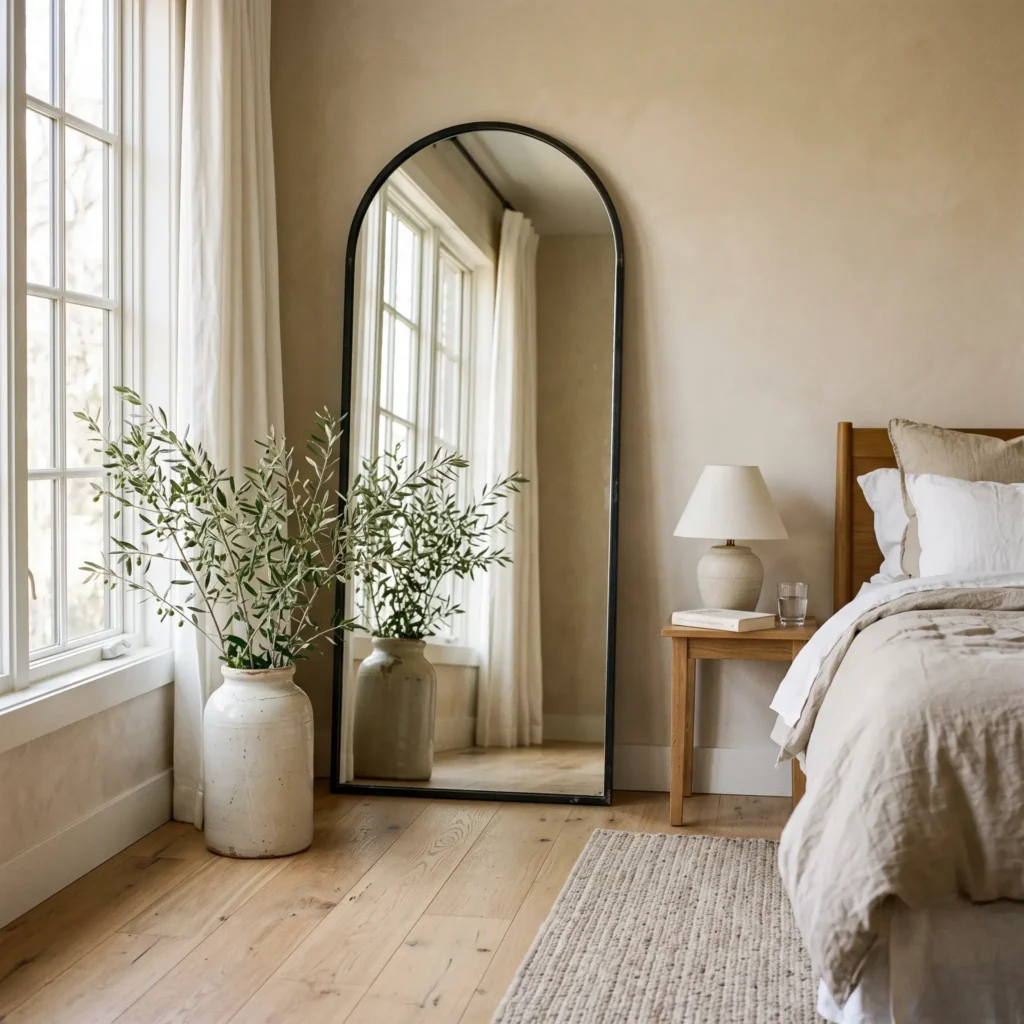
7. The Angled Leaning Floor Mirror
An empty corner makes a primary bedroom look incomplete. A substantial full-length floor mirror expands perceived floor space, bounces natural daylight into dark corners, and adds a vertical reflective surface.
- Placement Rule: Position the mirror on a wall perpendicular to the bed or beside the closet entry, angled 5 to 7 degrees back. Avoid placing large mirrors directly opposite the bed where reflections can startle you at night. Select a mirror that measures at least 70 inches tall by 30 inches wide.
- Featured Products for This Setup:
- 72×32 inch arched metal frame leaning full-length mirror
- Heavy-duty wall anchor safety strap kit
- Handcrafted stoneware vase with faux branch stems
8. The High-Medium-Low Nightstand Vignette
Nightstands easily turn into chaotic holding zones for phone cables, medicine bottles, and half-empty water glasses. A curated vignette creates functional order and leaves breathing room.
- Placement Rule: Use the rule of three with staggered heights. Place a tall ceramic lamp or vase on one side (high). Add a stack of two cloth-bound books (medium). Anchor small items inside a shallow stone or leather tray (low). Keep 30 to 40 percent of the tabletop completely empty as open negative space.
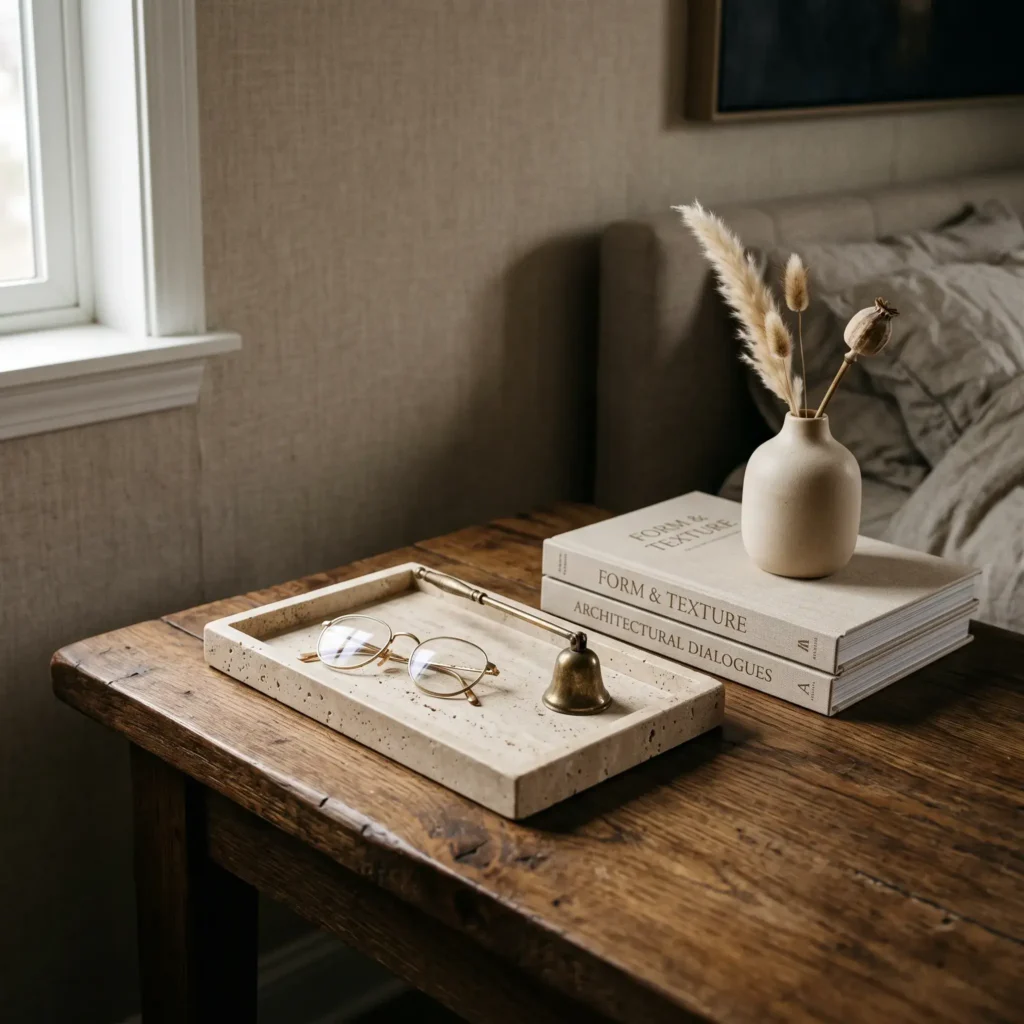
- Featured Products for This Setup:
- Honed beige travertine rectangular catchall tray (8×10 inches)
- Matte textured ceramic bud vase
- Hardcover architectural or design monographs
The Bedroom Diagnostic Guide: What Is Making Your Room Look Unfinished?
If your bedroom still feels off, review this quick diagnostic chart. Identify the visual symptom in your room and apply the practical fix.
| Visual Symptom | Root Cause | Immediate Decor Solution |
|---|---|---|
| Furniture looks disconnected | A 5×7 or 6×9 rug floating in the center of the room. | Upgrade to an 8×10 (Queen) or 9×12 (King) rug with an 18 to 24 inch border. |
| Room feels cold and flat | Harsh overhead ceiling lights (3500K to 5000K). | Switch to shaded bedside lamps or sconces with 2200K to 2700K warm bulbs. |
| Bed looks messy or flat | A single comforter pulled flat across pillows. | Layer a tucked coverlet, a double-folded duvet at the foot, and one long lumbar pillow. |
| Walls feel bare and tall | Short curtains hung directly to the window trim. | Move rods 6 to 10 inches above the trim and extend them 10 inches past the frame sides. |
| Surfaces look cluttered | Loose daily items scattered across nightstands. | Group loose essentials inside a shallow stone, leather, or wood catchall tray. |
| Room feels sterile like a catalog | All furniture pieces match in the same wood finish. | Mix materials by adding a boucle bench, brass lighting, and a woven rug. |
Primary Bedroom Sizing and Scale Formulas
Interior designers do not guess when finishing a room. They rely on standard spatial calculations to ensure items look proportional to the room architecture.
The Ceiling Chandelier Calculation
A tiny light fixture gets lost in a large bedroom, while an oversized fixture overwhelms the space. Use this standard formula:
Fixture Diameter (in inches)=Room Length (in feet)+Room Width (in feet)
- Example: If your bedroom measures 14 feet wide by 16 feet long, add 14 and 16. The ideal light fixture diameter is roughly 30 inches. Hang the fixture so the bottom sits at least 7 feet above your finished floor.
Rug and Bed Dimension Matching
- Queen Bed (60 x 80 inches): Use an 8×10 foot rug. This leaves a comfortable 20 to 24 inch perimeter on either side of the mattress.
- King Bed (76 x 80 inches): Use a 9×12 foot rug. This accommodates the mattress, both nightstands, and a foot-of-bed bench while exposing clean floor margins along the perimeter walls.
- California King (72 x 84 inches): Use a 9×12 or 10×14 foot rug to account for the extra bed length.
Lighting Temperature and Acoustic Softening
Two of the most overlooked design elements cannot be seen in a quick photograph: light temperature and sound reverberation.
Color Temperature Standards
A primary bedroom should signal to your brain that it is time to rest. Cool, daylight-balanced LED bulbs (3500K to 5000K) suppress natural melatonin production and make bedroom paint look washed out.
Equip all lamps, sconces, and ceiling pendants with warm bulbs rated between 2200K and 2700K. Install universal wall dimmers so you can lower the illumination as bedtime approaches.
Acoustic Dampening
Empty drywall, large window panes, and hard floors reflect high-frequency sound waves. This creates a subtle flutter echo that subconscious perception reads as cold and temporary.
To give your room a quiet, cocoon-like atmosphere, introduce heavy tactile textiles:
- Heavy lined drapery in Belgian linen, wool twill, or velvet
- High-pile or dense wool loop area rugs over a felt pad
- Upholstered headboards and fabric benches
- Textured waffle-weave throws and bouclé accent pillows
Frequently Asked Questions
What makes a primary bedroom look luxury hotel quality?
Hotel suites rely on three specific techniques: high-thread-count cotton percale base sheets, a down duvet folded twice at the bottom third for volume, and warm 2700K lighting placed at seated eye level. They also avoid matching furniture suites, mixing warm woods with upholstered seating and stone accents.
How high should you hang art above a bed?
Hang the bottom of the picture frame 6 to 10 inches above the highest point of your headboard. Hanging artwork higher disconnects the piece from the bed, making the frame look unanchored against the wall.
Can nightstands be different from the dresser?
Yes. Using different finishes makes a room look curated over time rather than purchased in a single store run. You can easily pair natural white oak nightstands with a dark walnut dresser, or use painted nightstands alongside an upholstered fabric bed.
What is the best rug placement under a bed?
Place the rug perpendicular to the bed frame. Pull the rug forward so it starts roughly 8 to 12 inches in front of the nightstand faces, extending past the foot of the bed. This ensures your feet step onto a soft surface on all three sides without hiding expensive rug material under headboards.
How do you style a nightstand without clutter?
Follow the rule of three: one tall piece (a lamp or ceramic vase), one medium piece (a small stack of books), and one low piece (a catchall tray). Always keep at least 30 percent of the nightstand surface completely bare so the table remains practical for daily use.
A finished primary bedroom does not require filling every empty corner with knickknacks. It requires the right foundation: an oversized rug, floor-length curtains hung high, warm 2700K lighting, and layered bedding. Start with your rug and drapery first. Once those two architectural boundaries are in place, add your secondary pieces to bring comfort and balance to the room.