9 Clever Pegboard Ideas to Organize Every Room (With Weight & Mounting Specs)

Empty walls offer valuable storage space that most rooms overlook. A well-placed pegboard changes that dynamic. It moves tools, cookware, and creative supplies off flat surfaces and keeps them directly in your line of sight.
Selecting the right setup requires more than picking a paint color. You must match the board material to your room, secure the right mounting hardware, and anchor it properly.
Here are 9 practical pegboard ideas built for daily utility, followed by the exact structural specs you need to install them safely.
1. The Julia Child Cookware Wall
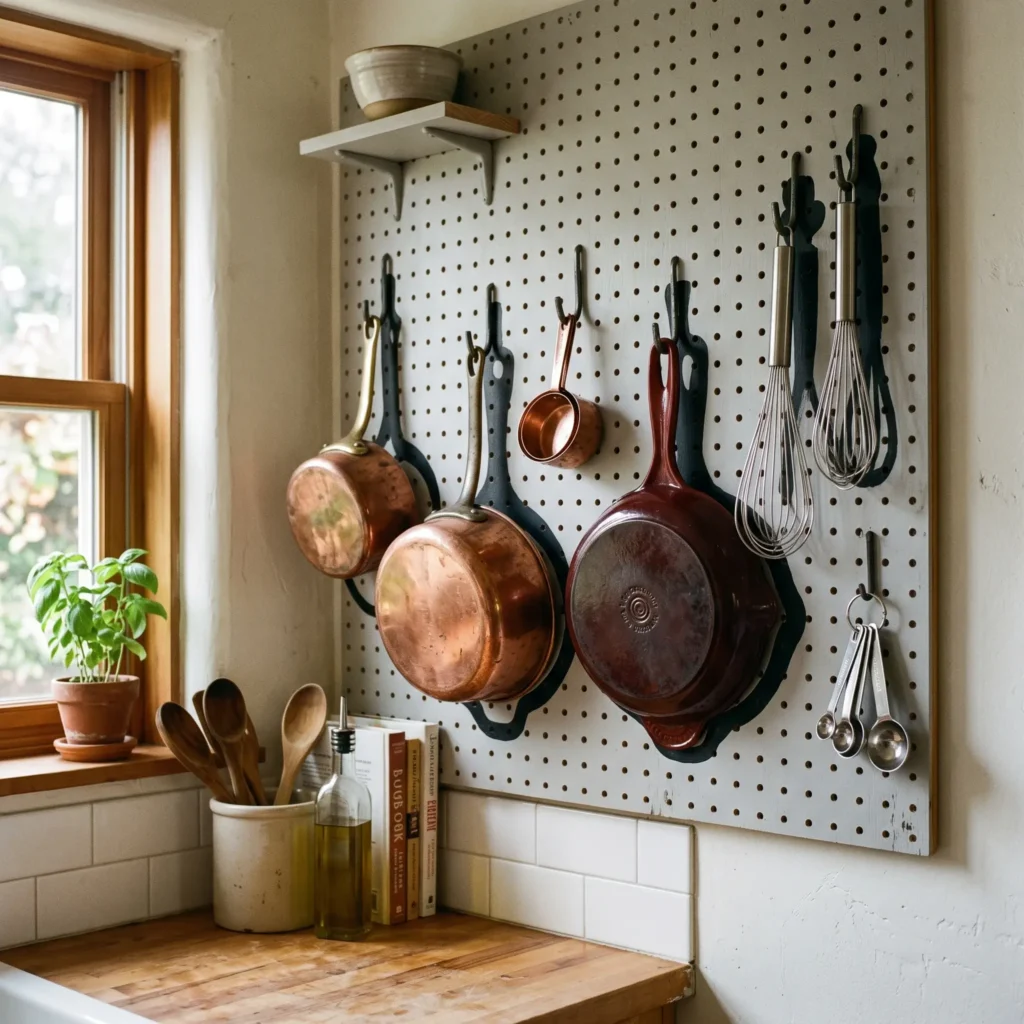
Inspired by Julia Child in her 1961 Cambridge home kitchen, this setup turns everyday cookware into an organized wall display. Heavy pans, colanders, and copper pots hang from heavy-duty hooks. Black silhouetted outlines painted directly around each tool mark the exact return spot for every item.
- Best for: Small kitchens lacking base cabinets, home cooks with heavy cookware.
- Weight guideline: 50 to 100 pounds across multiple wall studs.
- Key detail: Mount into wooden wall studs using three-inch wood screws. Hollow drywall anchors cannot handle dynamic cast-iron loading.
- Products Used in This Setup:
- 1/4-inch tempered hardboard or powder-coated steel panel
- 1/4-inch heavy-duty steel J-hooks
- 1×2 pine furring strips for rear wall clearance
- Black paint pen for tool outlines
- Number 10 wood screws, three inches long
2. The Minimalist Tech Battlestation
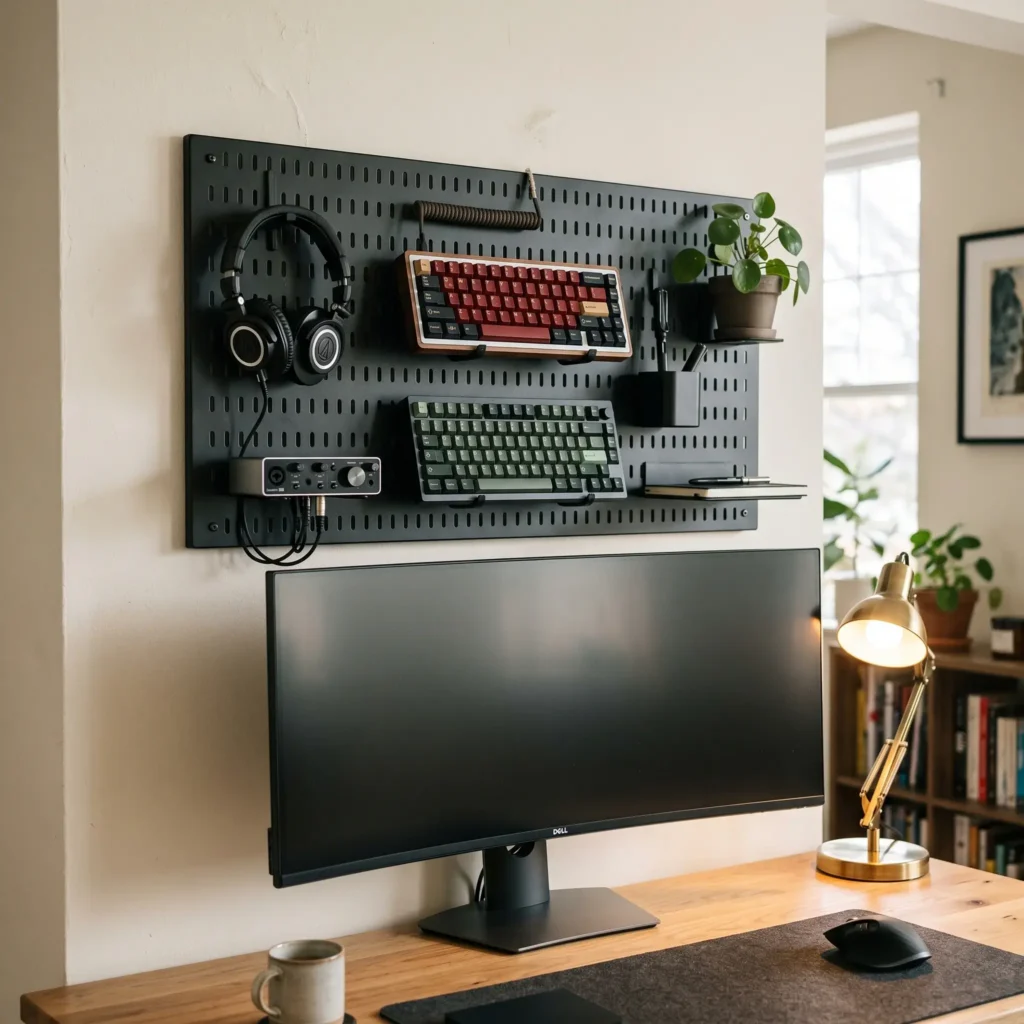
This setup clears controllers, headphones, and mechanical keyboards off the desk surface. It uses an IKEA SKADIS composite board or a matte black steel panel directly above your monitor. Charging cords run through the panel slots, hiding power bricks and loose cables behind the board.
- Best for: Remote workers, software developers, and PC gamers.
- Weight guideline: 15 to 25 pounds.
- Key detail: Maintain an 0.2 mm clearance tolerance if you print your own custom brackets for the oval slots.
- Products Used in This Setup:
- IKEA SKADIS pegboard panel in matte black or white
- SKADIS wall mounting bracket rail
- 3D-printed controller brackets made from PETG plastic
- Rubber-padded headphone cradle hook
- Hook-and-loop cable management wraps
Check out more Interior Ideas
3. Deep-Drawer Horizontal Peg Partition
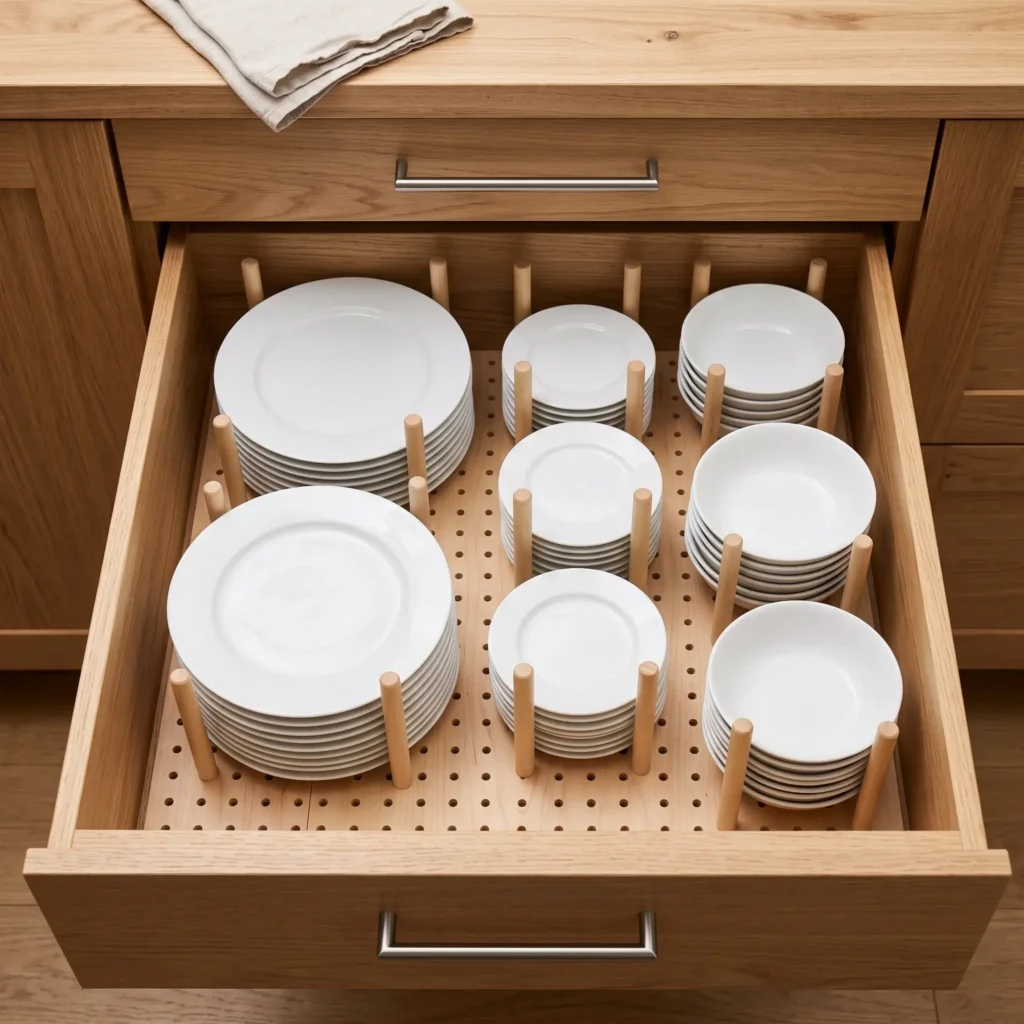
Pegboards do not belong exclusively on vertical walls. Placing a custom-cut hardwood peg matrix flat inside deep base cabinet drawers creates an adjustable storage divider. Repositionable wooden dowels slip into the holes to hold plate stacks, ceramic bowls, and pot lids in place during drawer movement.
- Best for: Kitchens with wide, deep pull-out base drawers.
- Weight guideline: Governed by drawer slide capacity, typically 75 to 100 pounds.
- Key detail: Cut the board 1/8-inch narrower than interior drawer dimensions to allow natural seasonal wood movement.
- Products Used in This Setup:
- 5/8-inch maple multi-ply drawer insert board
- 6-inch turned maple wooden dowel pins
- Adhesive rubber bumper feet for the panel underside
- Clear food-safe mineral oil wood finish
4. The Scandinavian Architectural Dowel Wall
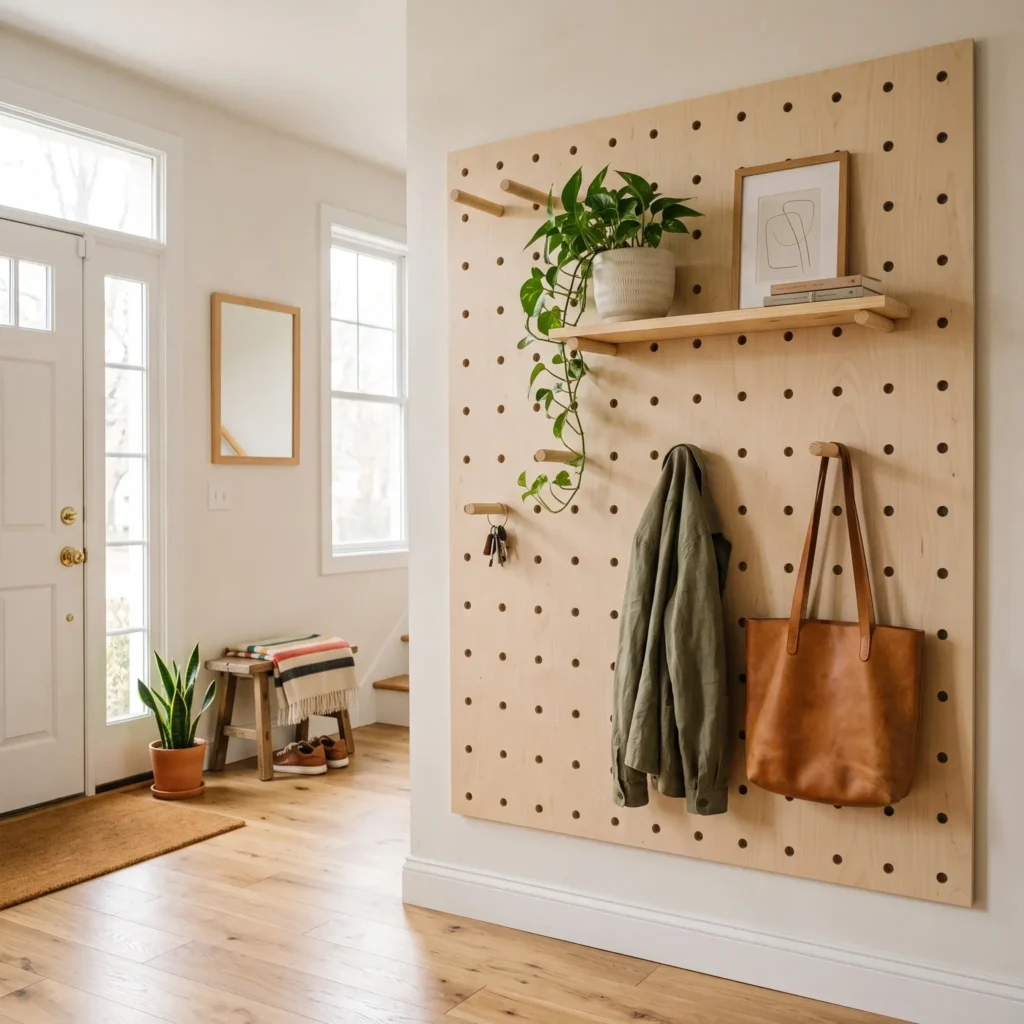
This installation swaps small metal perforations for oversized architectural geometry. Built from 3/4-inch furniture-grade Baltic birch plywood, it uses one-inch round holes bored on six-inch centers. Thick solid hardwood dowels slide into these pockets to support floating timber display shelves and outer garments.
- Best for: Main entryways, living rooms, and open mudrooms.
- Weight guideline: 30 to 40 pounds shear load per individual dowel.
- Key detail: Bore apertures using a sharp Forstner bit clamped in a drill press to prevent back-face wood splintering.
- Products Used in This Setup:
- 3/4-inch Baltic birch cabinet plywood panel, 4×8 feet
- 1-inch diameter solid oak turned dowels
- 8-inch wide matching Baltic birch timber shelf planks
- Matte water-based polycrylic protective clear coat
- Countersunk structural wall screws
5. The Sewing and Maker Craft Station
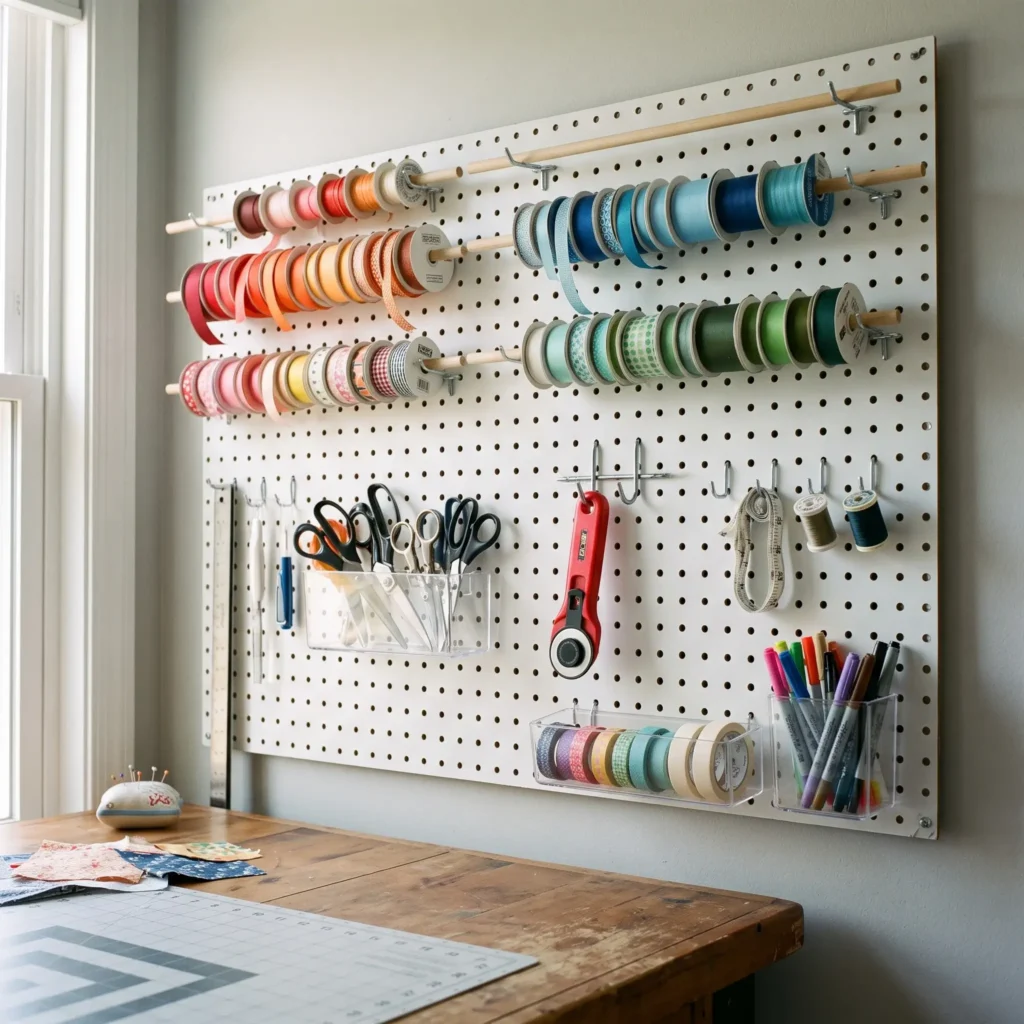
Craft rooms collect hundreds of oddly shaped supplies. This layout uses long horizontal spindle rods to store ribbon rolls and embroidery thread spools without tangling. Clear acrylic bins hold adhesives, rotary cutters, and fabric shears in plain sight, keeping desk surfaces clear for cutting mats.
- Best for: Textile studios, sewing spaces, and paper crafters.
- Weight guideline: 20 to 35 pounds.
- Key detail: Group items by color gradient and functional category to maintain visual calm across high-density storage.
- Products Used in This Setup:
- 1/4-inch white tempered hardboard panel
- 6-inch straight spindle pegs for spools
- Clear molded acrylic drop-in pegboard bins
- Multi-prong scissor and cutter brackets
- Silicone peg-lock stabilizer clips
6. The Heavy-Duty Workshop and Charging Station
Standard wood hardboard sags and rots under garage humidity. This heavy-duty workshop setup relies on 20-gauge cold-rolled galvanized steel panels. It integrates a dedicated tool charging shelf with an overhead shop power strip, keeping drill drivers, battery packs, and impact wrenches off the workbench.
- Best for: Garages, carpentry shops, and mechanical workbenches.
- Weight guideline: 200 to 400 pounds across a multi-stud span.
- Key detail: Stamped vertical slots perform significantly better than round holes by locking brackets against dynamic pull forces.
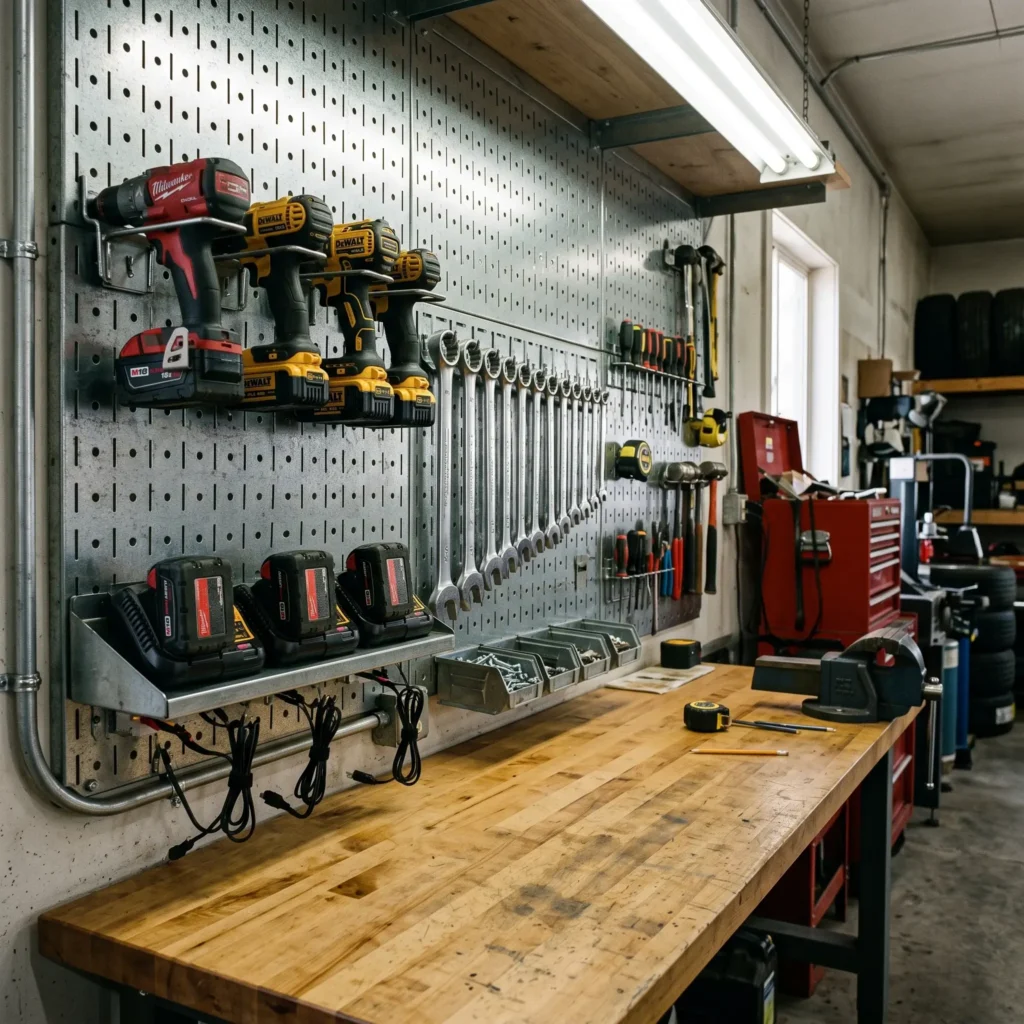
- Products Used in This Setup:
- Wall Control 32×16-inch galvanized steel panels
- Slotted steel drill hanging brackets
- Industrial steel tool cradles and wrench racks
- 48-inch grounded metal shop power strip
- 2-inch structural lag screws
7. Renter-Safe Desk-Clamped Cubicle Board
Rental leases rarely permit drilling large anchor holes into drywall. This solution mounts a lightweight perforated panel directly to the rear edge of an office desk using steel C-clamps. The vertical board floats cleanly above the desk without putting a single hole into apartment walls.
- Best for: Rental apartments, college dorms, and temporary corporate workspaces.
- Weight guideline: 10 to 15 pounds.
- Key detail: Line the clamp jaws with adhesive felt or neoprene pads to avoid marring desk finishes.
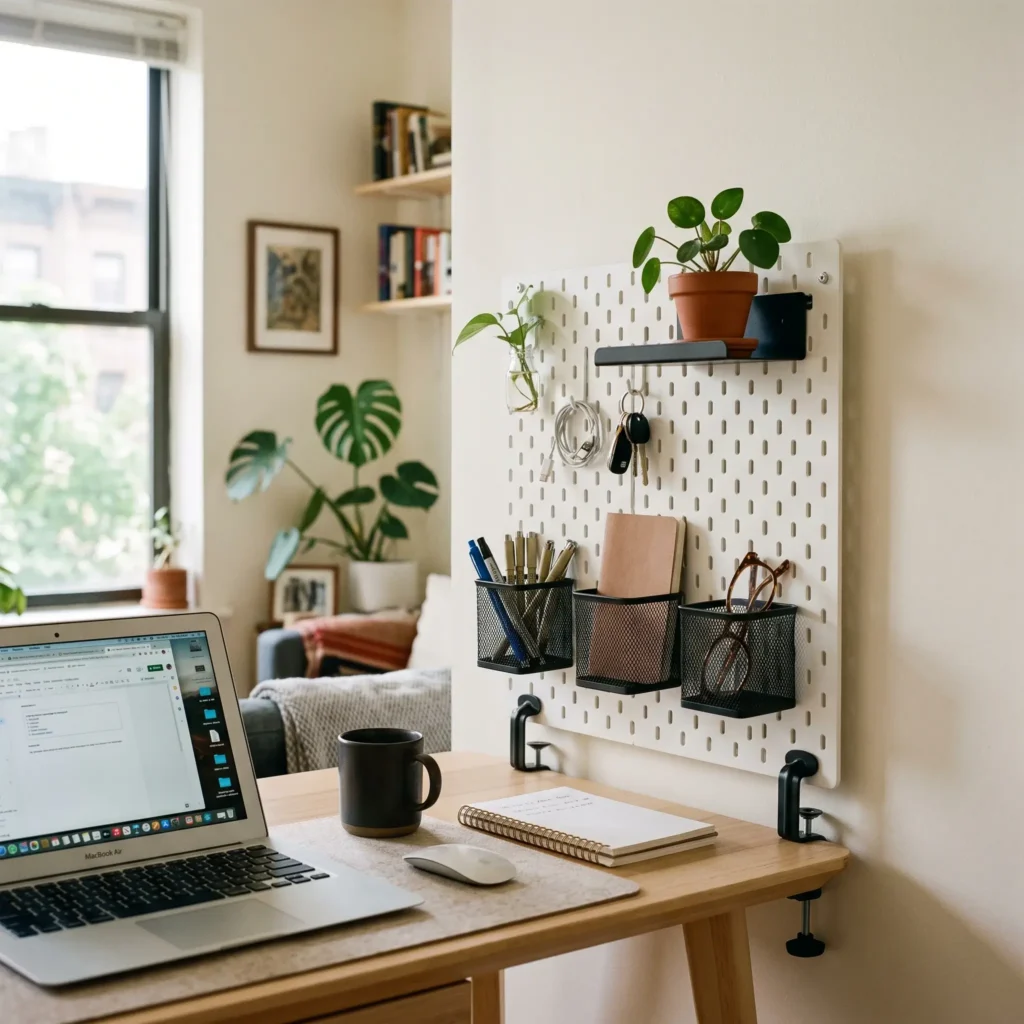
- Products Used in This Setup:
- Steel edge-mounting desktop C-clamps with turn knobs
- 24×18-inch composite or plastic perforated panel
- Neoprene anti-scratch surface protector pads
- Drop-in wire mesh stationery baskets
- Single-point plastic accessory hooks
8. The Modular Bedside Headboard
This installation runs architectural panels across the full width of a bed frame. It replaces floor-bound nightstands with cantilevered floating wooden ledges. Holes along the upper grid act as pass-through ports for reading lamp cords, hiding messy wiring behind the board.
- Best for: Narrow bedrooms, studio apartments, and modern lofts.
- Weight guideline: 20 to 30 pounds per cantilever shelf.
- Key detail: Insulate the rear frame cavity with dense mineral wool batts. This turns the headboard into an acoustic panel that absorbs room sound.
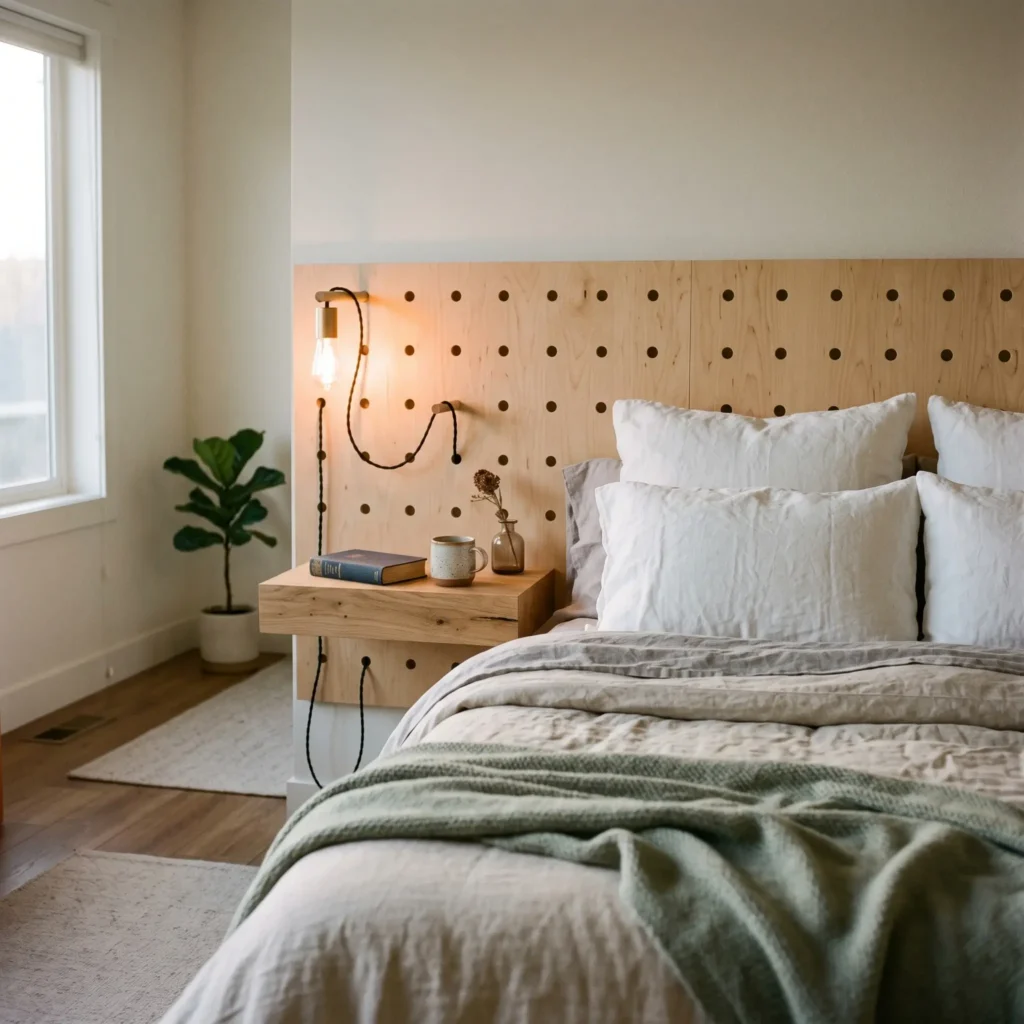
- Products Used in This Setup:
- 3/4-inch multi-ply hardwood plywood panels
- Mineral wool acoustic insulation batts
- Cantilevered wooden shelf brackets with rear locking pins
- Fabric-wrapped cord pendant sconces with plug-in switches
- 1×3 structural pine wall mounting frame
9. The Vertical Biophilic Plant Wall
Houseplants clear floor surfaces when mounted vertically. Using waterproof acrylic or powder-coated steel panels, this plant wall supports terracotta and ceramic pots on circular metal wire ring brackets. Trailing vines train along dowels, creating a living green display that softens indoor walls.
- Best for: Sunlit living rooms, plant hobbyists, and kitchen herb gardens.
- Weight guideline: 30 to 60 pounds total wet soil load.
- Key detail: Maintain an intentional one-inch standoff gap from the wall to encourage air circulation and prevent moisture buildup behind pots.
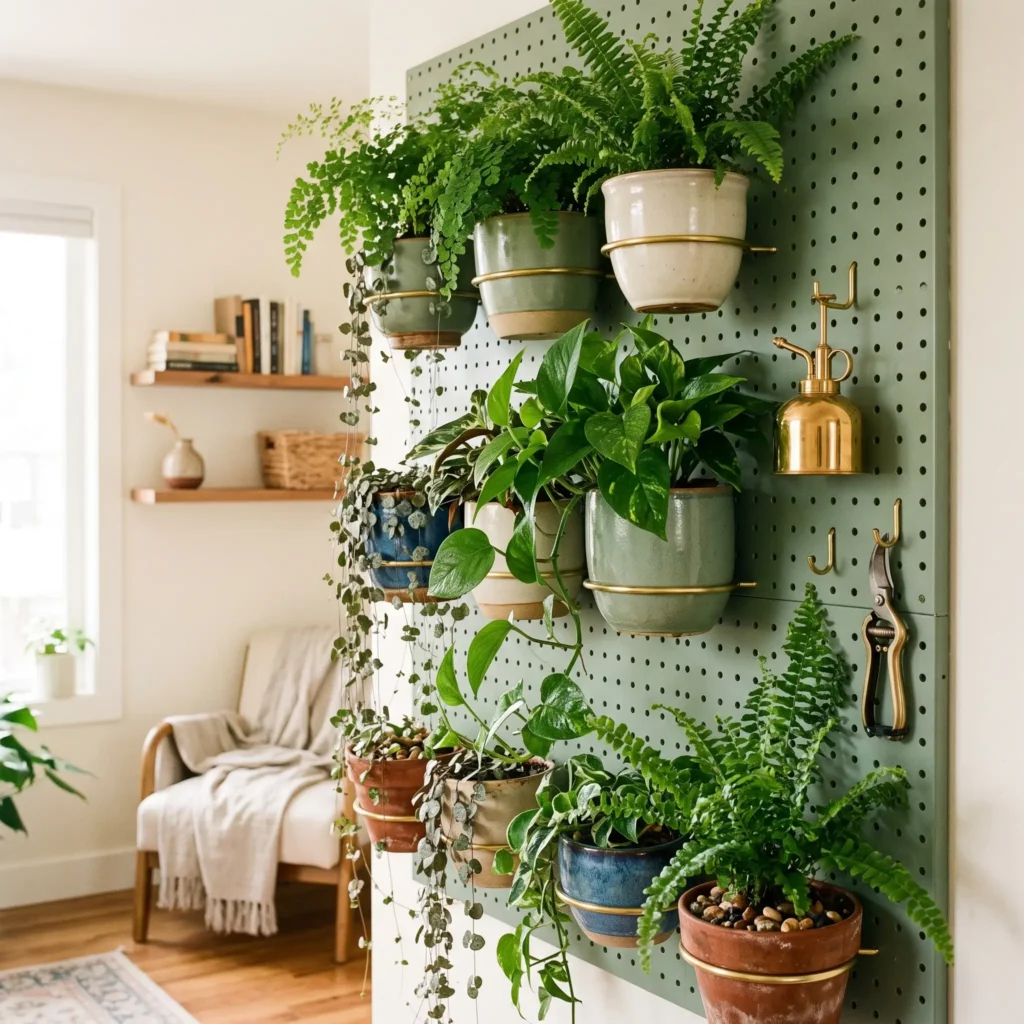
- Products Used in This Setup:
- Waterproof powder-coated 16-gauge steel or acrylic panel
- 4-inch and 6-inch circular drop-in pot ring holders
- Lightweight plastic nursery pots with drainage trays
- Brass fine-mist plant sprayer bracket
- 1-inch aluminum standoff wall spacers
Material Comparison: Picking Your Base Board
Selecting the wrong material causes planar sagging, hole tear-out, or board failure. Match your room conditions and load requirements to this guide:
| Material Type | Distributed Load Capacity | Moisture Resistance | Aperture Standard | Primary Use Case |
| Tempered Hardboard | 50 lbs per panel | Poor (swells in humid air) | 1/4″ or 1/8″ round holes | Dry craft spaces, closets |
| Galvanized Steel | 200 to 400 lbs | High (rust and grease proof) | Dual round and vertical slots | Garages, shops, heavy kitchens |
| Baltic Birch Plywood | 30 to 50 lbs per dowel | Moderate (requires clear sealer) | Custom 3/4″ to 1″ round holes | Entryways, modern living rooms |
| Cast Acrylic / Lucite | 20 to 30 lbs | Total (impervious to water) | Custom laser-cut patterns | Bathrooms, luxury displays |
| IKEA SKADIS (HDF) | 20 to 35 lbs | Moderate (sealed painted finish) | 5×15 mm vertical slots | Desks, hobby spaces, dorms |
Structural Installation: Fasteners and Clearances
A pegboard assembly holds only as much weight as the wall structure behind it. Follow these mechanical installation guidelines to prevent damaged drywall.
1. The Standoff Rule
You cannot screw a traditional pegboard flat against a wall. Peg hooks have a curved lower shank that must pivot through the hole and drop down behind the panel.
Without a rear air gap of at least 1/2 inch (3/4 inch is ideal), hook shanks collide with the drywall and cannot seat. Build a perimeter mounting frame using 1×2 pine furring strips, or buy steel panels with pre-formed perimeter flanges.
2. Fastener Hardware Selection
Match your wall substrate to the proper mechanical fastener:
- Wood Studs (16 inches on-center): Drive number 8 or number 10 wood screws 2.5 to 3 inches long directly into stud centers. This handles 80 to 120 pounds of shear force per screw.
- Hollow Drywall (No Studs): Use 1/4-inch steel spring-wing toggle bolts. These spread load force across the back of the gypsum board. Cut rated capacity in half for deep cantilevered shelves.
- Avoid Plastic Sleeves: Ribbed plastic wall plugs pull loose under the constant forward tugging of retrieving tools.
3. Stopping Loose Hook Syndrome
Single-point wire hooks frequently wobble and fall out when you lift a tool. Fix this issue using three reliable methods:
- Silicone Peg Locks: Snap plastic barbell clips across the hook shank into adjacent holes to immobilize the hardware.
- Zip-Tie Loops: Feed an ultra-thin zip tie through the lower perforation directly around the hook base for a permanent, vibration-proof lock.
- Dual-Prong Hardware: Purchase hooks with twin parallel mounting prongs. These eliminate side-to-side axial sway.
Frequently Asked Questions
What is the difference between 1/8-inch and 1/4-inch pegboard?
The measurement refers to both the hole diameter and panel thickness. 1/8-inch panels suit lightweight crafting tools, scissors, and small accessories. 1/4-inch panels are the standard for workshops, power tools, and heavy kitchen gear. Standard 1/8-inch hooks wobble loosely in 1/4-inch holes, while 1/4-inch hooks will not fit into 1/8-inch boards.
Can you hang a pegboard without drilling into drywall?
Yes. You can use heavy-duty desk clamps on home office workstations, lean a framed timber board securely like an easel, or suspend panels from freestanding floor-to-ceiling tension poles. Avoid using adhesive strips for panels supporting heavy or fragile gear, as dynamic pull force quickly tears drywall paper.
How much weight can a standard pegboard hold?
A standard 1/4-inch tempered hardboard panel holds roughly 50 pounds when framed with furring strips and secured into wall studs. Industrial 20-gauge steel panels hold 200 to 400 pounds across multiple studs, making them the safest choice for heavy lawn tools, cast-iron pots, and power tools.
Why do pegboard hooks pull out of the wall?
Hooks pull loose because single-point wire shanks lack lateral retention. When you lift a hanging wrench or mug, friction pulls the hook upward with the item. Installing plastic peg locks, dual-prong brackets, or slotted steel panels eliminates this movement entirely.
A functional pegboard balances visual order with mechanical strength. Assess the items you plan to hang, pick the matching panel substrate, and install proper furring strips for clean hook clearance. Anchoring directly into wall studs ensures your vertical storage remains solid, organized, and reliable for years of daily use.