8 Bed Frame Ideas for Style, Storage, and Real Durability

Your bed platform anchors your bedroom layout and directly influences how well your mattress supports your body. Choosing the wrong foundation leads to blocked walkways, loose and noisy joints, and sagging mattresses that void your warranty.
A great foundation balances visual scale, physical footprint, and mechanical strength. Whether you want to open up a compact apartment or ground a large master bedroom, the right design solves everyday spatial problems.
Here are 8 practical, structurally sound concepts you can adapt for your home.
8 Curated Bed Frame Ideas for Modern Homes
1. The Japandi Low-Profile White Oak Platform
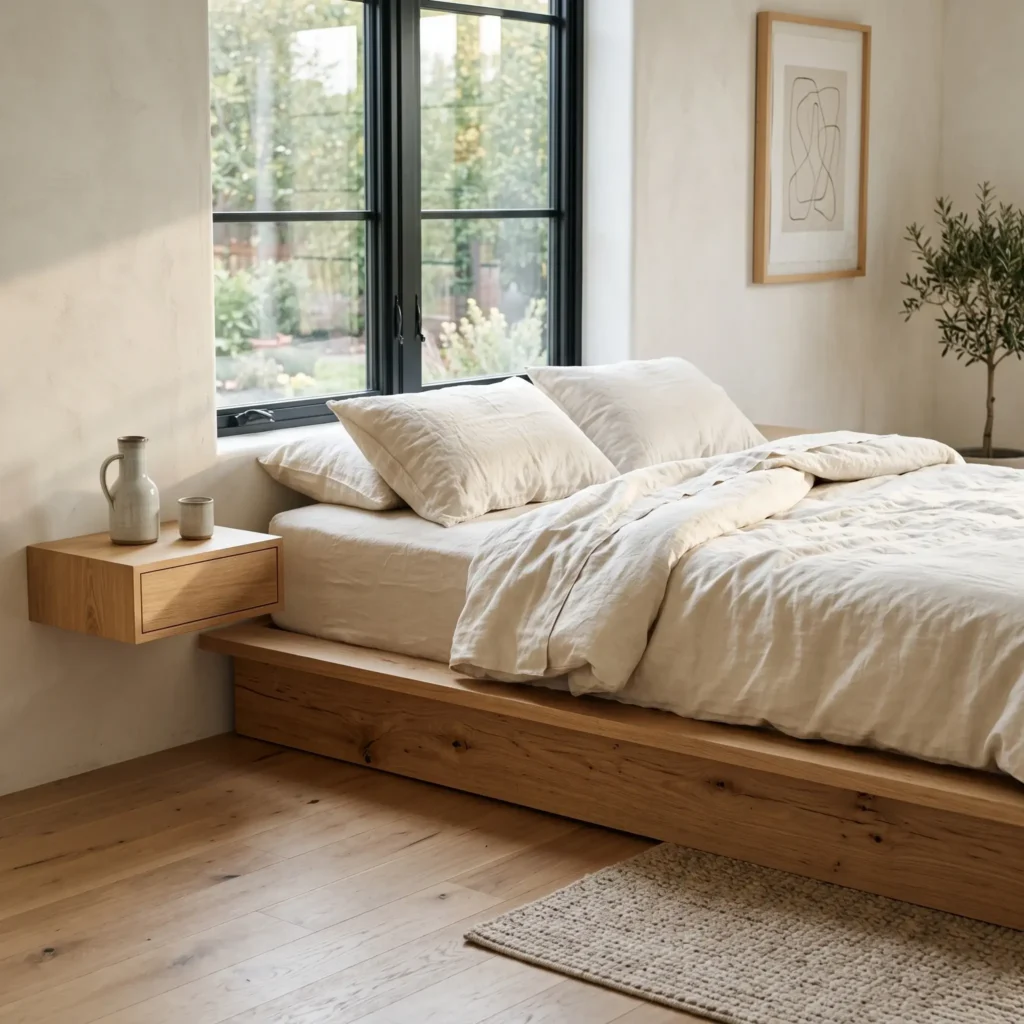
This design sets the sleeping surface 8 to 10 inches above the floor. Lowering the bed drops the visual center of gravity in the room. This adjustment creates more open space between the mattress and the ceiling, which helps standard 8-foot rooms feel open and airy.
The frame extends 4 inches beyond the mattress edge on three sides. This integrated wood ledge replaces bulky side furniture and keeps the floor line clear. Rift-sawn white oak provides a light, calm grain that brightens the room by catching natural daylight.
- Best For: Rooms with low ceilings, minimal storage needs, or compact footprints.
- Key Advantage: Expands vertical room volume and keeps the perimeter visible.
Products and Materials Used in This Design
- Solid rift-sawn white oak platform with a matte polyurethane finish
- Natural stone-washed Belgian flax linen duvet and sheet set in soft oat
- Wall-hung floating oak cubbies mounted 10 inches off the floor
- Flush ceramic wall sconces with warm 2700K downward light
- Flat-weave natural jute runner rug
2. The Cantilevered Floating Platform with Concealed LED Base
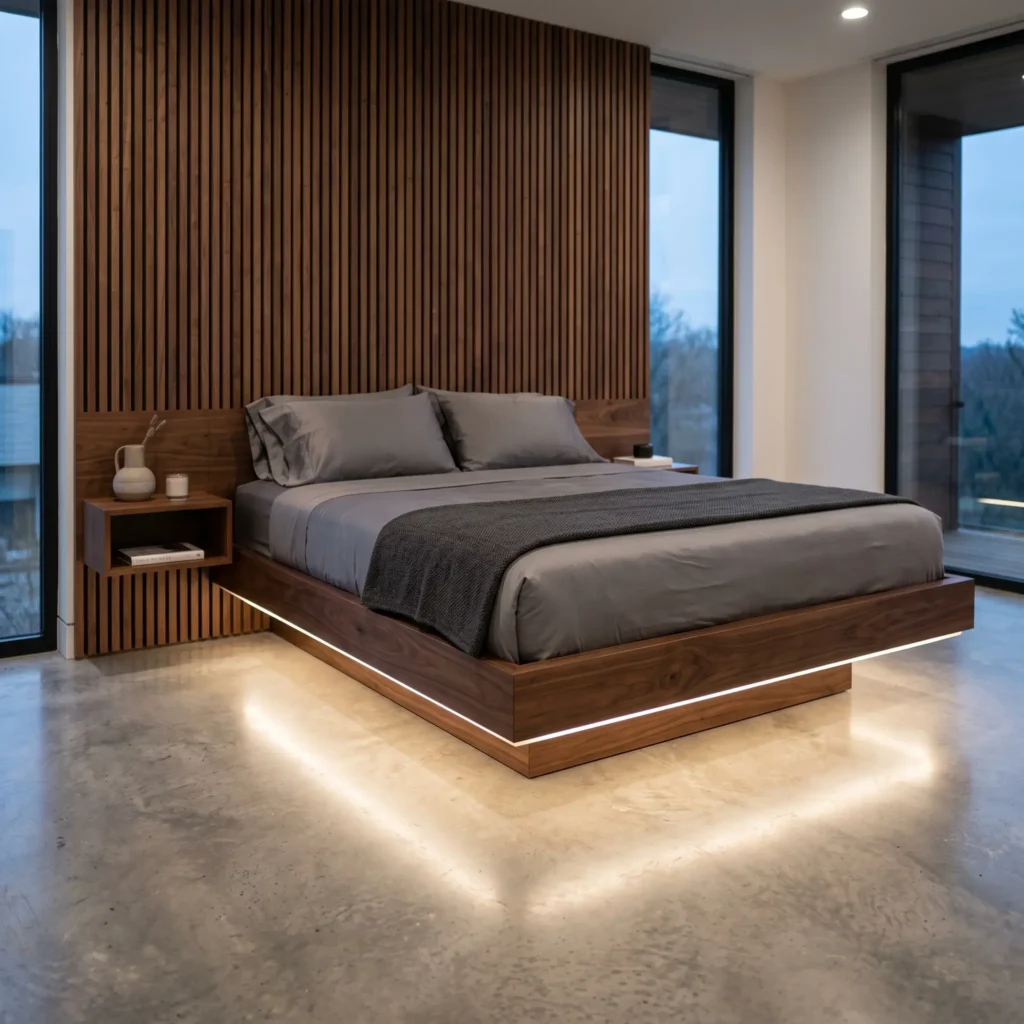
Floating frames eliminate exterior corner legs entirely. This open floor design makes vacuuming simple and prevents stubbed toes during the night.
The structural base sits recessed 10 inches inward from the mattress edge. This setback completely hides the lower frame from a standard standing view. A concealed aluminum LED channel runs along the bottom lip of the upper deck, casting a warm glow downward that emphasizes the hovering effect after dark.
- Best For: Contemporary master bedrooms and open-concept living spaces.
- Key Advantage: Clears perimeter floor space and delivers clean sightlines.
Products and Materials Used in This Design
- Cantilevered carbon steel chassis with walnut-faced side rails
- 24V COB LED strip (2700K warm white) in a 45-degree aluminum profile with an opal frosted diffuser
- Full-width wall-mounted walnut slat acoustic paneling
- Matte gray Egyptian cotton sateen sheets with a charcoal wool blanket
- Floating walnut bedside shelves connected directly to the wall panels
Check out more Decor Styles
3. The Gas-Strut Hydraulic Ottoman Storage Base
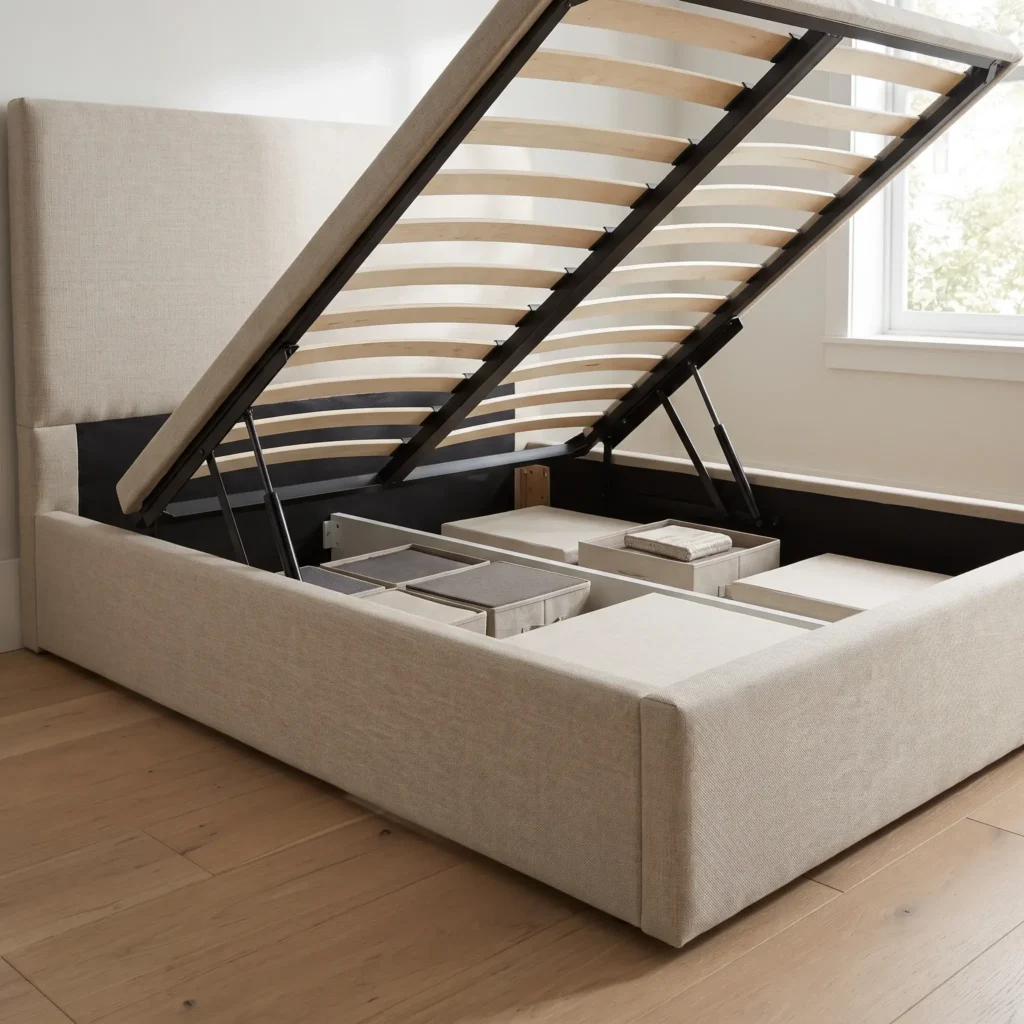
Slide-out drawers often fail in small bedrooms because bedside tables or nearby walls block them from opening. A hydraulic lift platform solves this problem by lifting the mattress straight upward within the perimeter of the bed.
Dual nitrogen-gas pistons counterbalance the mattress weight, letting you lift heavy hybrid bedding with one hand. This setup turns the entire 30 cubic feet beneath a queen mattress into sealed, dust-free storage for spare bedding, bulky coats, and luggage.
- Best For: Small apartments, guest rooms, and compact spaces under 110 square feet.
- Key Advantage: Unlocks massive under-bed storage without needing any floor clearance around the sides.
Products and Materials Used in This Design
- Tailored linen-upholstered lift bed with an internal steel sub-chassis
- Dual 1000-Newton gas-charged pneumatic struts with steel pivot hinges
- Padded rectangular headboard with tailored French seams
- Textured taupe waffle-weave blanket over crisp white percale sheets
- Heavy-duty canvas storage bins with leather pull handles
Look more design ideas
4. The Wall-Mounted Fluted Panel Headboard with Low Slat Base
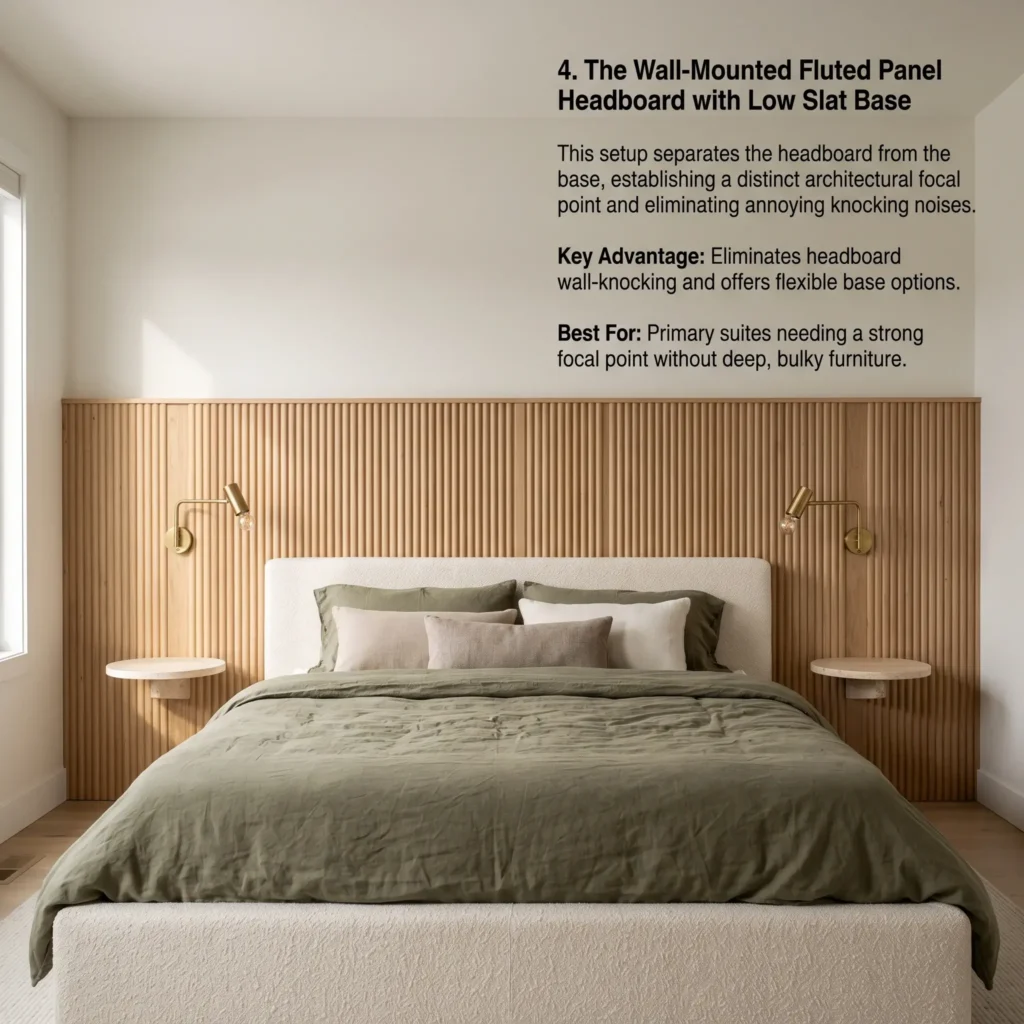
Traditional bed frames bolt the headboard directly to the platform. This setup transfers mattress motion directly into the wall, which often causes annoying knocking noises.
Separating the headboard from the base fixes this acoustic problem. Mounting a wide fluted oak panel to your wall studs establishes a distinct architectural focal point. You can then slide an independent, low-profile box platform against it. This split configuration lets you change mattresses or frames later without rebuilding the wall feature.
- Best For: Primary suites that need a strong focal point without deep, bulky furniture.
- Key Advantage: Eliminates headboard wall-knocking and offers flexible base options.
Products and Materials Used in This Design
- Solid white oak fluted tambour paneling secured with heavy-duty aluminum French cleats
- Minimalist birch plywood platform box wrapped in textured cream wool
- Articulating brushed brass reading sconces wired into the wood panel
- Olive green washed linen duvet with layered neutral lumbar pillows
- Round floating travertine stone shelves anchored to the wall panel
5. The Architectural Slim Steel Canopy Bed
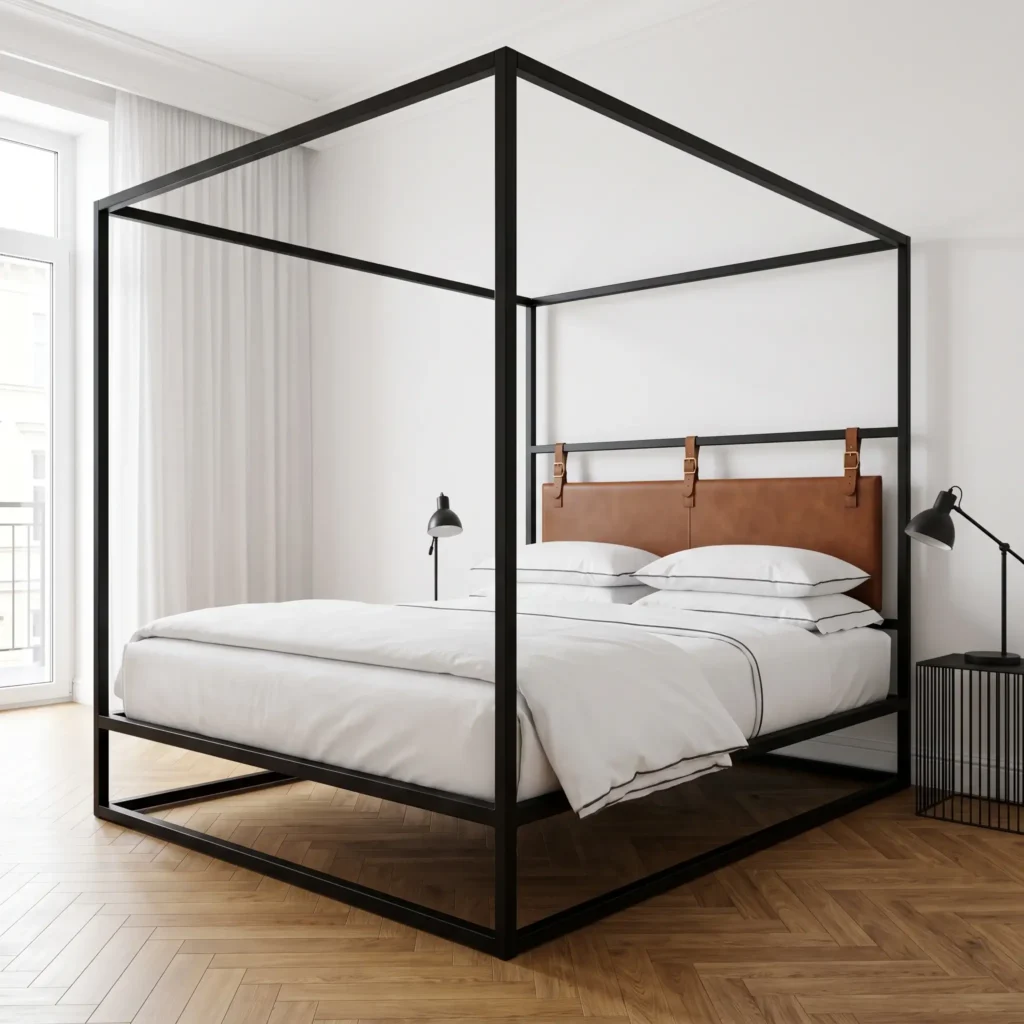
Older canopy frames were heavy, dark, and wrapped in thick fabric. Modern versions rethink this silhouette by using 1-inch box-steel tubing to define an open, architectural frame.
The slender frame outlines the sleeping zone without blocking sightlines or trapping air. Welded steel corners provide rigid lateral stability, stopping the structural sway and joint creaks that often occur with tall wooden four-poster beds.
- Best For: Rooms with ceilings 9 feet or higher.
- Key Advantage: Adds vertical scale to high-ceiling rooms without looking heavy.
Products and Materials Used in This Design
- Welded 1-inch square tube steel canopy frame in a matte black powder coat
- Saddle-brown top-grain leather sling headboard suspended from the rear steel rail with brass buckles
- Hotel-weight 400-thread-count white cotton percale sheets with charcoal edge piping
- Warm herringbone-patterned oak parquet floor
- Matte black metal task lamps set on open wire bedside pedestals
6. The Sculptural Curved Bouclé Upholstered Bed
Sharp, rigid furniture edges cause discomfort in narrow bedrooms and create visual tension. A fully padded bed frame with rounded corners softens tight layouts and brings tactile warmth into the space.
High-density foam wraps around the internal hardwood rails to eliminate hard impacts. The heavy textured bouclé fabric also acts as an acoustic baffle, reducing sound reverberation on wood or tile flooring.
- Best For: Bedrooms with tile or hardwood floors that need acoustic softening.
- Key Advantage: Replaces hard corners with padded surfaces while dampening room echoes.
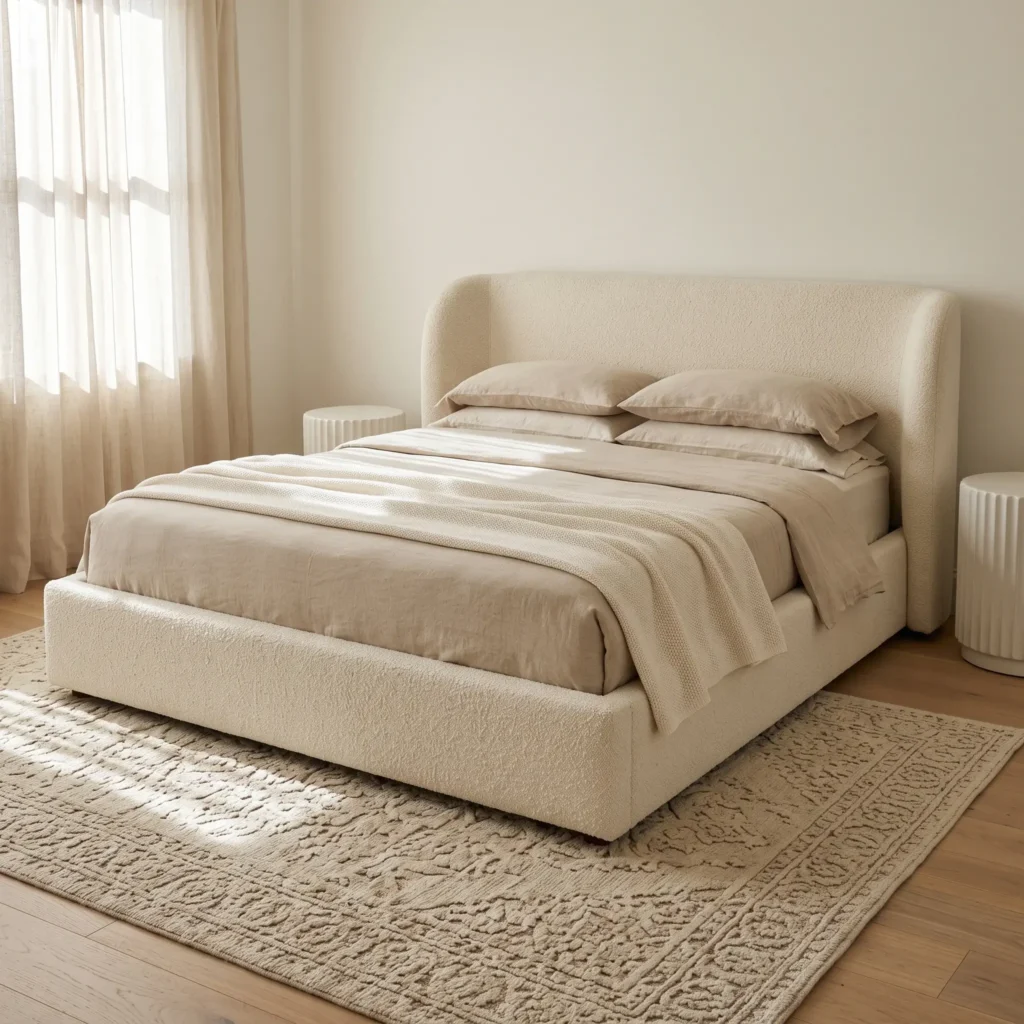
Products and Materials Used in This Design
- Kiln-dried hardwood internal frame wrapped in high-resilience foam and thick cream bouclé
- Gently curved wingback headboard with smooth radius corners
- Sand-colored washed cotton sheets paired with an ivory knit wool throw
- Fluted cylindrical ceramic side tables in a matte white glaze
- High-pile Moroccan wool area rug placed under the lower two-thirds of the bed
7. The ISPM-15 Heat-Treated Pallet Platform with Slat Ventilation
Upcycled wooden pallets provide an affordable, rustic base. However, using industrial lumber inside your home requires careful sourcing. Always look for pallets stamped with the ISPM-15 “HT” mark, which proves the wood was heat-treated in a kiln rather than sprayed with chemical pesticides.
This setup rebuilds the pallets into an extended platform with a wide perimeter ledge for books and morning drinks. Keeping 2.5-inch gaps between top boards allows proper airflow beneath your mattress to keep it dry and fresh.
- Best For: Industrial lofts, rustic guest spaces, and budget DIY projects.
- Key Advantage: Low build cost paired with a functional perimeter wood ledge.
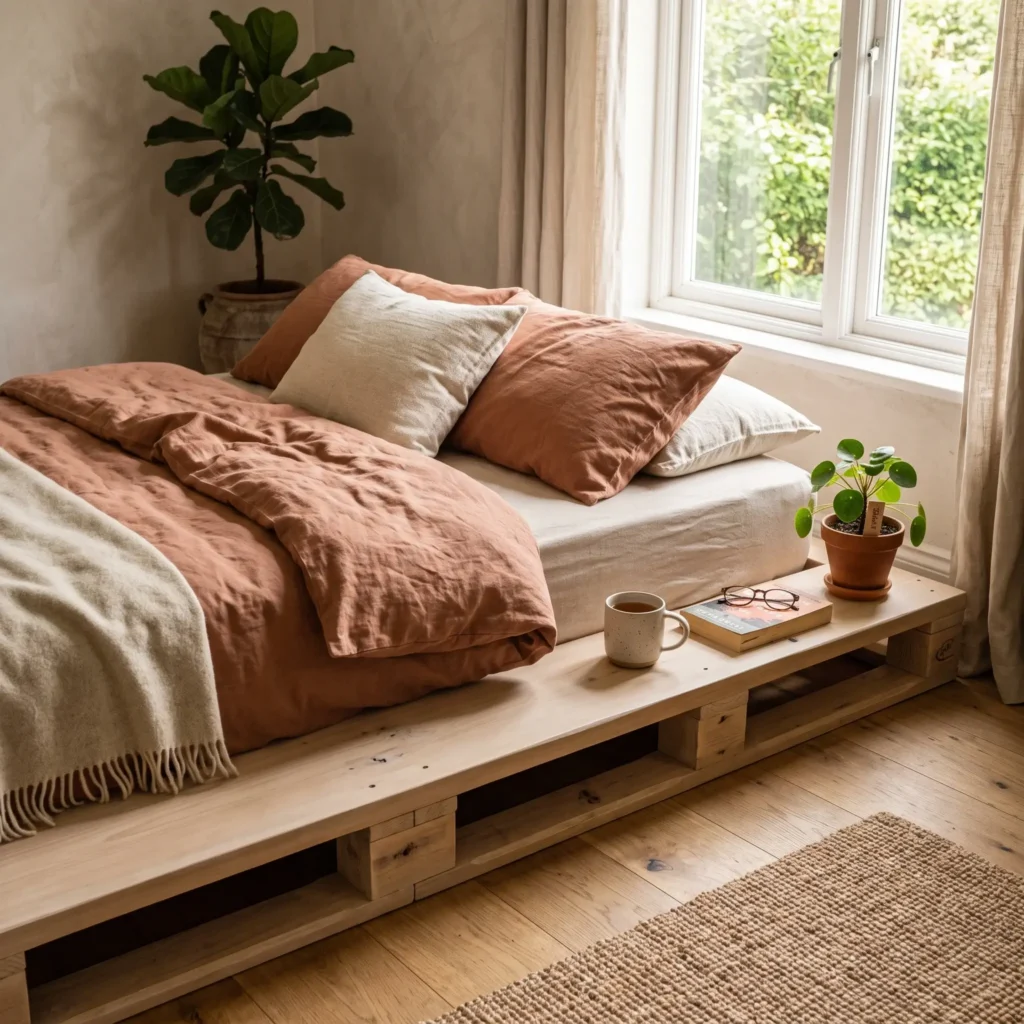
Products and Materials Used in This Design
- Cleaned, triple-sanded ISPM-15 kiln-dried spruce pallets sealed with a low-VOC matte limewash
- Breathable 2-inch felt bunkie board placed beneath the mattress core
- Heavy washed cotton canvas duvet in faded terracotta with frayed linen shams
- Industrial wire drop pendants with warm LED filament bulbs
- Potted snake plant and books styled on the extended wooden ledge
8. The Mid-Century Solid Walnut Spindle Bed
Mid-century designs use tapered legs to raise the chassis 8 to 10 inches off the floor. Leaving this floor area open helps bedrooms feel larger and lighter.
Solid American walnut provides dense strength and resists bending under load. Slender turned spindles in the headboard support your back comfortably while letting daylight pass through from behind, making this frame ideal for placement in front of windows.
- Best For: Mid-century modern, transitional, and classic spaces.
- Key Advantage: Keeps floor areas visible while providing an airy, light-filtering headboard.
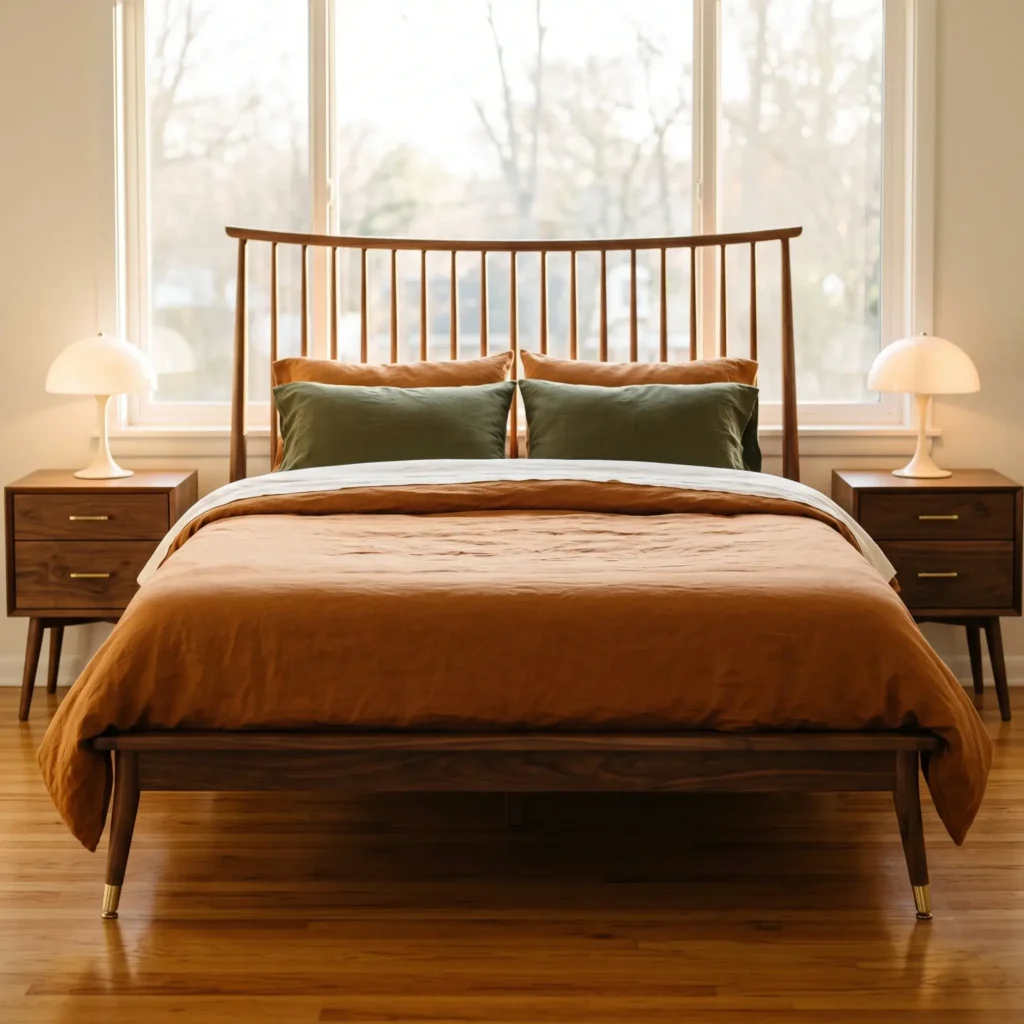
Products and Materials Used in This Design
- Solid American black walnut frame finished with natural hardwax oil
- Turned solid walnut spindles joined to a curved top rail with round mortise joints
- 10-inch outward-canted tapered round walnut legs with brass glides
- Burnt-amber linen sheets paired with deep olive green accent pillows
- Two-drawer walnut nightstands with tapered legs and solid brass pulls
Bedroom Layout and Spatial Clearance Rules
Even the best bed platform will feel frustrating if it blocks pathways or prevents doors from swinging open. Follow these three layout measurements before ordering or building your frame:
The 30-Inch Perimeter Rule
Leave 30 to 36 inches of open floor space along your main walking routes. This applies to the path between your bedroom door, the foot of your bed, and your closet entry. Secondary sides against a wall can drop to 24 inches if space is limited.
Nightstand Height Alignment
Keep the top surface of your bedside table level with, or within 2 inches of, the top of your mattress. A low platform bed paired with tall 28-inch tables makes reaching for a glass of water awkward from bed.
Drawer and Door Extension Clearances
Standard under-bed drawers slide out 20 to 24 inches. You need at least 30 inches of open floor beside the frame so you can stand comfortably while opening them. If a fixed nightstand blocks that space, choose a hydraulic lift frame instead.
Mattress Warranty Compliance and Slat Spacing Rules
Most mattress sagging comes from poor base support rather than broken foam or coils. Placing a modern mattress on widely spaced slats can damage the core and void your warranty.
Manufacturer Slat Tolerances
- Tempur-Pedic: Requires a solid flat deck or rigid slats measuring at least 3 inches wide. Gap spacing must never exceed 4 inches. The warranty voids if the mattress sags more than 0.75 inches due to weak support. Queen and King models require a center support beam with at least 5 to 6 legs touching the floor.
- Purple: The flexible GelFlex Grid needs rigid, level support. Purple requires slat gaps between 2.75 and 3.5 inches. Wider gaps allow the flexible grid to push through the openings, which damages the comfort layer.
- Saatva: Platform slats must sit less than 4 inches apart with a center support rail on Queen and King frames. Heavy specialty beds like natural latex require a solid barrier, such as a 0.5-inch plywood bunkie board, laid across the slats.
The Problem with Unventilated Solid Bases
Do not drop a mattress directly onto an unvented sheet of plywood. Your body releases moisture vapor while you sleep. Solid plywood traps that humidity against the underside of the mattress, creating a breeding ground for mold, mildew, and dust mites. Keep slat gaps between 2.5 and 3 inches to maintain continuous air circulation.
Storage Mechanics: Gas Struts vs. Slide-Out Drawers
Choosing the right storage mechanism depends on your available floor clearance and mattress weight:
| Parameter | Gas-Strut Hydraulic Ottoman | Slide-Out Compartment Drawers |
| Required Side Space | Zero (lifts upward) | 24 to 30 inches of clear floor |
| Usable Storage Volume | Entire base cavity (25 to 32 cu. ft.) | Drawer box interior (12 to 16 cu. ft.) |
| Nightstand Clearance | No interference | Often blocked by bedside tables |
| Dust Protection | Fully sealed cavity | Gaps around drawer slides allow dust |
| Lifting Effort | Assisted by gas pistons | Manual pull on slides or wheels |
Selecting the Correct Gas Strut Rating
Hydraulic lift beds use nitrogen-charged pistons rated in Newtons (N). Under-rated struts make the mattress heavy and dangerous to lift. Over-rated struts make the frame difficult to close and can cause an empty base to spring open unexpectedly.
- Twin / Single (18 to 25 kg mattress): Use two 400N to 600N struts
- Full / Double (25 to 40 kg mattress): Use two 800N to 900N struts
- Queen (35 to 50 kg mattress): Use two 900N to 1100N struts
- King / California King (45 to 65 kg mattress): Use two 1100N to 1200N struts
- Dense Latex / Heavy King (65 to 85+ kg mattress): Use two 1350N to 1500N struts
How to Stop Bed Frame Squeaks with Acoustic Decoupling
Bed creaking happens when loose structural joints rub together under dynamic weight. Standard wood screws driven into raw lumber loosen over time as wood fibers compress.
Use these three steps to keep your bed completely silent:
- Use Machine Bolts with Steel Threaded Inserts: Choose frames assembled with steel machine bolts that screw into threaded metal inserts or steel barrel nuts. This metal-on-metal connection allows high clamping force without stripping the wood fibers.
- Apply Viscoelastic Felt Isolation Tape: Stick adhesive felt tape along the top edge of the side-rail support ledges before setting down your wooden slats. This layer stops dry wood-on-wood rubbing when slats flex under movement.
- Lubricate Wood Tenons with Paraffin Wax: Rub natural paraffin wax or dry beeswax over wood joints and corner tenons. The wax seals contact points and stops friction squeaks without harming the wood finish.
Pallet Wood Safety: Sourcing and Preparing HT Timber
If you build a DIY pallet platform, prioritize indoor air quality and personal safety. Shipping pallets carry different chemical treatments based on international transport rules.
Check the Heat-Treatment Stamp
Look for the official IPPC rectangular stamp burned into the pallet wood.
- Safe for Indoor Use: Pallets stamped with HT (Heat-Treated) were heated in a kiln to a core temperature of 56°C for softwoods or 60°C for hardwoods for at least 30 minutes. This process eradicates pests without chemicals. Pallets marked EPAL or DB (Debarked) are also safe.
- Dangerous for Indoor Use: Never use pallets stamped with MB (Methyl Bromide). Methyl bromide is a toxic pesticide that off-gasses dangerous chemical residues into your room. Reject unbranded pallets, painted pallets, or wood showing oil and chemical stains.
Proper Sanding and Finishing Protocol
- Wash raw pallets outside with water, mild soap, and oxygen bleach. Let them dry in the sun for 48 hours.
- Countersink all nail heads 2 millimeters below the wood surface using a hammer and punch.
- Sand the wood outdoors wearing an N95 respirator mask. Follow a three-step progression: 60 grit to level rough lumber, 120 grit to remove scratches, and 220 grit along the grain for a smooth finish.
- Wipe off dust and seal the wood with two coats of low-VOC, water-based polycrylic to lock down loose fibers.
Summary and Next Steps
Choosing the right platform starts with matching your bedroom dimensions to practical structural support. In rooms under 110 square feet, a hydraulic lift frame provides deep storage without blocking floor space. In rooms with lower ceilings, low-profile oak platforms lower the visual center of gravity to make the room feel open.
Always verify your mattress warranty before buying a new base. Ensure your frame has slat spacing between 2.75 and 3 inches to prevent premature sagging. If you are building a custom pallet frame, check for the HT stamp to ensure your home stays safe, healthy, and quiet.
Frequently Asked Questions
What is the best bed frame height for most bedrooms?
The standard distance from the floor to the top of the mattress should measure between 22 and 25 inches for easy sitting. In low-ceiling rooms, dropping the total height to 16 or 18 inches creates a grounded look that makes the ceiling feel higher.
Can I place my memory foam mattress directly on the floor?
Avoid placing a mattress directly on the floor. Without open slat airflow underneath, body heat and perspiration condense beneath the bottom fabric. Trapped moisture can produce mold and mildew in less than three months.
How do I stop a floating bed frame from tipping on the edge?
Limit the perimeter platform overhang to 10 or 12 inches from the recessed base. For overhangs beyond 12 inches, bolt the headboard rail directly into your wall studs using heavy lag screws or a structural ledger cleat.
Are wooden platform slats better than a traditional box spring?
Wooden platform slats are better for modern foam and pocket-coil mattresses because they provide a rigid, flat surface. Modern mattresses need firm, unyielding support rather than the springy give of traditional wire box springs.