A Tiny Detail That Makes Your House More Homey
You bought the right sofa. You painted the walls in popular neutral tones. You spent weeks picking rugs, coffee tables, and wall art. Yet, when you walk through your front door after a long day, the space still feels stiff and cold. It looks like a furniture catalog, but it does not feel like a sanctuary.
A house rarely becomes warm through major remodeling projects or high-ticket purchases. True domestic comfort happens at the micro level. It relies on subtle sensory cues, soft acoustic absorption, and low-level lighting that signal safety to your nervous system.
Here are seven practical, micro-scale design details that strip away sterile showroom energy and give your living space an authentic, lived-in warmth.
1. The Kitchen Counter Mini Lamp
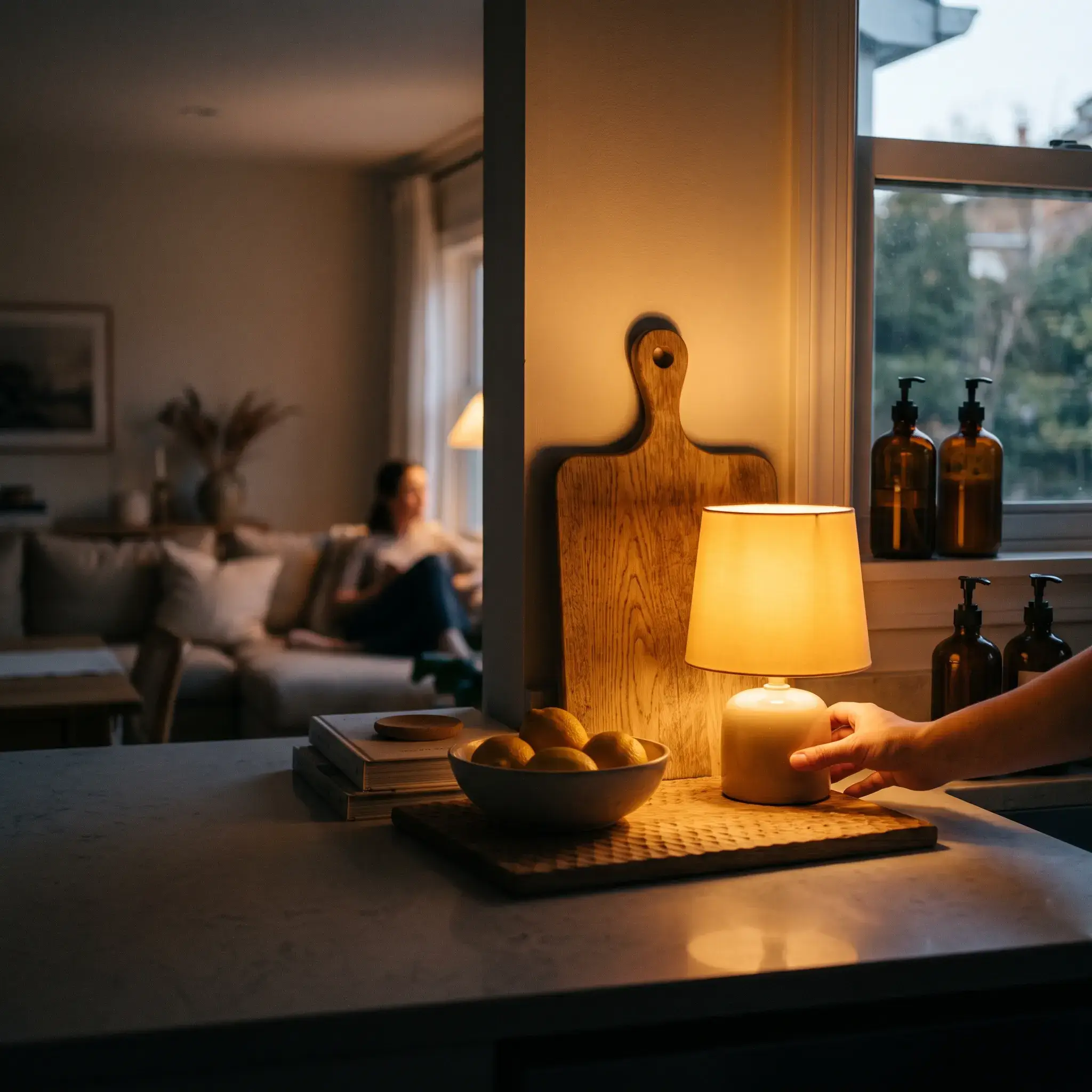
Most modern kitchens rely entirely on high-altitude ceiling downlights. These bright, recessed bulbs flood the room with harsh white light from above, highlighting polished quartz counters, glazed tile backsplashes, and stainless steel appliances. The setup makes your kitchen feel like an operating room.
You can fix this by introducing a small, opaque-shade accent lamp on your kitchen counter perimeter. Tuck it near a corner, an open coffee bar, or beside a wooden cutting board. Fit the lamp with a warm 2200K to 2400K LED bulb.
When evening arrives, turn off the ceiling grid completely and leave only this small lamp glowing. The low-level golden light softens hard stone surfaces and turns a cold utility room into an intimate evening retreat.
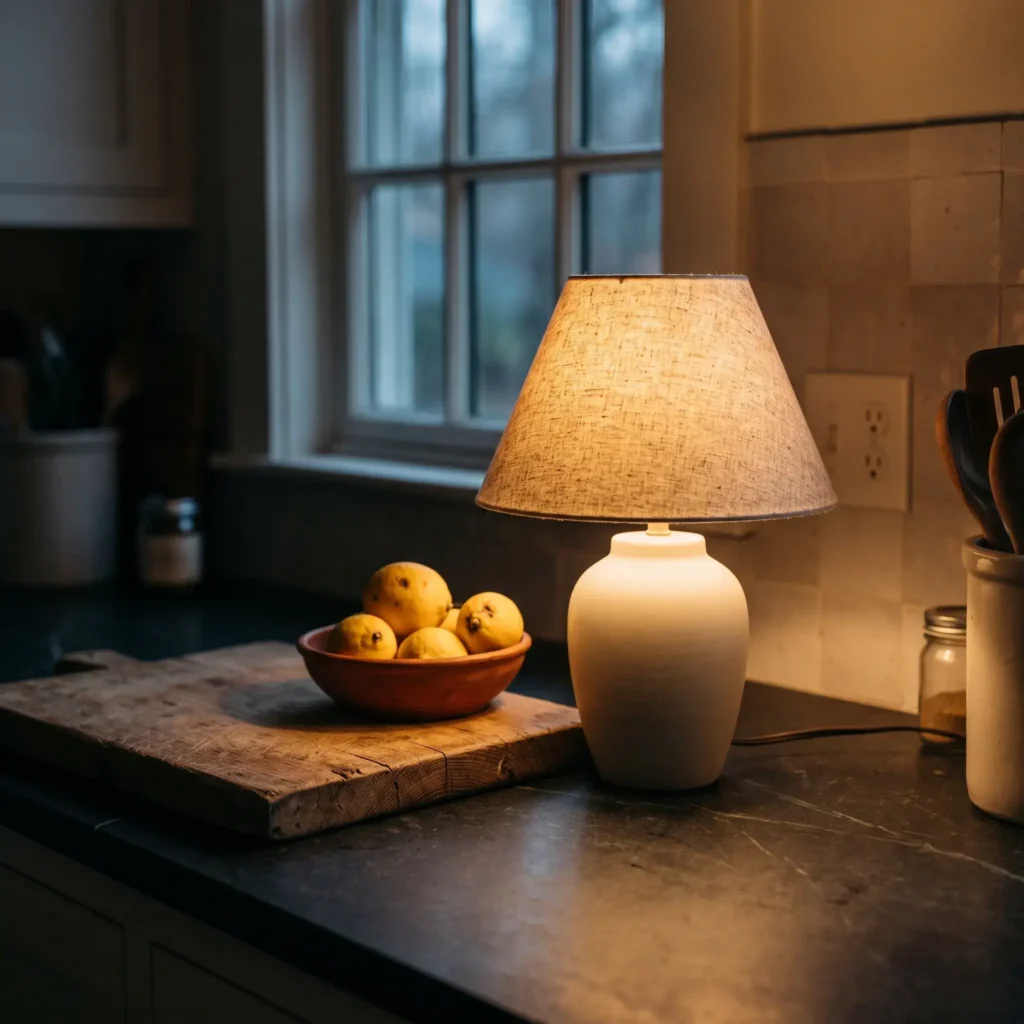
- Products Featured in Image:
- 10-inch ceramic base mini accent lamp in matte cream
- Neutral cone-shaped pleated linen lamp shade
- 2200K warm-dim candelabra base LED bulb
- Reclaimed rustic oak rectangular cutting board
- Hand-thrown footed terracotta fruit bowl
2. The 2-Inch Oversized Feather Cushion Insert
Throw pillows often look stiff and uninviting because of their internal fill. Most mass-market cushions come stuffed with synthetic polyester fiberfill. These synthetic plastic strands act like mechanical springs. They push back aggressively against your body, resist natural folds, and sit rigidly on upholstery crevices without moving.
To make any couch look and feel deeply comfortable, replace synthetic cores with natural feather inserts. Look for a mix of 90 percent waterfowl feathers and 10 percent down clusters. Natural feather quills function like micro leaf springs that yield gently under your weight while holding structural loft.
Always follow the two-inch oversize rule: buy an insert that measures precisely two inches larger than your pillow cover. For example, stuff a 22-inch insert into a 20-inch linen cover. The extra fill pre-stresses the fabric seams, prevents limp corners, and allows the cushion to hold a relaxed indent when you press down on it.
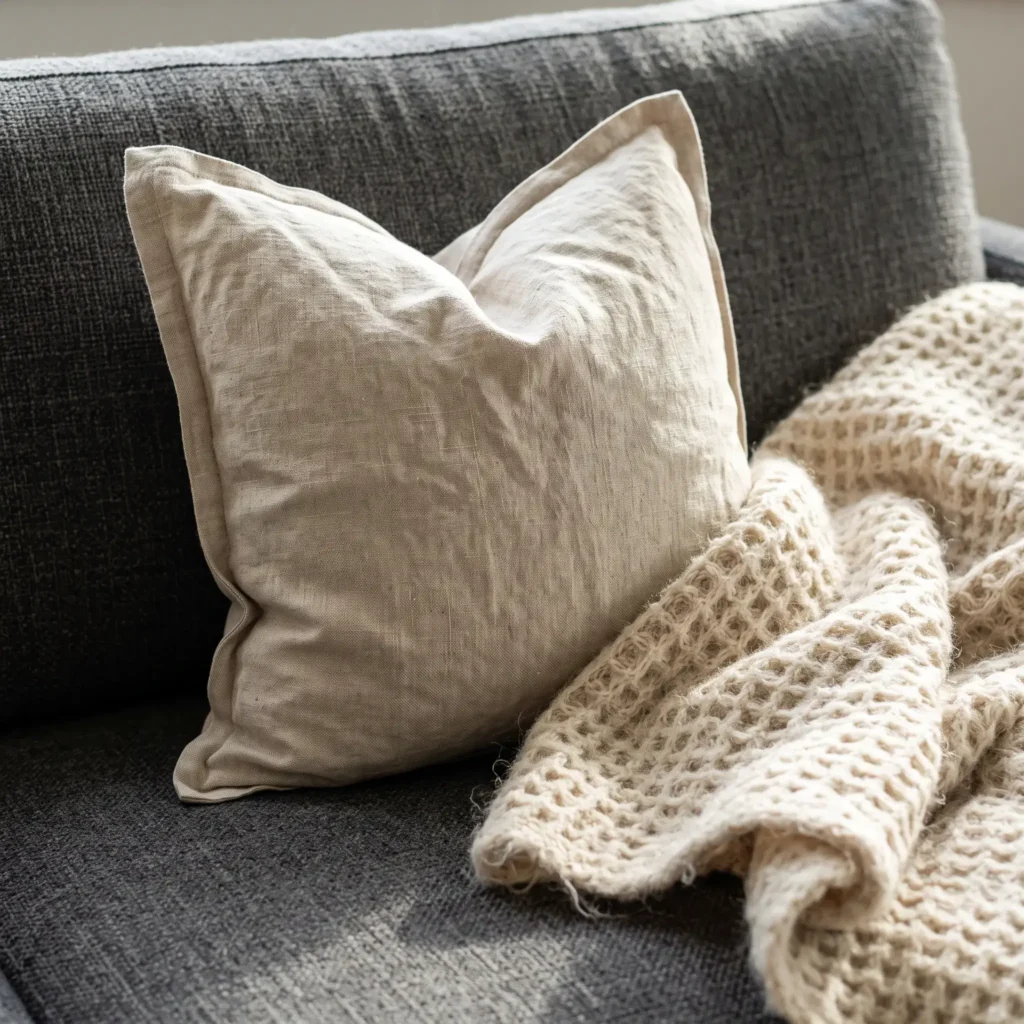
- Products Featured in Image:
- 20×20 inch heavy-weight Belgian linen pillow cover in oat
- 22×22 inch 90/10 duck feather and down insert
- Chunky ribbed alpaca wool throw blanket in heather gray
- Textured charcoal linen upholstered deep sofa
Check out more Styling Ideas
3. The 3/8-Inch Compressed Felt Rug Pad
A hidden reason many homes feel cold and hollow comes down to floor acoustics. Hard surfaces like oak flooring, porcelain tile, and drywall reflect sound waves constantly. These hard planes cause persistent flutter echoes and loud footfall noises that subconsciously keep your brain alert.
Homeowners often buy area rugs to soften a room, but they place them over cheap PVC plastic mesh pads. Plastic mesh prevents slipping, but it has zero mass. Every footstep transfers straight through to the hard subfloor, creating a hollow, clattering report.
Swap that plastic mesh for a dense, 3/8-inch needle-punched compressed recycled felt rug pad with a natural rubber base. The interlocked felt fibers trap high-frequency vibrations and absorb physical impacts before they hit the subfloor. Walking across the room instantly feels cushioned, quiet, and solid underfoot.
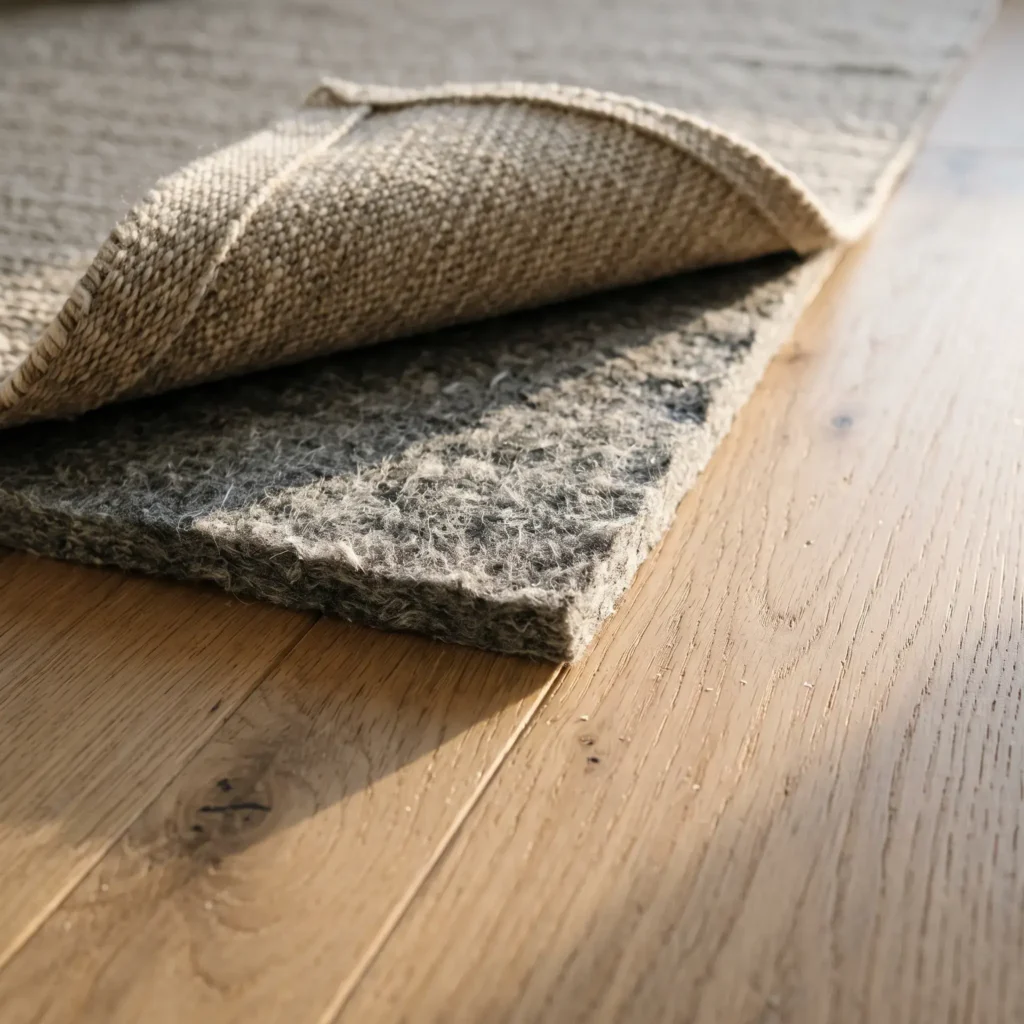
- Products Featured in Image:
- Hand-woven wool geometric flatweave area rug
- 3/8-inch thick needle-punched compressed felt rug pad with rubber backing
- 7-inch wide-plank white oak engineered hardwood flooring
4. Living Unlacquered Brass Hardware
Most modern door handles, cabinet pulls, and faucets come sealed in polyurethane or factory chrome. These coatings are designed to resist age. When they take scratches or chips, the damage stands out as an ugly flaw rather than an organic sign of life.
In contrast, unlacquered architectural brass has no chemical sealant. The bare metal reacts with air and the natural oils on your hands from day one. Where your fingers grip a door knob or cabinet pull, the metal stays polished to a warm satin gold. In the corners and unhandled edges, exposure to oxygen causes natural oxidation:
2Cu+21O2⟶Cu2O
This copper oxide layer slowly deepens into caramel, bronze, and dark chocolate tones. This evolving finish provides visible proof of human touch and routine, turning plain cabinetry into a space that feels grounded and historic.
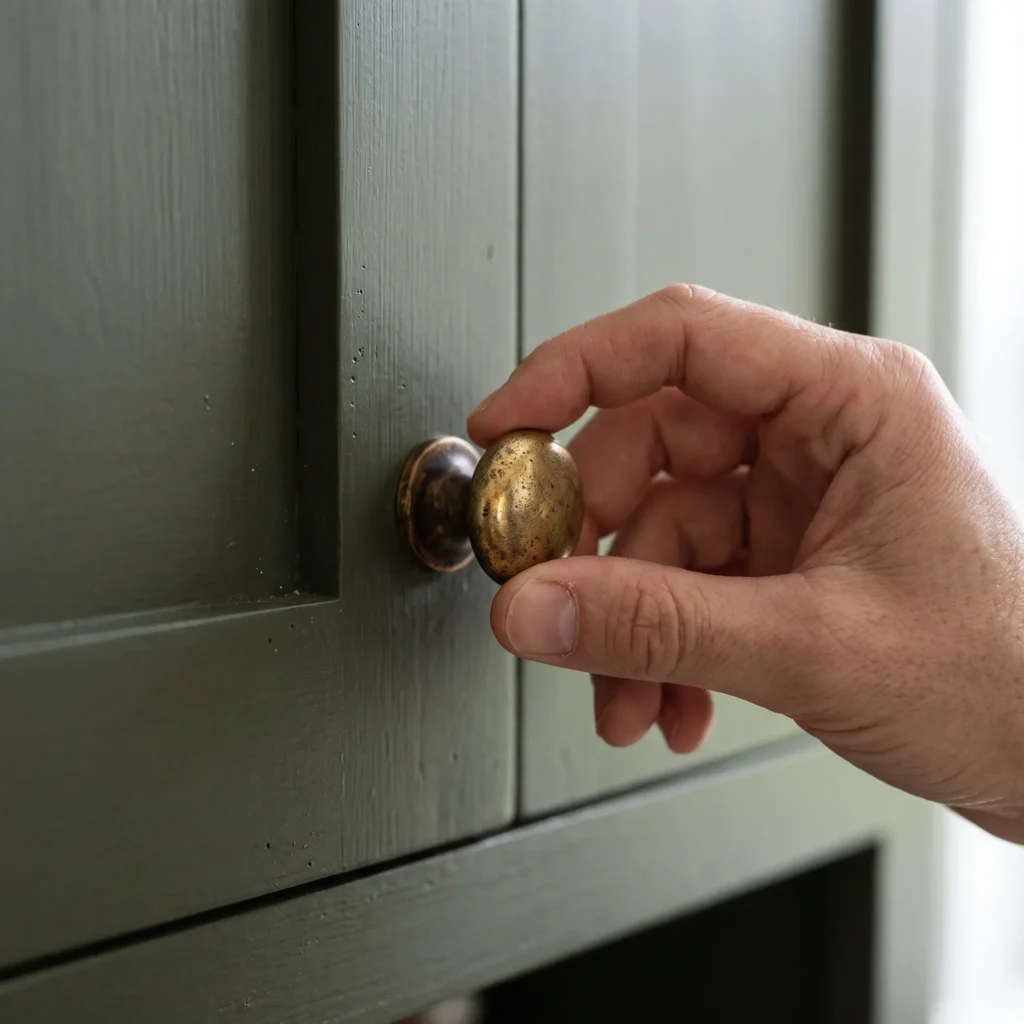
- Products Featured in Image:
- Solid unlacquered raw brass round cabinet knob
- Shaker-style cabinet door painted in dark olive green
- Honed Carrara marble countertop edge visible below
5. The Steaming Shower Eucalyptus Bundle
Synthetic room sprays, plug-in air fresheners, and paraffin candles frequently flood small rooms with artificial fragrance. These heavy chemicals cause olfactory fatigue and mild headaches rather than true physical relaxation.
You can create a natural, restorative scent ritual in your bathroom using fresh plant stems. Take a small bunch of silver dollar eucalyptus, wrap the stems with plain unbleached jute twine, and hang it directly behind your showerhead away from the direct water stream.
When your shower water heats past 98.6 degrees Fahrenheit (37 degrees Celsius), the surrounding steam opens the cellular pores of the eucalyptus leaves. This process naturally vaporizes 1,8-cineole, an organic plant compound that clears your airways, calms the nervous system, and fills your bathroom with a clean, earthy forest scent.
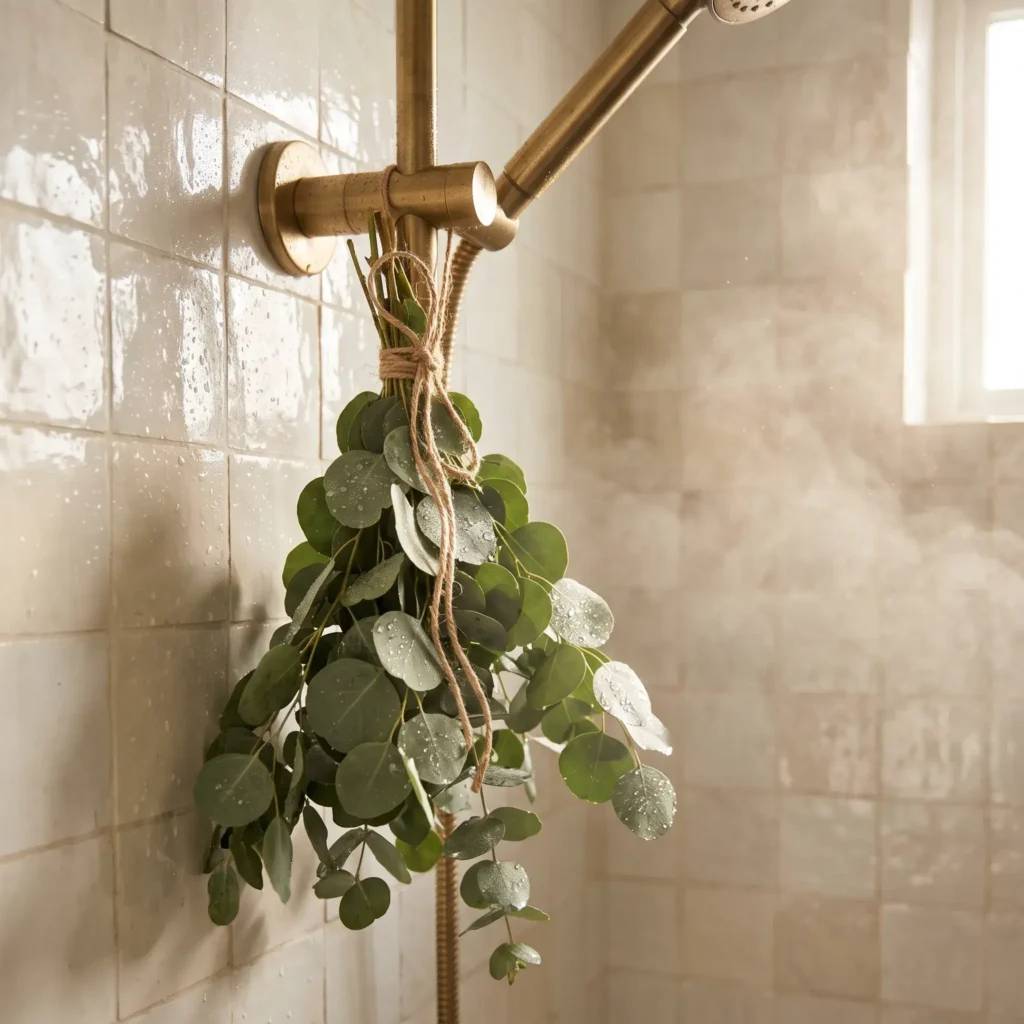
- Products Featured in Image:
- Fresh cut silver dollar eucalyptus branch bundle
- Natural unbleached jute twine cord
- Wall-mounted brushed brass rainfall showerhead
- Handcrafted glossy zellige ceramic wall tiles
6. Amber Glass Decanting for Daily Staples
Commercial dish soap, olive oil, and shampoo bottles use saturated neon colors, bold logos, and loud fonts. Brands design this packaging to scream for attention on crowded supermarket shelves. When you leave those plastic containers sitting on your kitchen counters and bathroom vanities, your visual cortex has to process that clutter constantly.
Decanting daily essentials into matching amber, smoky glass, or ceramic pump bottles eliminates this typographic noise. The dark glass conceals neon-colored liquids and creates an earthy, uniform visual foundation. Clear counters allow your eye to rest, making rooms feel calm without requiring you to hide everyday necessities inside cabinets.
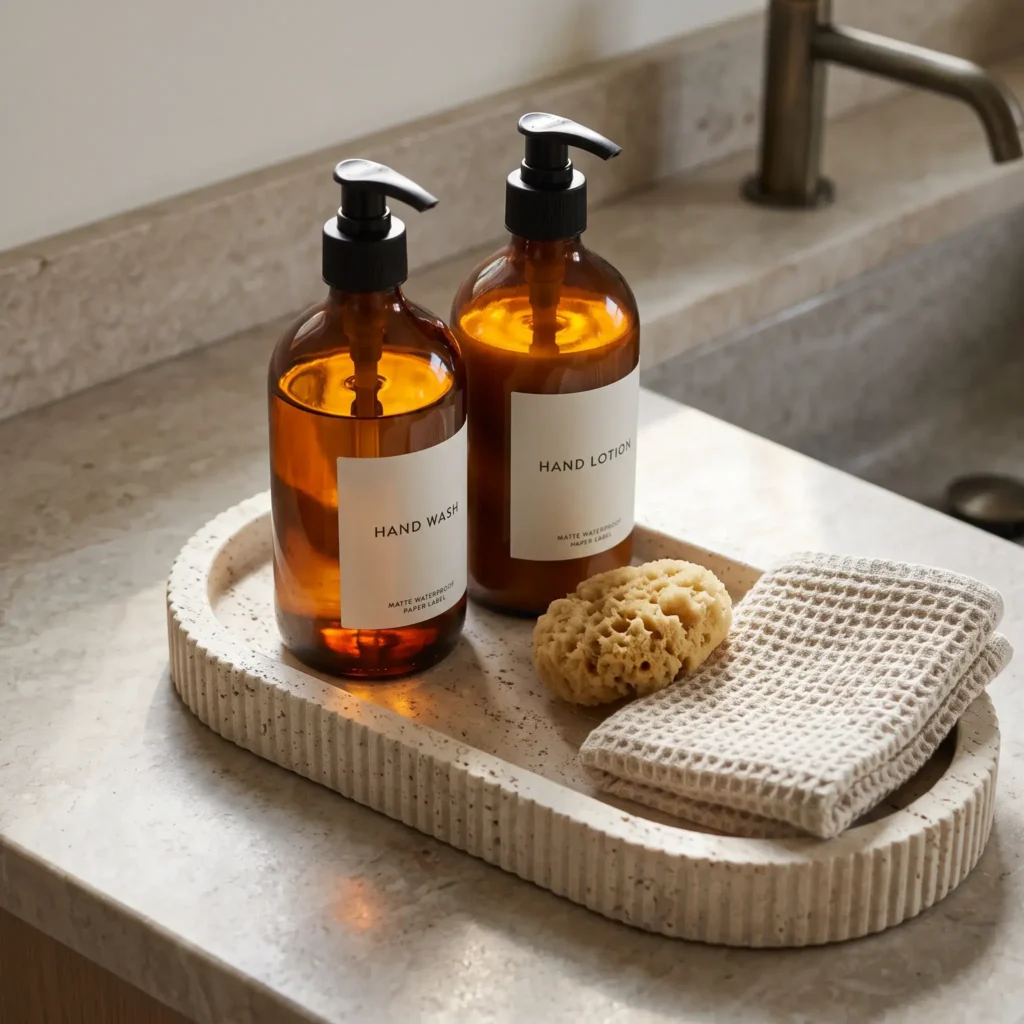
- Products Featured in Image:
- 16-ounce amber glass dispenser bottles with matte black metal pumps
- Minimalist waterproof labels for hand soap and lotion
- Carved natural travertine stone bathroom tray
- Natural honeycomb sea sponge
- Organic cotton waffle-weave hand towel in sand
7. The Asymmetric Rule-of-Three Vignette
When people try to style their sideboards, open shelves, or coffee tables, they often default to formal symmetry. They place identical lamps on both ends of a credenza or align small decorative objects in straight lines. This stiff symmetry feels corporate and unapproachable.
Warm, lived-in homes rely instead on deliberate asymmetry, a concept rooted in the Japanese principle of fukinsei. Arrange items in odd-numbered groups, especially clusters of three complementary forms:
- A vertical anchor: A hand-thrown ceramic vase with one bare, clipped branch.
- A horizontal foundation: Two stacked hardcover art books lying flat.
- A tactile grounding piece: A small unlacquered brass bowl or soapstone dish.
To check your arrangement, use the stylist squint test. Take three steps back and squint your eyes until details blur. If the shapes bleed together into one heavy, awkward mass, add more empty space between them. Negative space gives individual pieces room to breathe, letting your eyes move across the surface without tension.
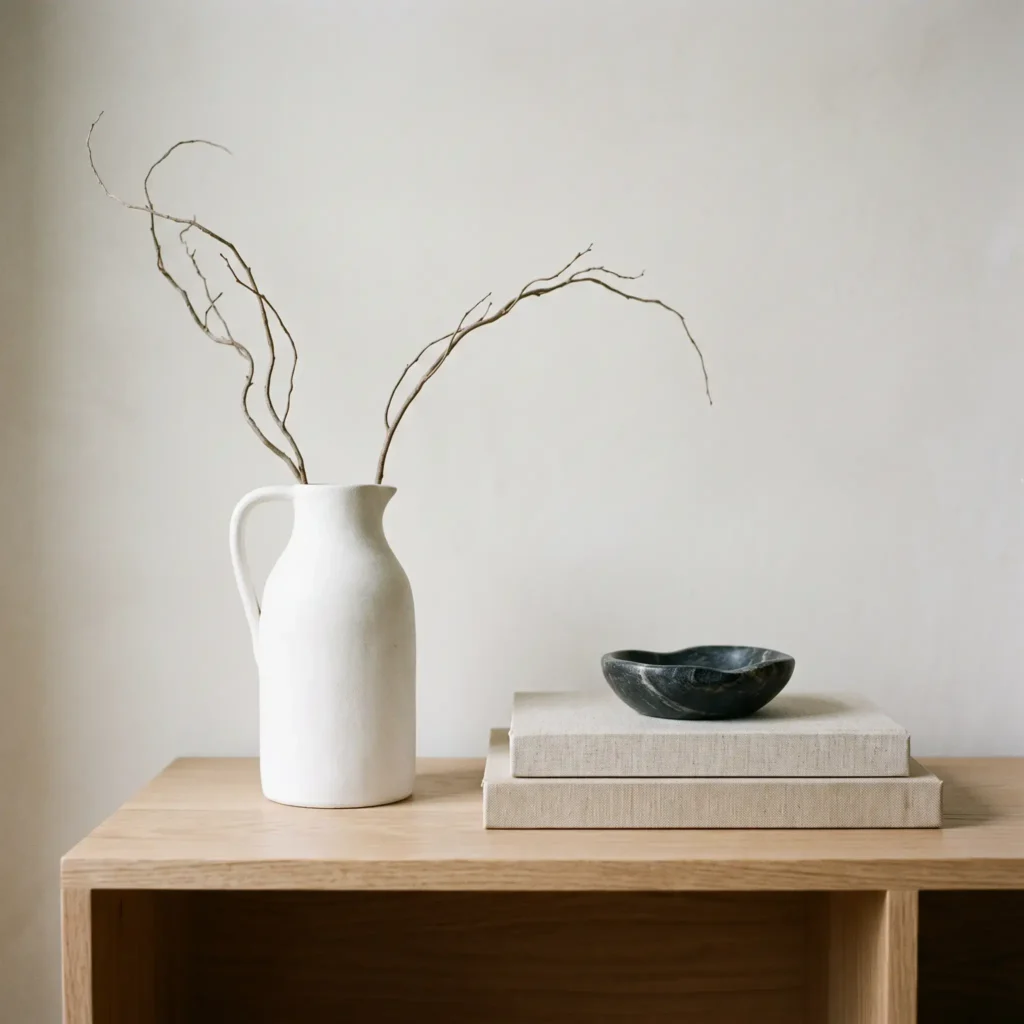
- Products Featured in Image:
- Handcrafted matte white ceramic pitcher vase
- Dried natural pear tree sculptural branches
- Cloth-bound hardcover interior design art books
- Hand-carved charcoal soapstone pinch bowl
- Solid white oak low credenza
The Spatial Psychology of Domestic Warmth
Why do these small touches change how a room feels? The answer lies in environmental psychology and evolutionary biology.
In the 1970s, environmental geographer Jay Appleton introduced Prospect-Refuge Theory. Appleton noted that humans possess an evolved biological preference for environments that combine clear viewing lines (prospect) with protected physical enclosure (refuge). In ancestral landscapes, humans needed to scan for opportunities and hazards while keeping their backs protected from exposure.
Modern open-concept floor plans disrupt this balance. Large spaces with soaring ceilings and expansive glass walls provide endless prospect, but almost zero refuge. Sitting in the center of an enormous, unpartitioned room leaves your autonomic nervous system in a subtle state of exposure.
True domestic comfort returns when you introduce protective boundaries. A high-backed reading chair placed against a solid partition wall, a dropped pendant over a breakfast nook, or an intimate seating arrangement tucked into a corner immediately provides physical refuge. These micro-zones allow your nervous system to switch from sympathetic alertness to restful parasympathetic equilibrium.
Why Overhead Lighting Ruins Evening Calm
Lighting is the primary environmental cue regulating human biology. For thousands of years, sunset signaled our bodies to wind down and prepare for sleep.
High-altitude ceiling fixtures, often called the “big light,” emit light from overhead at color temperatures between 3500K and 5000K. This spectral mix mimics the midday sun. When blue-enriched light strikes intrinsically photosensitive retinal ganglion cells (ipRGCs) in your eyes, your brain suppresses melatonin production and elevates cortisol. Sharp downward shadows also emphasize harsh corners and give rooms an institutional look.
To create true domestic warmth after dusk, transition your home to a low-level lighting network. Keep fixtures at or below eye level, between 3.5 and 5 feet off the floor. Table lamps, wall sconces, and low credenza accent lights cast gentle horizontal light across living areas.
Using warm-dimming LED bulbs calibrated between 2000K and 2400K mimics the soothing glow of campfires and candlelight. This golden light visually softens architectural boundaries, flatters facial features, and triggers your body’s natural circadian wind-down.
Micro-Upgrade Comparison Guide
| Room Zone | Micro-Intervention | Exact Specification | Immediate Sensory Payoff |
|---|---|---|---|
| Living Room | Cushion insert swap | 90% duck feather / 10% down; 2 inches larger than cover | Sinks under body weight; eliminates springy bounce |
| Hallways & Floors | Dense rug underlayment | 3/8-inch needle-punched compressed felt with rubber base | Muffles footsteps; eliminates hollow floor echo |
| Kitchen Counters | Low-level accent lighting | Ceramic mini-lamp with 2200K–2400K LED bulb | Transforms sterile prep counters into a warm hearth |
| Doors & Cabinets | Living hardware finishes | Solid unlacquered architectural brass | Buffs smooth with touch; darkens in corners over time |
| Bathroom / Shower | Steam botanical bundle | Fresh eucalyptus bound with unbleached jute twine | Releases natural 1,8-cineole vapor for daily calm |
| Shelves & Tables | Asymmetric vignettes | 3-item rule (tall vertical + flat stack + tactile piece) | Breaks catalog stiffness; preserves restful negative space |
Frequently Asked Questions
What makes a room feel instantly homey?
A room feels homey when it engages multiple senses simultaneously. Soft acoustic damping from thick felt rug pads, low-level warm amber lighting below eye level, and natural tactile fabrics like linen and down feathers immediately make a space feel safe, lived-in, and comfortable.
Why does my house look great but feel cold?
Most cold spaces suffer from hard acoustics, visual noise, and overhead lighting. If you have unshaded ceiling lights on, bare floors that echo, stiff synthetic sofa cushions, and branded product bottles covering countertops, your brain perceives the space as a sterile commercial showroom rather than a personal sanctuary.
What bulb temperature is best for a cozy evening room?
Choose warm-white LED bulbs rated between 2200K and 2700K for living rooms and bedrooms. Bulbs in the 2200K to 2400K range produce an amber glow similar to candlelight and incandescent filaments, which encourages your nervous system to relax. Keep bulbs above 3500K strictly for functional utility zones like garages and laundry rooms.
How do I reduce visual clutter without buying more storage bins?
Start by removing retail packaging. Decant dish soaps, cooking oils, and bathroom essentials into plain amber or smoke glass pump bottles. Clear small paper clutter from tables, and leave generous empty space on shelves. Group remaining decor in small, odd-numbered clusters using the rule of three.
Why do my decorative pillows always look flat and cheap?
Cheap pillows usually rely on lightweight synthetic polyester fiberfill that mats down and resists body contours. Replacing them with 90/10 duck feather and down inserts sized two inches larger than your covers provides weight, plumps out limp corners, and allows the pillows to hold a soft, tailored indent.
Making a house feel like a home does not require knocking down walls or purchasing designer furniture sets. It comes down to noticing how your space speaks to your senses. Swap out the harsh overhead lights for an amber kitchen counter lamp. Lay a dense felt pad beneath your living room rug to silence hollow footsteps. Choose materials that show the honest patina of daily life. When your home cushions your steps, softens its light, and welcomes your touch, comfort follows naturally.