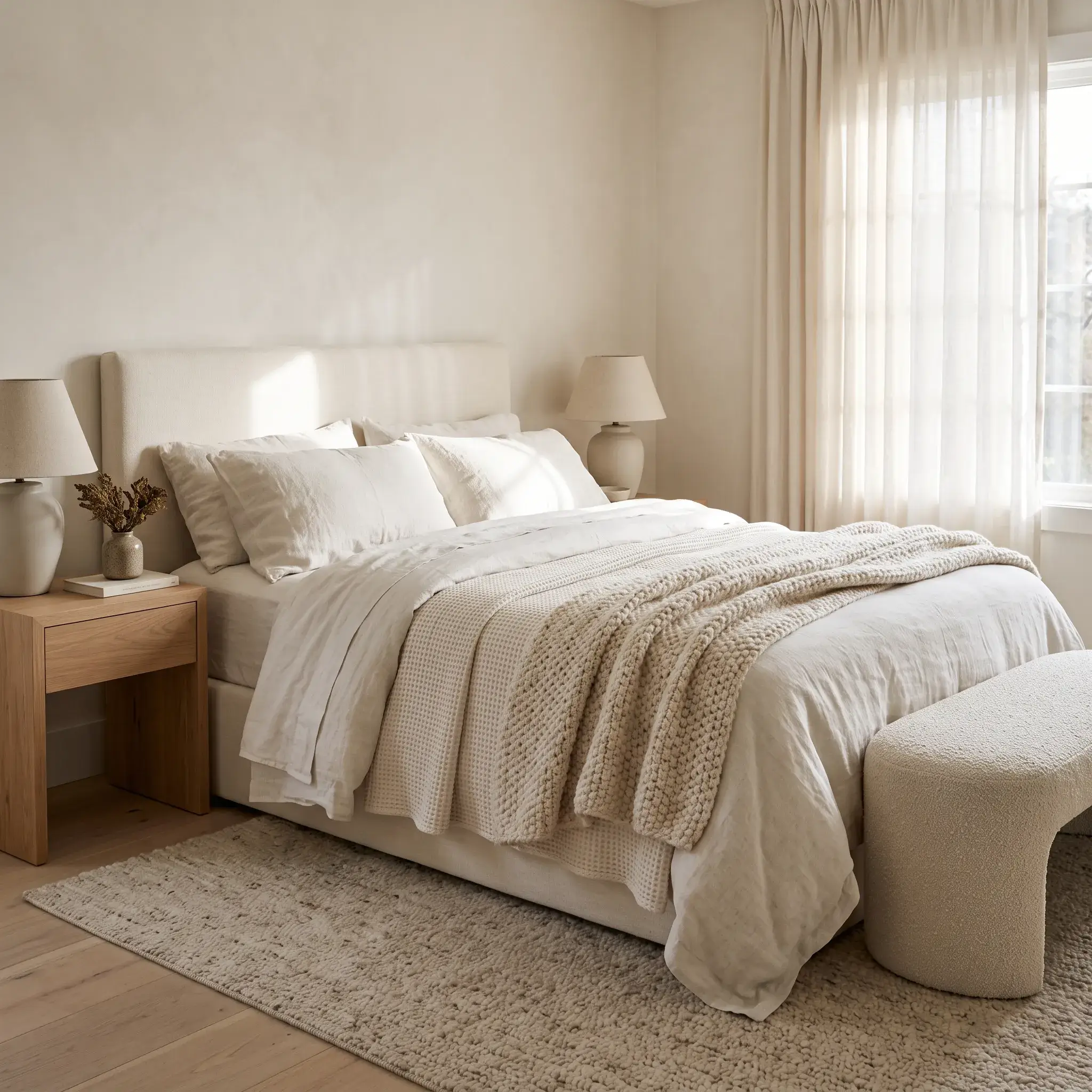
How to Decorate an Earthy Green Bedroom Without Making It Feel Flat

Painting your bedroom walls green often leads to quick regret. You pick a soft sage or moody olive from a paint swatch. You roll two coats onto smooth drywall. Once the paint dries, the room feels cold, muddy, or uncomfortably sterile.
The issue is not your color choice. Human eyes detect more shades of green than any other color on the visual spectrum. Because our eyes process green so easily, unbroken green surfaces quickly blend into a dull background. Flat drywall scatters light evenly. Without physical shadows, varied textures, and warm undertones, the walls lose all visual depth.
You can fix this without repainting. By mixing tactile textiles, balanced timber tones, directional lighting, and physical wall relief, you can turn a lifeless green box into a layered, grounded space.
Here are seven practical design concepts you can apply right away, followed by the architectural rules that keep earthy greens vibrant in any light.
7 Practical Earthy Green Bedroom Ideas That Add Instant Depth
Idea 1: The Washed Linen and Chunky Waffle Bedscape
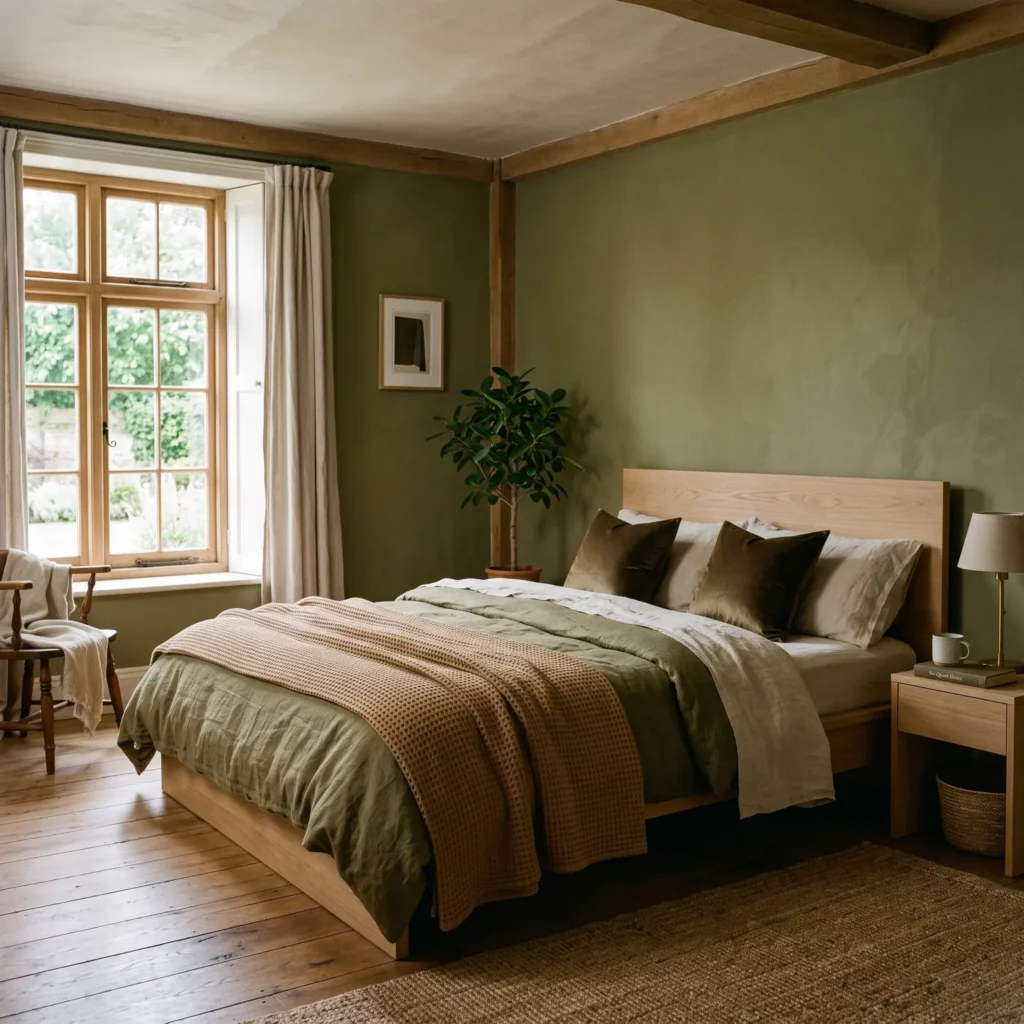
Green walls need immediate tactile relief at the center of the room. Pairing a matte olive wall with smooth cotton bedding makes the entire space look two-dimensional.
Build your bed with distinct fabric weights. Start with garment-washed flax linen sheets in warm biscuit or unbleached ecru. Lay a mid-weight olive linen duvet across the mattress, then fold a heavy honey-camel waffle blanket across the bottom third of the bed. Finish the arrangement with two bronze velvet accent shams. The deep pile of the velvet catches room light, while the open weave of the waffle blanket casts tiny shadows across the covers.
- Products Used in This Design:
- Washed Belgian flax linen sheet set in Natural Ecru
- Stonewashed olive green linen duvet cover
- Heavyweight cotton waffle-knit throw blanket in Camel
- Two 20×20 cotton velvet accent pillow covers in Cognac Bronze
- Low-profile solid white oak platform bed frame
Idea 2: Limewashed Olive Walls with Unlacquered Brass Accents
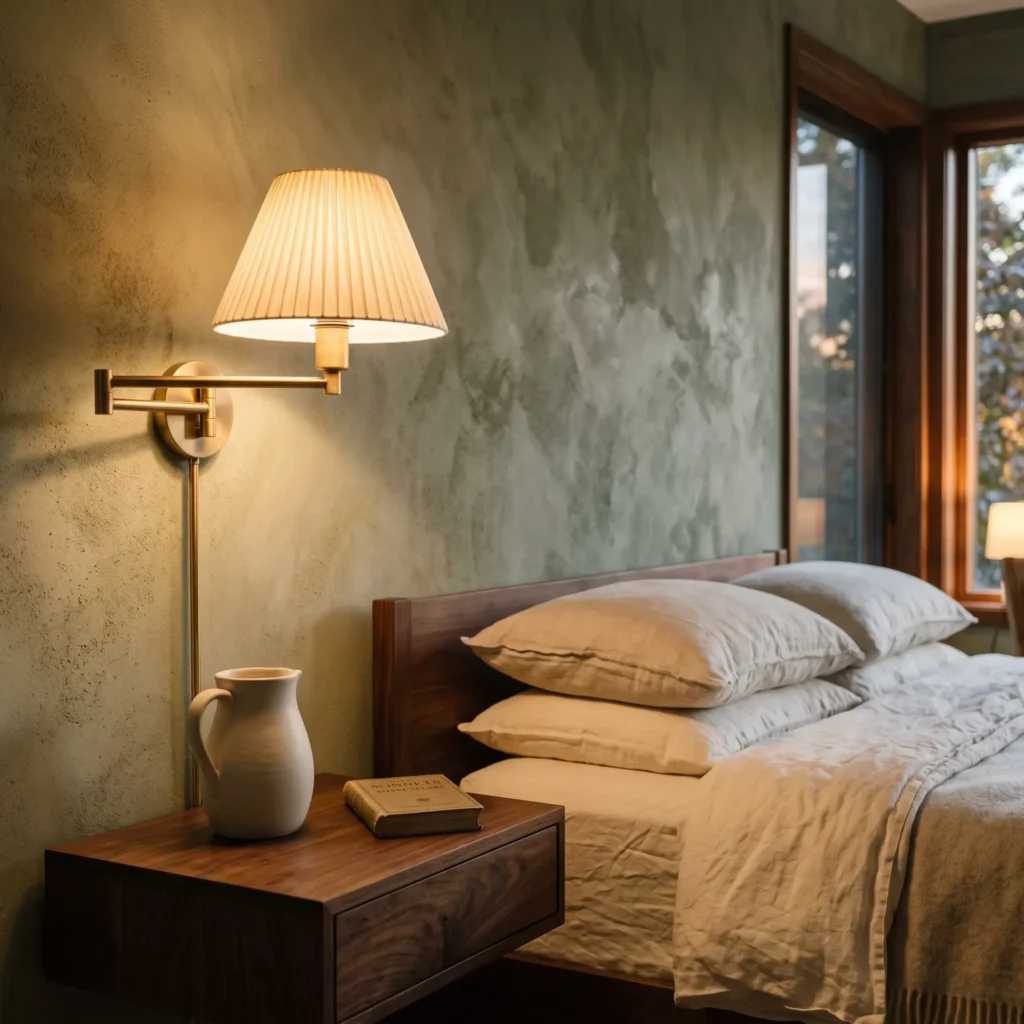
Standard latex paint creates a plastic-like film over drywall that absorbs light evenly. Applying mineral limewash completely changes how light behaves on your walls.
Apply two coats of olive limewash using broad cross-hatch brush strokes. The slaked lime cures into microscopic crystals that refract daylight, creating a soft, suede-like finish with natural movement. Mount solid, unlacquered brass swing-arm sconces directly beside the headboard. The warm metallic reflections slice through the powdery matte wall, giving your eyes a bright focal point to rest on.
- Products Used in This Design:
- Mineral limewash paint in deep muted olive
- Unlacquered brass swing-arm wall sconces with pleated cream linen shades
- Reclaimed walnut nightstands with open lower shelving
- Matte ceramic water carafe in chalk white
- Ivory wool flatweave runner rug
Check out more Modern Bedroom Ideas
Idea 3: The 4-Inch Reveal Picture Frame Moulding Grid
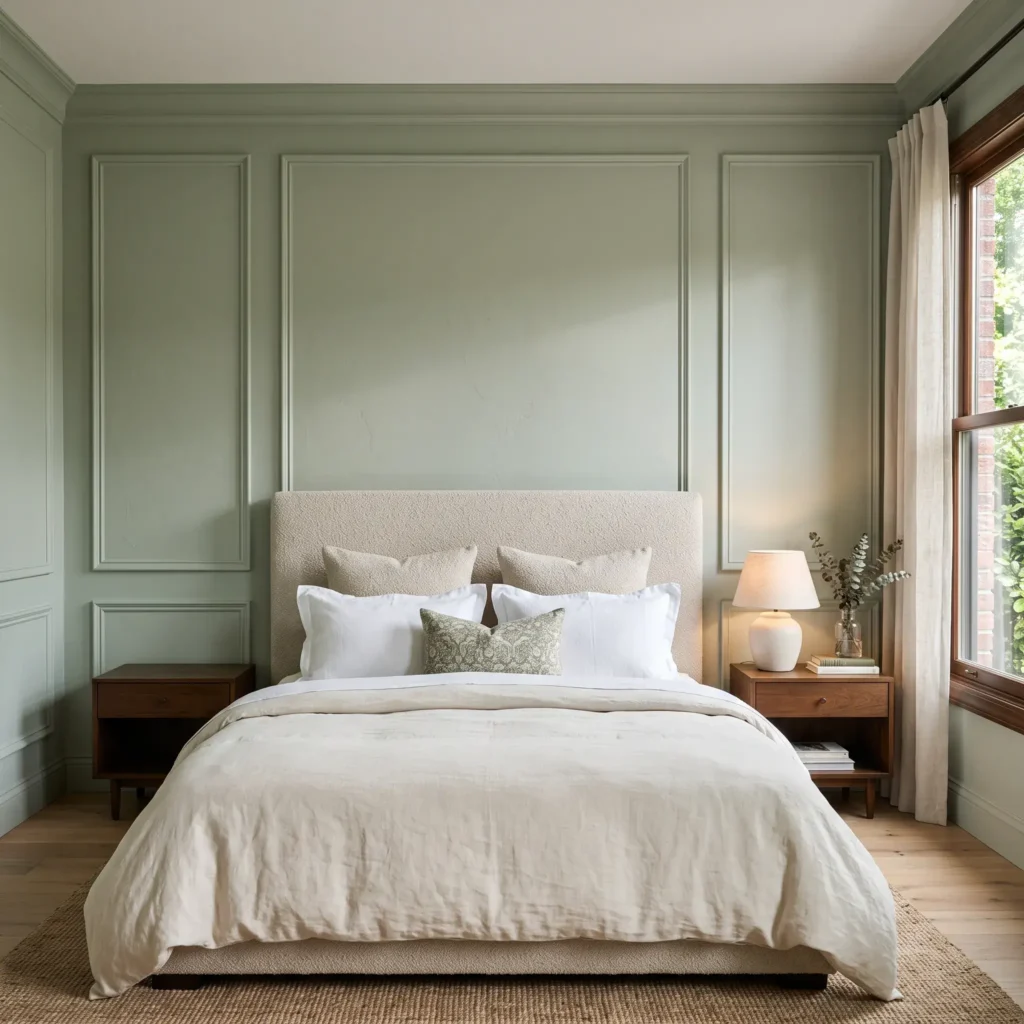
Large expanses of flat drywall make green paint look cheap and unfinished. You can solve this by adding physical woodwork that creates real shadow lines across the wall plane.
Install applied picture frame moulding across your main focal wall. Maintain a strict four-inch spacing gap between baseboards, crown moulding, and adjacent wall boxes. Paint the moulding and drywall the exact same shade of desaturated sage green. When sunlight enters from the side, the raised wooden profiles cast crisp pencil-thin shadows across the wall. The wall changes throughout the day as the sun moves, keeping the color lively without adding extra patterns.
- Products Used in This Design:
- 1.5-inch primed pine picture moulding profiles
- Benjamin Moore October Mist (1495) in eggshell finish
- 6-inch architectural baseboards
- High-back upholstered headboard in oatmeal bouclé
- Antiqued bronze directional picture light
Idea 4: Color-Drenched Sage with Sheen-Modulated Millwork
White trim around dark green walls creates harsh visual borders. These sharp lines break up the room and make the walls look like flat vertical boards.
Drench the entire space in one cohesive green tone. Paint the ceiling, window frames, door profiles, baseboards, and walls the exact same color. To keep the woodwork distinct, change the paint sheen rather than the color. Use a dead flat finish on the ceiling to hide drywall seams and absorb glare. Use an ultra-matte finish on the walls. Finish all trim, casings, and doors in a satin enamel. The satin finish catches ambient light along the edges of the room, defining the architecture cleanly without high-contrast white trim.
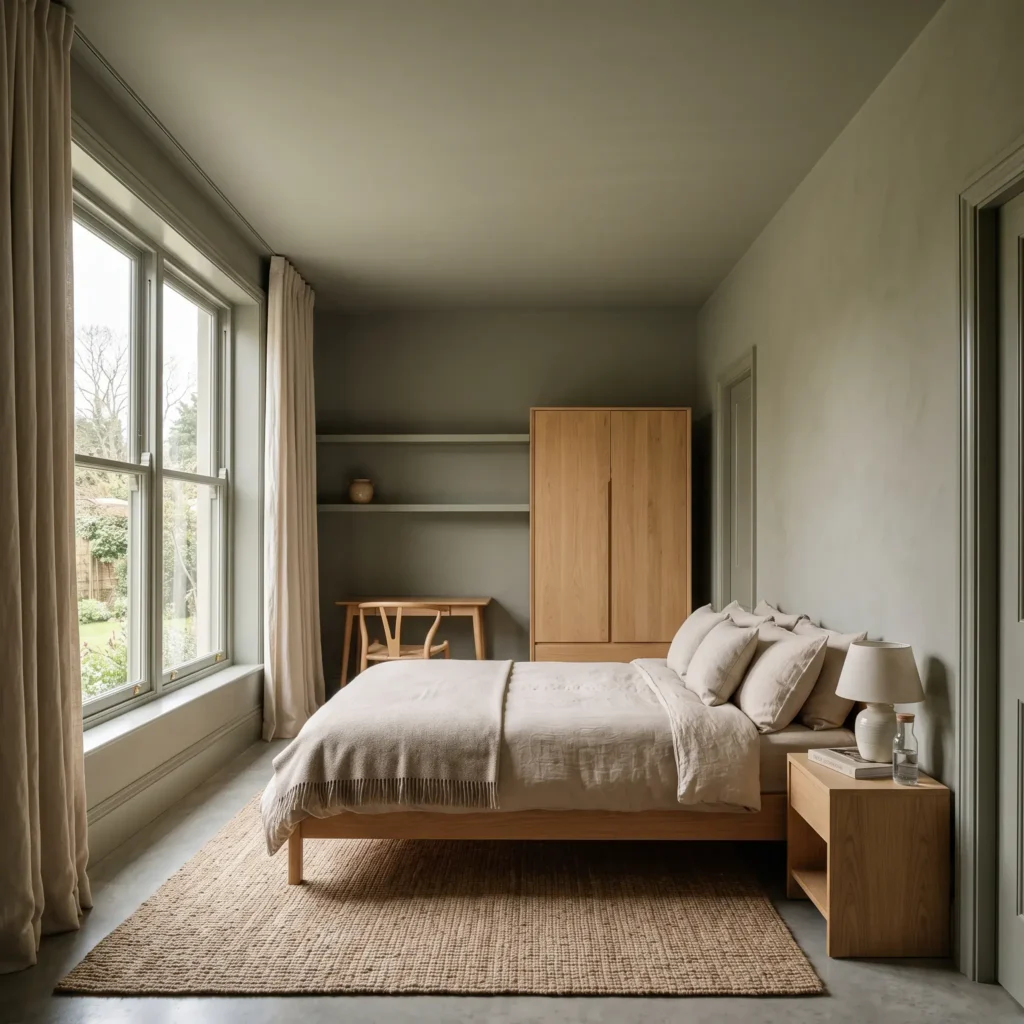
- Products Used in This Design:
- Farrow & Ball French Gray in Dead Flat (ceiling)
- Farrow & Ball French Gray in Modern Emulsion (walls)
- Farrow & Ball French Gray in Estate Eggshell (trim and baseboards)
- Fluted white oak dresser with matte black iron knobs
- Floor-length off-white sheer linen curtains on a bronze ceiling rod
Idea 5: Warm Terracotta and Aged Cognac Leather Anchors
Green sits opposite red and red-orange on the color wheel. Without warm complementary accents, an earthy green room feels cold, medicinal, and unfinished.
Introduce warm earth tones through accent pieces to bring the room to life. Place an aged cognac leather bench at the foot of your bed. Set hand-thrown terracotta table lamps with natural parchment shades on your nightstands. The warm, advancing red and amber tones draw the eye forward, while the cool green walls naturally recede. This spatial separation immediately makes a compact bedroom feel deeper and more dimensional.
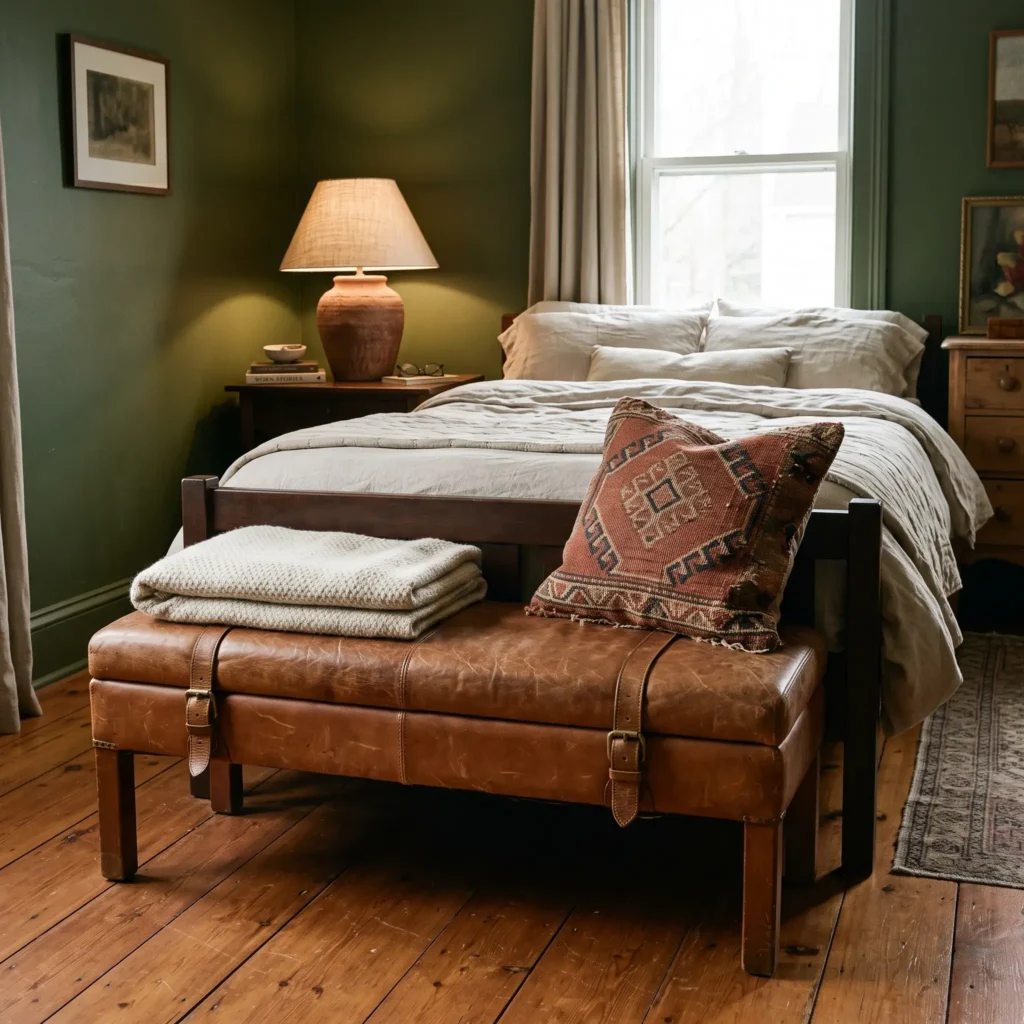
- Products Used in This Design:
- Handcrafted cognac leather strapped bench with dark wood legs
- Unglazed rustic terracotta table lamp bases with empire parchment shades
- Vintage wool kilim throw pillow with rust, umber, and olive patterns
- Matte black metal curtain rods
- Warm ecru textured cotton quilt
Idea 6: Layered Flooring with Braided Jute and Distressed Vintage Wool
Bare light oak floors or wall-to-wall gray carpet drain the warmth from green walls. A room with dark or saturated walls needs strong grounding at the floor level.
Build a two-tier foundation under your bed. Lay a large, thick-braided natural jute rug as your base, extending at least two feet past all sides of the mattress. Over the jute, layer a smaller vintage Persian or Turkish Oushak runner. Look for rugs with vegetable dyes featuring faded terracotta, deep indigo, warm stone, and moss. The raw, rough texture of the jute breaks up the smooth flooring, while the intricate, faded rug patterns anchor the color scheme.
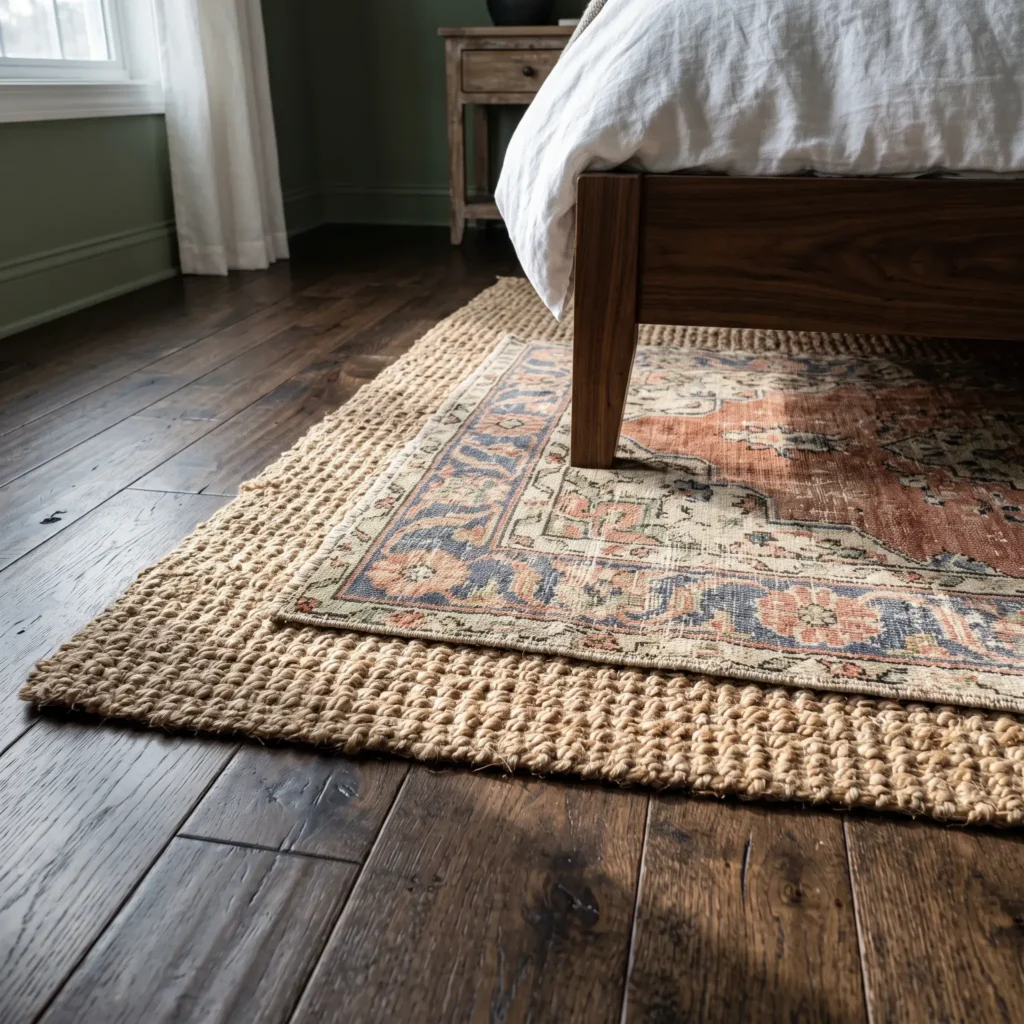
- Products Used in This Design:
- 9×12 thick chunky-braided natural jute area rug
- 5×8 authentic vintage semi-antique Turkish Oushak wool rug
- American walnut low-profile nightstands
- Washed ivory percale sheet set
- Matte black metal reading floor lamp
Idea 7: The Three-Tier Lighting System with Botanical Shadows
A single overhead ceiling fixture flattens rooms. Downward light creates harsh shadows under your furniture while leaving perimeter walls looking dim and muddy.
Turn off your central fixture and build three distinct levels of light. Place a mini canister spotlight on the floor behind a tall, leafy indoor plant, like a potted olive tree or fiddle leaf fig. Aim the beam upward to throw soft leaf shadows across the green wall. At eye level, use shaded sconces with 2700K warm incandescent bulbs to wash the mid-wall sections. Finally, hang an open-weave rattan or textured fabric drum pendant from the ceiling for gentle, indirect fill light. This cross-lighting turns flat walls into a dynamic mix of light and shadow at night.
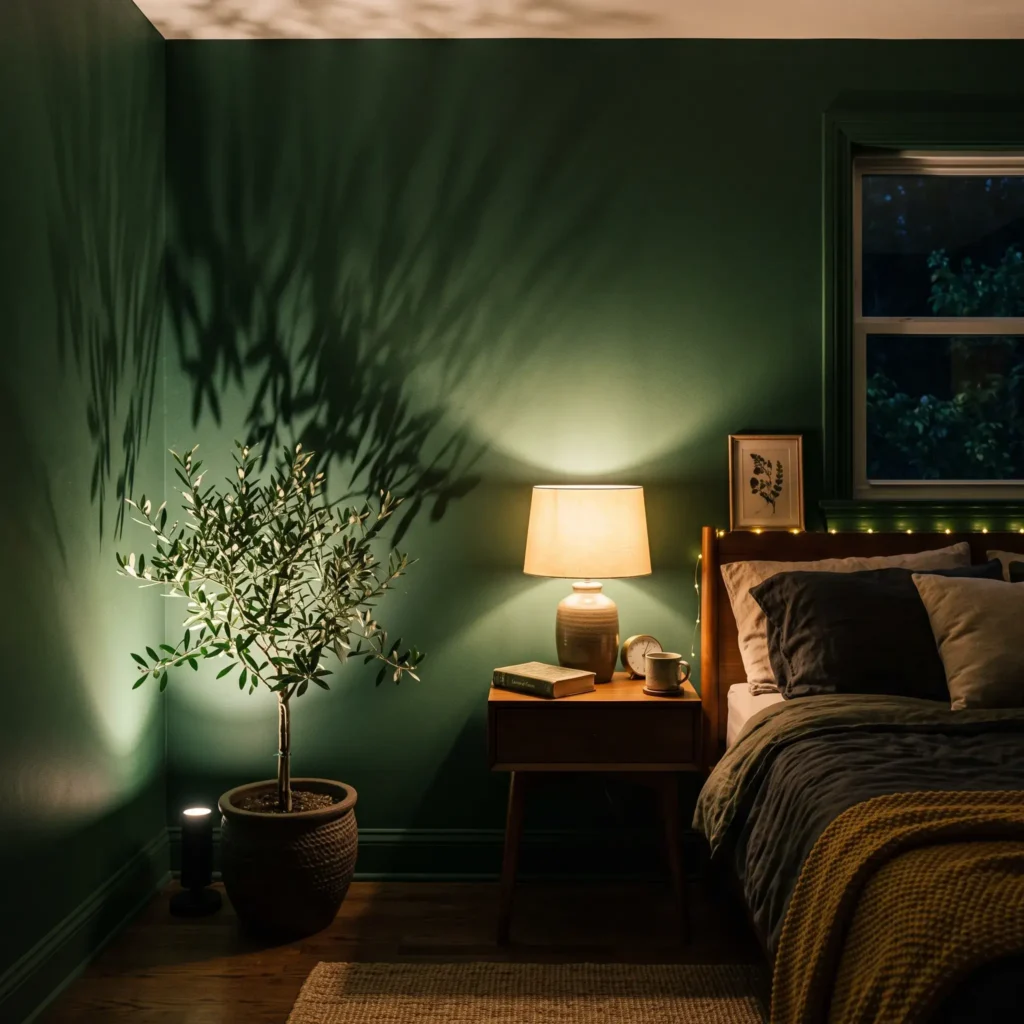
- Products Used in This Design:
- Floor-standing compact LED accent uplight with foot switch
- 6-foot potted indoor olive tree in a weathered stone planter
- Fluted ceramic bedside lamps with linen drum shades
- Oversized woven linen pendant ceiling fixture
- 2700K 90+ CRI dimmable warm white LED bulbs
Architectural Rules: Why Green Flattens and How to Prevent It
Applying paint to walls without understanding room physics often leads to disappointing results. Use these technical design rules to ensure your green bedroom maintains depth throughout the entire day.
1. The Solar Exposure and Paint Matrix
Natural daylight shifts constantly in color and intensity. The direction your bedroom windows face determines whether green paint looks rich and grounded or dull and cold.
- North-Facing Rooms: These windows receive weak, cool, blue-tinted daylight. Cool greens turn chalky, industrial, or somber in this setting. Choose greens built on yellow, ochre, or raw umber bases. These warm undertones absorb cold blue wavelengths and keep the walls welcoming.
- South-Facing Rooms: These windows receive intense, warm sunlight all day. Warm greens can flare with yellow saturation, flattening your room under heavy glare. Choose desaturated greens with slate-gray or blue undertones to balance the strong golden daylight.
- East-Facing Rooms: Morning light is clear and warm, but afternoons turn cool and shadowy. Use balanced moss or olive tones with a neutral base to keep the room from feeling washed out after midday.
- West-Facing Rooms: Mornings are dim, while late afternoons bring fiery orange light. Pick muted, cool-leaning greens that can handle intense late-day warmth without looking overly bright.
Use this tested paint guide to match your room orientation:
| Paint Brand & Color | LRV | Undertone Profile | Best Window Exposure | Visual Effect |
|---|---|---|---|---|
| Farrow & Ball Dibber (No. 312) | ~38 | Muted yellow-brown | North / East | Counteracts cold shadows; stays warm in weak light |
| Benjamin Moore Spanish Olive (1509) | ~62 | Warm greige-olive | North / North-West | High reflectance prevents dark, gloomy corners |
| Sherwin-Williams Evergreen Fog (SW 9130) | ~30 | Neutral gray-slate | South / West | Balances bright golden sun without turning muddy |
| Farrow & Ball Green Smoke (No. 47) | ~19 | Smoky slate-blue | South / All exposures | Creates deep historic depth; blue notes prevent yellow flare |
| Sherwin-Williams Pewter Green (SW 6208) | ~12 | Deep olive-charcoal | South / High light | Adds rich visual weight; makes walls recede naturally |
| Benjamin Moore October Mist (1495) | ~46.5 | Organic silver-gray | South / East | Serves as an airy neutral ground for darker furniture |
2. The 60-30-10 Earthy Color Formula
Monochromatic rooms look flat when colors are not balanced properly. Use this strict ratio to build contrast without creating visual chaos:
60% The Dominant Canopy (Base Layer)
- Colors: Muted Sage, Olive, or Moss Green
- Placement: Perimeter drywall, ceiling wash, or oversized wall-to-wall drapes. This establishes your quiet background without competing for attention.
30% The Secondary Warmth (Tactile Mid-Tones)
- Colors & Materials: Warm Cream, Oatmeal, White Oak, American Walnut, and Natural Jute
- Placement: Duvet covers, headboards, nightstands, and large woven floor rugs. These elements soften the green and prevent the room from feeling cold.
10% The Visual Anchors (Focal Contrast)
- Colors & Accents: Unlacquered Brass, Fired Terracotta, Aged Cognac Leather, and Blackened Iron
- Placement: Bedside sconces, decorative stoneware, hardware pulls, and accent pillows. These pieces draw the eye forward and create spatial depth.
- 60% Dominant Base (The Canopy): Your primary green hue across the walls, large drapes, or area rug.
- 30% Secondary Neutral Warmth (The Earth): Warm cream textiles, natural wool, white oak, or rich walnut furniture. Never use stark, cool white (#FFFFFF). Opt for warm whites like Sherwin-Williams Alabaster or Benjamin Moore Swiss Coffee.
- 10% Contrast Anchors (The Spark): Small, deliberate accents of terracotta pottery, cognac leather, unlacquered brass hardware, or matte black iron fixtures.
3. Lighting Science: The 2700K and R9 Rule
Your lighting plan can easily ruin a well-painted room. Standard commercial LED bulbs often make earthy greens look sick and gray.
Always check the bulb specifications on the packaging:
- Color Temperature: Choose 2700K (Warm White) for main bedroom areas, or 3000K (Warm Neutral) for reading fixtures. Never install 4000K or 5000K daylight bulbs. Cool lighting kills the yellow and brown pigments in green paint, turning your room into a sterile box.
- Color Rendering Index (CRI): Select bulbs with a 90+ CRI rating. Bulbs with poor ratings compress color wavelengths and flatten subtle paint undertones.
- The R9 Red Spectral Metric: Green paint requires red light wavelengths to show its true depth. Standard LEDs frequently score below 10 on the R9 test. Look for high-performance architectural bulbs with an R9 value above 50. This ensures the light contains enough warm spectrum to keep your green paint lively after dark.
Final Takeaway: How to Start Today
You do not need to repaint your room to get rid of flat green walls.
Start by addressing your light sources. Replace any cool white bulbs with 2700K warm options with a high CRI rating. Next, review your bed setup. Pull back flat sheets and introduce a chunky waffle blanket or a pair of velvet shams to create surface shadows. Finally, introduce warm wood tones and brass accents to give your eyes clear focal points.
Once you introduce real surface textures, warm undertones, and directional shadows, your earthy green bedroom will naturally transform into a comfortable, grounded retreat.
Frequently Asked Questions
What accent color prevents an earthy green bedroom from feeling flat?
Warm earth tones like terracotta, cognac leather, burnt amber, and unlacquered brass work best. Because these warm tones sit opposite green on the color wheel, they draw the eye forward. This contrast separates foreground furniture from your background walls, creating immediate visual depth.
Why do my sage green walls look gray and cold?
Sage green looks gray when painted in north-facing rooms or under cool-white LED lighting. Cool natural light drains yellow undertones from the paint. To fix this, switch your bulbs to 2700K warm LEDs and layer warm cream blankets, honey-toned oak furniture, and cognac accents into the room.
Should my bedroom ceiling be white if my walls are dark green?
Avoid stark, optic white ceilings. A bright white ceiling creates a sharp visual line around the perimeter of the room, making your walls look shorter and two-dimensional. Instead, paint the ceiling in a warm off-white, or color-drench the ceiling in the same green paint using a dead flat sheen.
What wood tone pairs best with olive green bedroom walls?
American black walnut and white oak pair naturally with olive walls. Walnut has deep brown and violet-taupe grain lines that ground darker greens. Rift-sawn white oak brings light, honey-wheat warmth that keeps deeper paint shades from feeling dark or heavy. Avoid orange-stained red oak or yellow pine.
Does limewash paint hold up well in a bedroom?
Yes, limewash works very well on bedroom walls. Because bedrooms are low-moisture spaces, limewash cures into a durable, breathable mineral surface. Its natural chalky mottling hides subtle drywall imperfections and diffuses light, adding texture that standard latex paint cannot replicate.