7 Warm Minimalist Living Room Ideas: Fix Cold, Sterile Spaces

Standard minimalism promised peace, but it often produced cold rooms that felt like clinical labs. Stripping away clutter was the right move. Stripping away comfort, texture, and warmth was a mistake.
Warm minimalism fixes that problem. It gives you the mental relief of clear surfaces without the cold chill of sterile spaces. You do not need to fill your room with random accessories to make it inviting. You only need materials that carry physical warmth, balanced lighting, and furniture that has room to breathe.
Here are seven practical concepts you can adapt right now to build a clean, restful living room that feels like home.
7 Practical Warm Minimalist Living Room Ideas
1. The Honed Travertine and Washed Linen Lounge
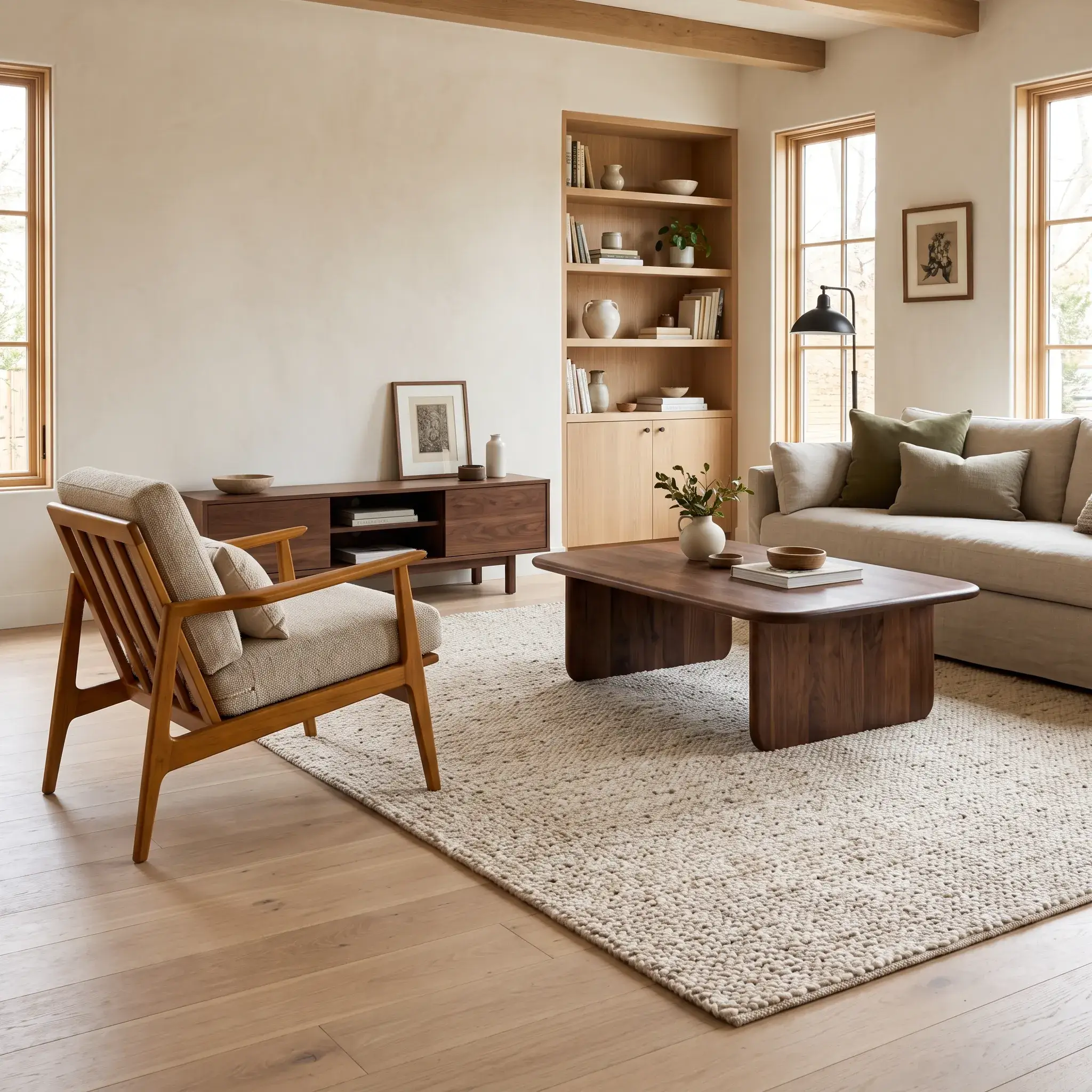
This layout anchors the center of the room with natural stone and textured fabric. Instead of pushing furniture against the walls, float an oatmeal linen sectional in the middle of the room. Pair it with a low travertine plinth coffee table. The natural pits in the stone break up flat surfaces without creating visual clutter. Keep the floor soft with an undyed wool-loop area rug that extends past the edges of the sofa.
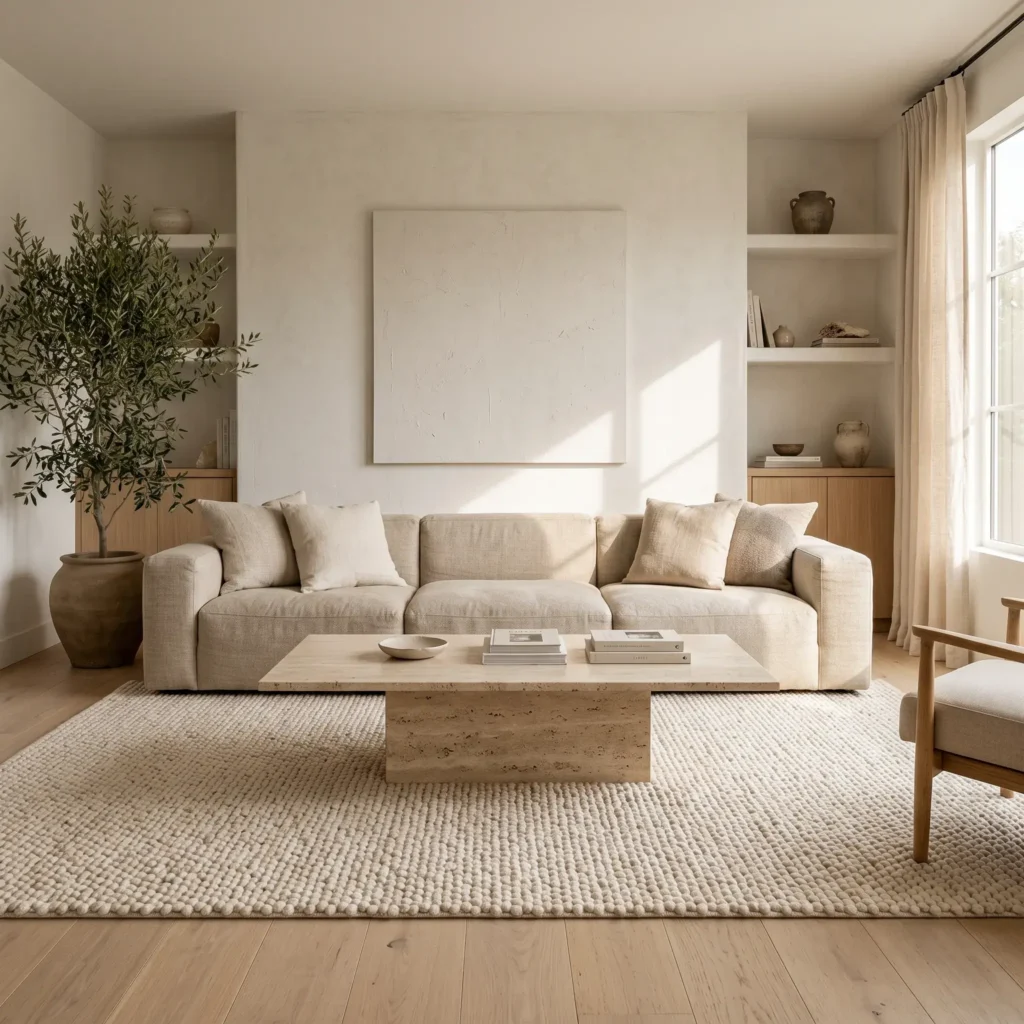
- Product Sourcing List:
- Low-profile sectional sofa in natural Belgian flax linen (oatmeal or wheat)
- Honed Roman travertine plinth coffee table (matte, unfilled finish)
- 9×12 foot undyed wool-loop rug in soft cream
- Hand-thrown unglazed ceramic centerpiece bowl
2. The Textured Plaster Wall with Fluted Oak Storage
Drywall painted in standard flat latex can look thin and flat. Coating your main wall in Roman clay or lime wash adds subtle variation that reacts softly to changing daylight. Below the wall, install a floating media console made of white oak with vertical fluted details. The vertical lines add texture and shadow, while the closed cabinet doors hide cables, consoles, and routers.
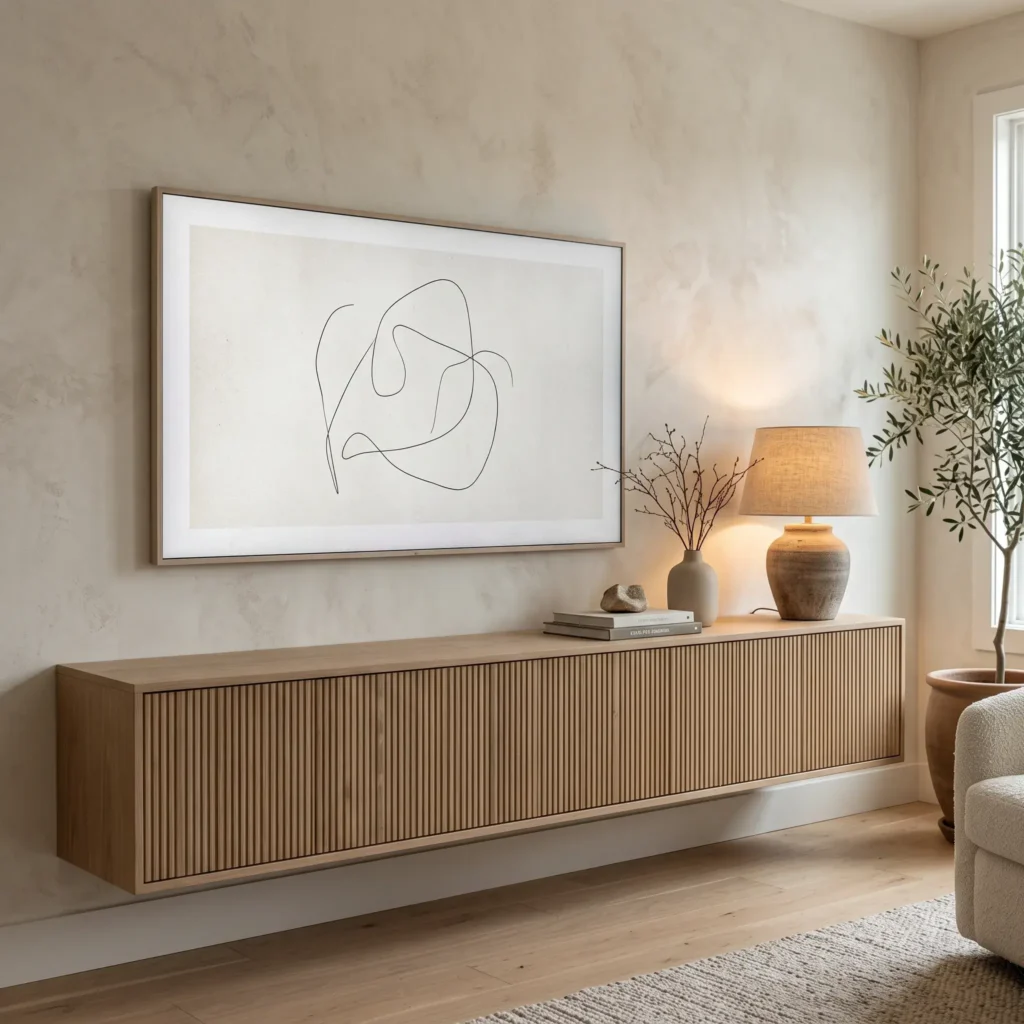
- Product Sourcing List:
- Roman clay or lime wash wall coating in soft bone or chalk
- Floating media credenza in natural white oak with push-latch fluted doors
- Samsung The Frame TV displaying a neutral charcoal sketch
- Low cream ceramic table lamp with a natural linen drum shade
Check out more Living Room Ideas
3. The Low-Profile Seating Group with Washi Paper Lighting
Lowering the height of your furniture makes your ceilings feel much taller. Choose a low-slung sofa and pair it with a curved accent chair to soften straight room lines. Instead of a harsh brass chandelier or recessed ceiling lights, hang an oversized Japanese paper pendant light right above the conversation area. The fibrous paper diffuses light evenly, turning the fixture into a soft glowing sculpture.
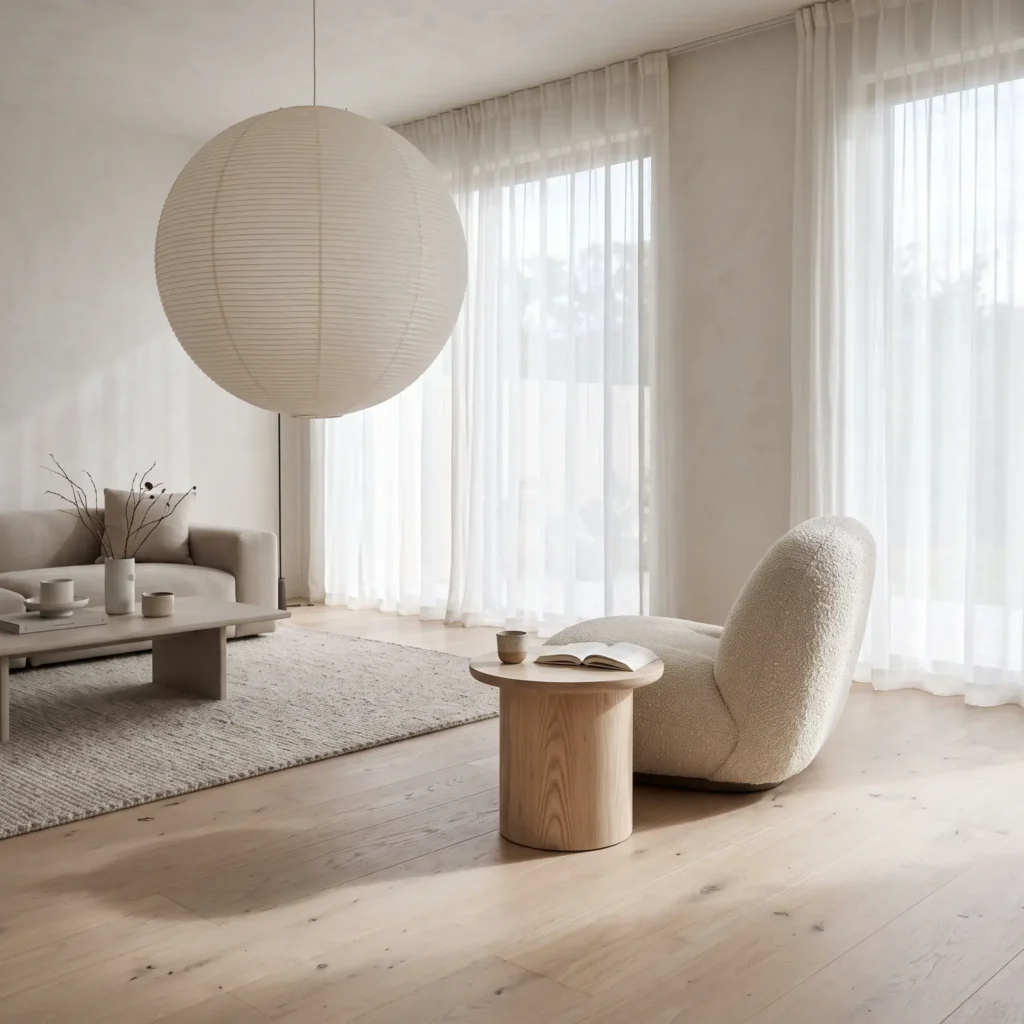
- Product Sourcing List:
- Isamu Noguchi Akari 75A paper pendant light (or Mino washi paper lantern)
- Low-profile curved accent chair in textured bouclé fabric
- Round solid ash wood side table with a matte oil finish
- Wide-plank European white oak flooring with an invisible matte sealant
4. The Earthy Mineral Palette with Leather and Jute
If you prefer not to paint your walls in deep colors, bring rich warmth through your seating materials. Start with creamy off-white walls. Layer a thick, bleached jute rug on the floor for heavy texture. Add a lounge chair made from saddle caramel leather and a matte black iron frame. The aged leather introduces warm amber tones that prevent neutral rooms from looking washed out.
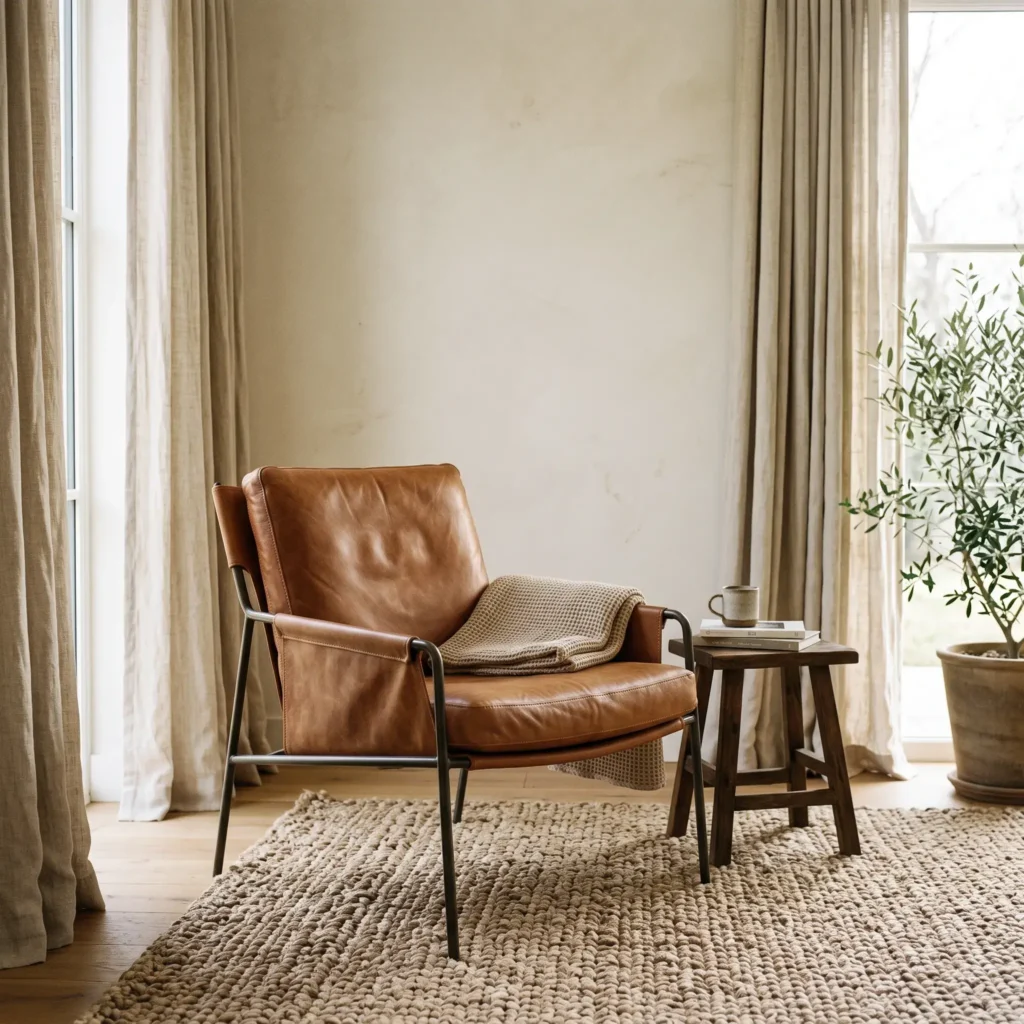
- Product Sourcing List:
- Cognac or caramel saddle leather sling lounge chair with black iron frame
- Thick hand-woven bleached jute area rug
- Benjamin Moore Swiss Coffee (OC-45) paint on walls and baseboards
- Floor-to-ceiling sheer linen drapery panels in soft ivory
5. The Sculptural Fireplace with a Floating Limestone Hearth
Skip crowded mantel decor, candle clusters, and seasonal signs. Instead, build a seamless fireplace breast covered in pale taupe plaster that runs straight into the ceiling. Anchor the base with a low floating bench made from a single slab of honed limestone. This setup creates a calm focal point that celebrates clean geometric shapes and honest raw stone.
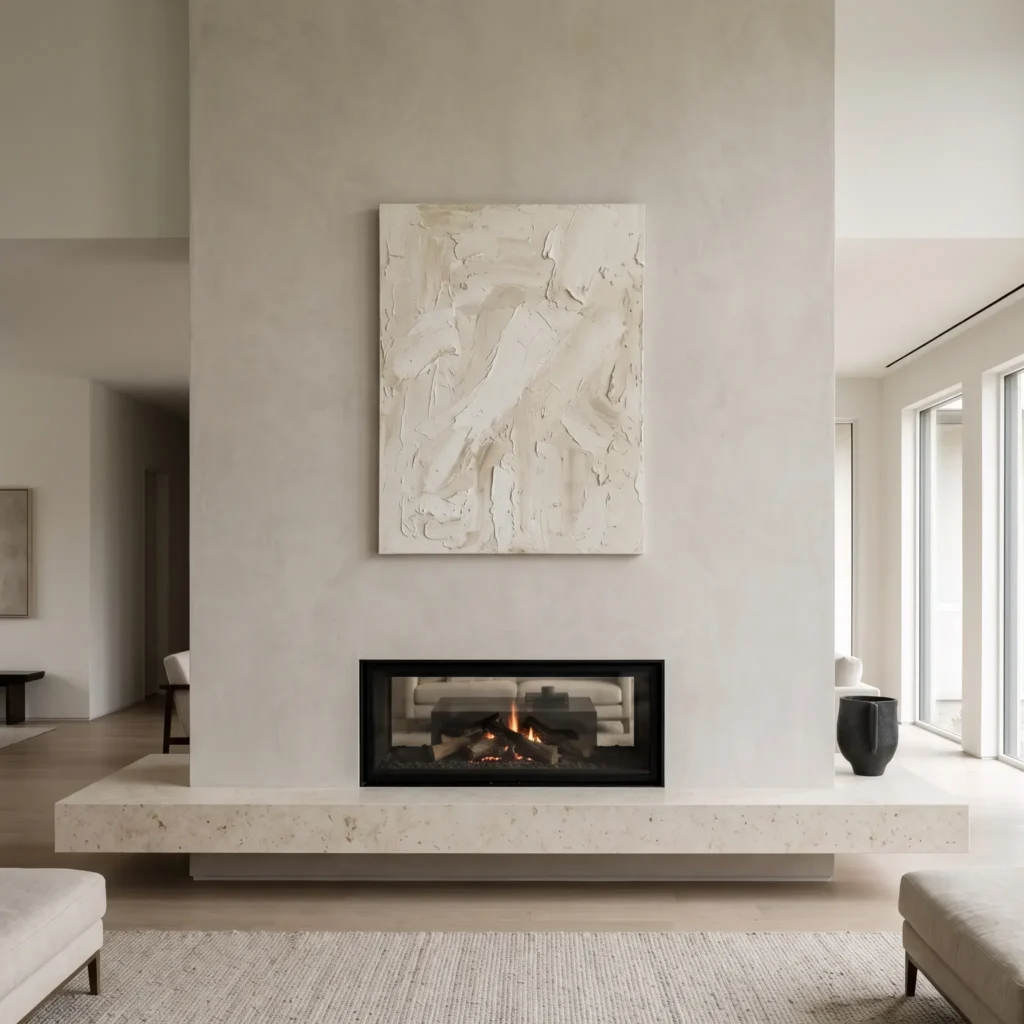
- Product Sourcing List:
- Seamless plaster chimney breast in warm taupe
- Custom floating limestone hearth slab
- Clean-face gas or electric firebox with ceramic logs
- Oversized framed canvas art featuring monochromatic impasto oil texture
6. The Biophilic Nook with an Architectural Olive Tree
Minimalist spaces need life, but a dozen small plant pots on every shelf create visual clutter. The solution is simple: buy one single, tall architectural plant and give it plenty of space. Set a mature dwarf olive tree or black ficus in a large, unglazed terracotta pot in an open corner. The green leaves add color, while the rough clay pot adds an earthy texture that balances clean drywall.
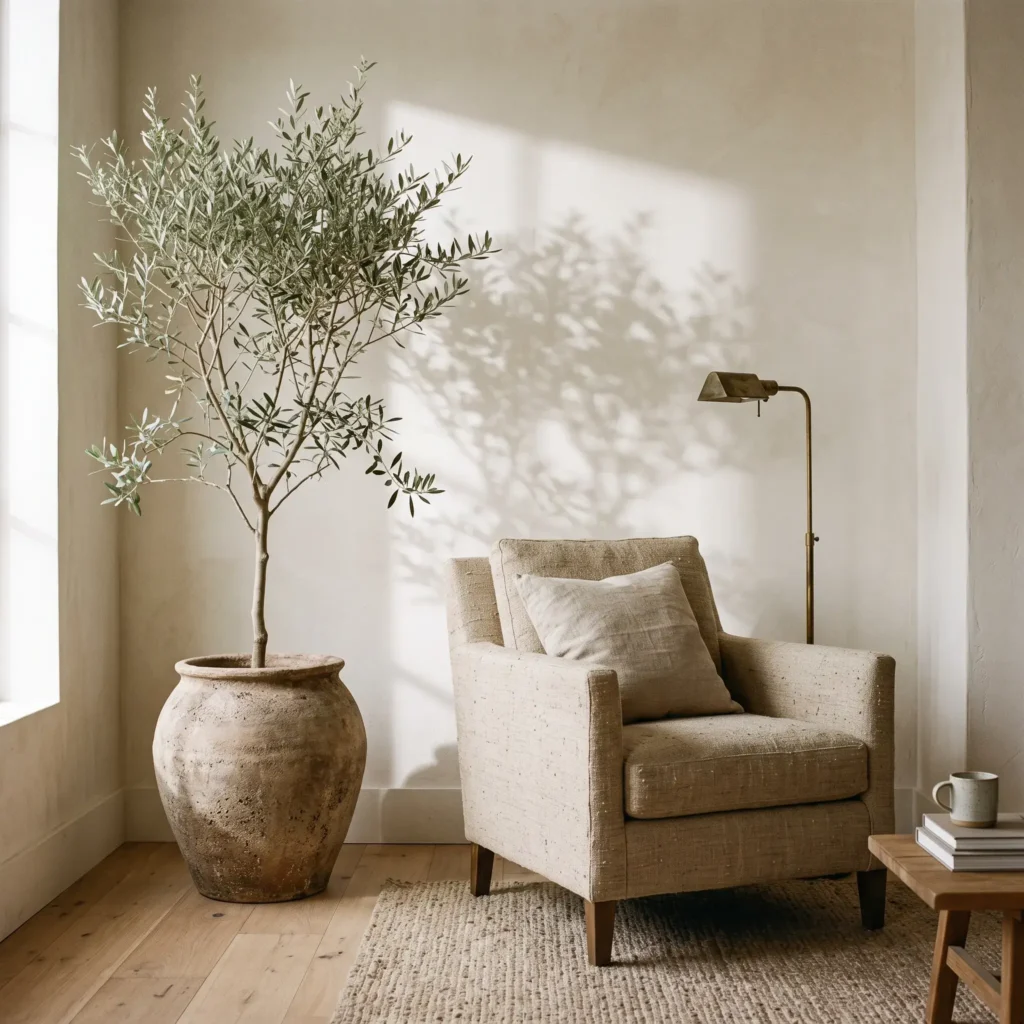
- Product Sourcing List:
- Indoor potted olive tree (or tall Ficus Audrey)
- Oversized unglazed terracotta planter pot
- Deep reading armchair in heavy slub cotton fabric (sand or taupe)
- Slim brass pharmacy task floor lamp with an aged bronze finish
7. The Great Room with Concealed Indirect Cove Lighting
Recessed can lights create glare and cast dark shadows under your eyes, nose, and furniture. To make a large living room feel cozy at night, hide LED light strips inside ceiling plaster coves. The light bounces off the ceiling and washes down the walls in a soft, warm glow. Turn off your ceiling downlights and let this indirect light illuminate the room.
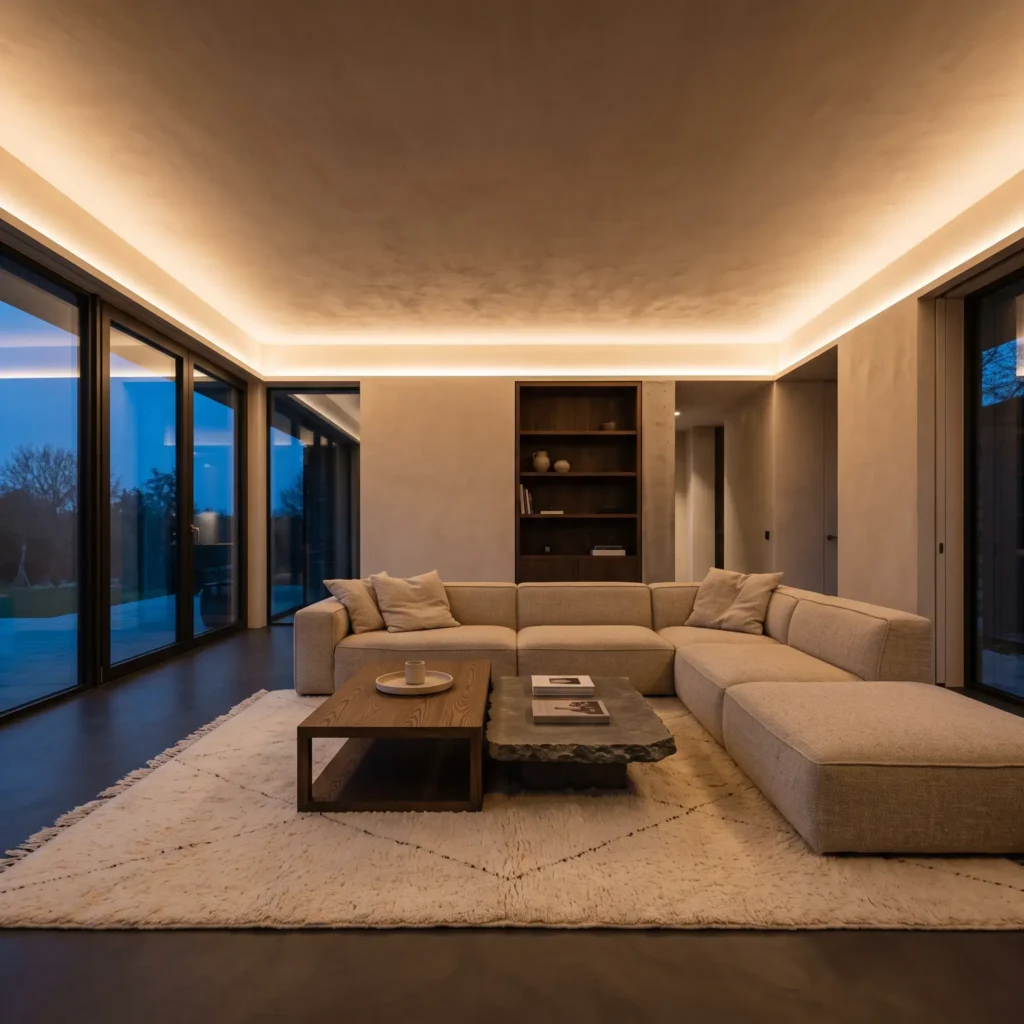
- Product Sourcing List:
- 2700K warm-dim high-CRI LED tape light hidden in drywall ceiling coves
- Deep modular sectional in sand-toned performance weave
- Pair of low round nesting coffee tables in brushed black ash and raw stone
- Hand-knotted Moroccan Berber wool rug with thin charcoal geometric lines
Architectural Roots of Warm Minimalism
Warm minimalism is not a quick internet trend. It is a direct response to the industrial, high-gloss interiors of the late twentieth century. Those early spaces relied on chrome, cold plate glass, glossy lacquer, and stark blue-tinted whites. They looked striking in magazines, but they felt uncomfortable to live in.
The current movement draws its principles from two major design traditions:
- Belgian Architectural Restraint: Designers like Vincent Van Duysen and Axel Vervoordt showed how deep wall reveals, balanced proportions, and weathered materials create quiet spaces. They proved that when you remove wall decorations, the raw materials must carry the room.
- The Japanese Principle of Ma: In Western decorating, empty space is often seen as an unfinished area that needs more furniture. In traditional Japanese spatial design, Ma defines negative space as an active element. The empty space around a sofa or table gives your eyes a place to rest. It reduces visual fatigue and makes the remaining furniture feel intentional.
When you bring these two ideas together, you get rooms that feel open without feeling empty.
Paint Science: Undertones, Light Values, and Sun Direction
Paint is where most decorating projects run into trouble. When homeowners want a bright, clean look, they often grab standard pure white off the shelf. In real rooms, pure white contains titanium dioxide with a Light Reflectance Value (LRV) above 85. When shadows hit those stark whites, the corners turn into a dull, cold gray.
Warm minimalism uses mineral whites, soft beiges, and pale clays with an LRV between 55 and 80. These formulas contain red, yellow, or umber pigments. Those warm bases catch daylight and turn shadows into soft gradients rather than cold gray corners.
Your window direction determines which paint formulation will work best.
Paint Selection by Window Exposure
| Paint Brand & Color Code | Primary Undertone | LRV Index | Best Window Exposure | Where to Use It |
| Benjamin Moore Swiss Coffee (OC-45) | Cream base with a hint of warm yellow-green | 81.9 | North or East | Ceilings and perimeter walls in rooms with cool light |
| Farrow & Ball Stirabout (No. 300) | Earthy oat base with natural clay pigments | ~64 | North or Overcast | Living rooms that need extra physical warmth on gloomy days |
| Sherwin-Williams Accessible Beige (SW 7036) | Warm beige stabilized by soft taupe | 58 | West | Main walls to soften harsh, blinding afternoon sun |
| Benjamin Moore Revere Pewter (HC-172) | Classic greige with an earthy green-gray base | 55.5 | South | High-sunlight rooms where yellow-tinted paints look too bright |
| Farrow & Ball Jitney (No. 293) | Earthy, sun-faded tan with stone undertones | ~52 | East or Low-Light | Reading nooks, fireplace walls, and cozy alcoves |
How to Match Paint to Your Room
- North-Facing Windows: North light is cool and blue. It pulls out gray undertones and makes plain rooms feel chilly. Choose paints with clear yellow, ochre, or pink-clay undertones like Swiss Coffee or Stirabout.
- South-Facing Windows: South light stays intense and golden all day. Warm paint can look too yellow or orange in this light. Balance the room with a muted greige like Accessible Beige or Revere Pewter.
The 60-30-10 Rule for Textures
In traditional decorating, the 60-30-10 rule balances wall colors, furniture fabrics, and accent pillows. Because warm minimalism uses a tight, calm color palette, using bright accent colors breaks the serenity. Instead, apply this ratio directly to surface textures:
- 60% Foundation Texture: This covers your largest surfaces. Use matte, light-absorbing textures that eliminate harsh shine. Examples include lime wash or Roman clay walls, unlined linen drapes, and large wool or jute rugs.
- 30% Organic Warmth: These are your primary furniture materials. Look for open-pore white oak, honed unfilled travertine, unglazed pottery, and textured linen or bouclé upholstery.
- 10% Grounding Contrast: Every light room needs dark accents to anchor the eye. Without them, a room floats and feels washed out. Introduce deep elements like blackened steel table legs, dark walnut picture frames, or aged bronze lamp stems.
Practical Layout Rules and Clearance Standards
A minimalist room quickly loses its calm feel if people bump into furniture or squeeze past tables. Good layouts rely on proper spacing and low sightlines.
Floating your sofa in the room creates circulation paths around the conversation zone. Keeping the backs of sofas and credenzas low allows natural light to flow across the room from window to window.
Living Room Layout Measurements
| Spatial Measurement | Recommended Distance | Why It Matters |
| Main Walking Corridors | 30 to 36 inches | Keeps primary walkways clear between entryways and seating. |
| Secondary Pathways | 24 to 30 inches | Lets you move behind sofas and around side chairs without turning sideways. |
| Sofa to Coffee Table | 14 to 18 inches | Puts drinks and books within arm reach without hitting your knees. |
| Conversation Distance | 7 to 10 feet | Keeps seating close enough for easy conversation at normal speaking volumes. |
| Side Table Height | Within 2 inches of sofa arm | Lets you set down a drink comfortably without awkward bending. |
| Bare Floor Rug Border | 8 to 24 inches | Shows off your wood flooring while keeping the rug large enough to anchor the furniture. |
| Art Hanging Height | 57 to 60 inches from floor to center | Places the center of your artwork at natural eye level. |
Rug Sizing Rules
An undersized rug makes a minimalist room look small and scattered. Your area rug must be large enough to sit under all four legs of your seating, or at least under the front legs of the entire conversational group.
In rooms measuring 10 by 12 feet, use an 8 by 10-foot rug. For large living rooms measuring 13 by 16 feet or bigger, choose a 9 by 12 or 10 by 14-foot rug. Always leave 8 to 24 inches of bare wood floor showing around the perimeter of the room.
Lighting Science: Color Temperatures and Light Layers
Good lighting makes or breaks a minimalist living room. Overhead lights arranged in a grid across the ceiling wash out textured plaster, create unflattering shadows, and make beautiful rooms feel like retail stores.
Turn off standard ceiling lights and replace them with warm, indirect lighting positioned at different levels throughout the room.
Two Lighting Rules to Follow
- Stick to 2200K to 2700K: Check the Kelvin rating on every light bulb package. Light at 2700K mimics the soft, warm tone of late afternoon sun. Light at 2200K matches the amber glow of a candle. Bulbs rated at 4000K or 5000K produce cool blue light that ruins warm minimalism immediately.
- Demand High Color Accuracy (CRI 90+): Buy bulbs with a Color Rendering Index (CRI) of 90 or higher. Low CRI bulbs wash out natural timber grains and make cream plaster look like dingy gray. High CRI bulbs show the true, rich tones of your wood, stone, and fabrics.
The 4 Essential Lighting Layers
- Layer 1: Indirect Ambient (Ceiling Level): Install dimmable LED strip lights inside architectural ceiling coves or behind wall valances. The light washes across the ceiling and drifts down into the room without any visible bare bulbs.
- Layer 2: Diffused Sculptural (Eye Level): Use fixtures made from fibrous washi paper, like Isamu Noguchi Akari lanterns, or frosted matte opal glass. These materials scatter light evenly in every direction and eliminate direct bulb glare.
- Layer 3: Focused Task (Seated Level): Place a reading lamp with a patina bronze or brass arm next to deep armchairs. Direct the beam down so the light stays where you need it.
- Layer 4: Low Accent (Floor and Table Level): Place small cordless table lamps or ceramic accent lights on low credenzas and corner tables to build soft pools of light across the perimeter.
Smart Storage: How to Hide Tech and Daily Clutter
A minimalist design only works if your home is easy to keep tidy. Cluttered surfaces rarely mean a person is messy; they usually mean the room lacks closed storage.
Open shelving often collects small, unrelated items that create visual clutter. Warm minimalism replaces open shelves with seamless, full-height built-in storage cabinets.
Solutions for Everyday Clutter
- Full-Height Cabinetry: Run built-in cabinets all the way to the ceiling. This eliminates dusty open spaces on top. Use touch-latches or hidden finger pulls instead of shiny hardware. Paint the cabinet doors the exact same color as your walls so the storage looks like an architectural wall rather than furniture.
- The Frame TV Trick: A large black rectangle on the wall dominates a quiet room. Mount a matte-screen art television flush against the wall and frame it in pale oak. When turned off, set it to display an antique pencil sketch or a quiet landscape.
- Concealed Tech Chases: Route all power cords, streaming boxes, and gaming consoles through walls or enclosed channels into a ventilated lower cabinet. Never leave black cables hanging down a light plaster wall.
Frequently Asked Questions
How do you make a minimalist living room feel warm?
Layer tactile materials instead of adding decorative knickknacks. Use lime wash on the walls, place an undyed wool rug on the floor, and choose furniture upholstered in slubby linen or textured bouclé. Keep all lighting between 2200K and 2700K to create a soft, welcoming glow at night.
What is the best paint color for a warm minimalist living room?
For rooms with cool northern light, choose a creamy white with yellow or clay undertones like Benjamin Moore Swiss Coffee (OC-45) or Farrow & Ball Stirabout (No. 300). For rooms with bright southern or western light, use a balanced greige like Sherwin-Williams Accessible Beige (SW 7036) to soften the strong afternoon sun.
What is the difference between warm minimalism and Japandi?
Japandi is a specific hybrid style that blends traditional Japanese craftsmanship with Scandinavian functionalism, often using paper shoji screens, black accents, and light beech wood. Warm minimalism is a broader architectural approach focused on soft neutral colors, rich textures, and generous breathing room. It incorporates Belgian and European influences alongside Japanese concepts.
How do you balance minimalism with everyday family living?
Incorporate plenty of closed, handleless storage into the room layout. Use full-height built-in cabinets to tuck away toys, electronics, and blankets in seconds. Choose durable performance fabrics like linen blends treated with stain barriers, and select honed stone tables that hide daily fingerprints.
What furniture shapes work best in a warm minimalist room?
Combine low-slung rectilinear sofas with soft, curved accent pieces. A boxy modular sofa paired with a round stone coffee table or a kidney-shaped armchair softens the room. This mix creates visual interest while keeping eye-level sightlines open.
Creating Your Restful Living Room
Transforming your living room into a warm minimalist space does not require buying dozens of new decor items. Start by clearing the space. Remove freestanding clutter, take down small picture frames, and pack away decorative accessories you do not love.
Look at the natural light entering your space. Coat the walls in a soft, mineral-based paint that complements your window direction. Float your primary seating in the center of the room to create easy conversation zones, and roll out an area rug large enough to anchor the entire arrangement. Finally, swap cold white bulbs for warm 2700K fixtures.
When you strip away visual noise and focus on quality materials, your living room stops feeling like a showpiece and becomes a calm sanctuary for everyday life.